An Alternative Version

By Tommy Airey

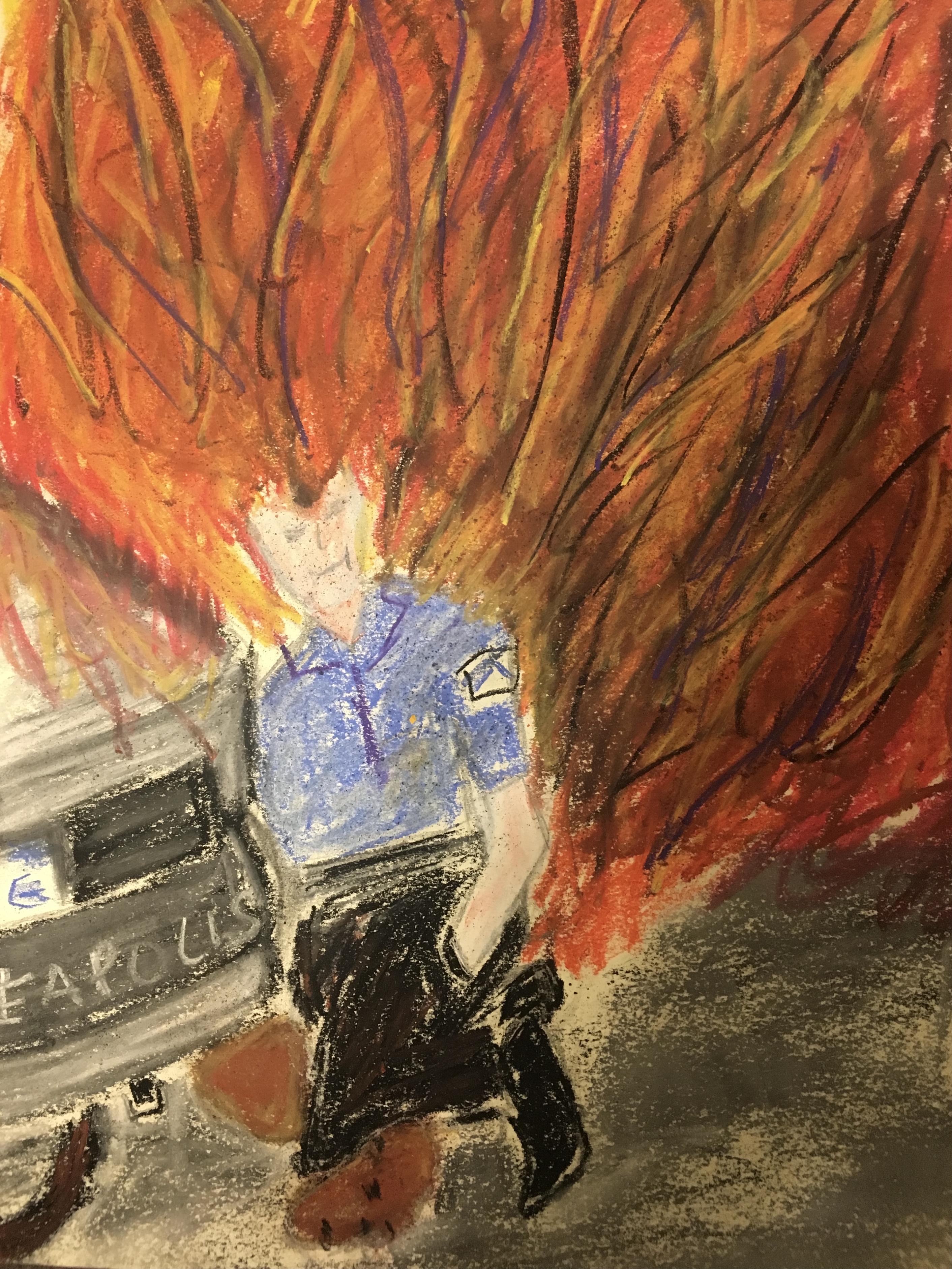
A year ago, police responded to a call from a convenience store employee who accused George Floyd of paying for cigarettes with a counterfeit $20 bill. Before every single one of us witnessed this Black man forty days younger than me face down on the street pavement calling for his mother while a white man in uniform with his left hand in his pocket took his life by kneeling on his neck, the Minneapolis Police Department issued a press release describing what happened:

Two officers arrived and located the suspect, a male believed to be in his 40s, in his car. He was ordered to step from his car. After he got out, he physically resisted officers. Officers were able to get the suspect into handcuffs and noted he appeared to be suffering medical distress. Officers called for an ambulance. He was transported to Hennepin County Medical Center by ambulance where he died a short time later. At no time were weapons of any type used by anyone involved in this incident.

This ordering of facts was the official account.  

Continue reading “An Alternative Version”

Holiness Entered Suffering

A recent social media re-post from Mark Van Steenwyk, the executive director of The Center for Prophetic Imagination.

At its best, Christianity isn’t about redemptive suffering. Suffering isn’t sacred. This is the classic mistake. That, somehow, enduring suffering is, in and of itself, something holy. This sort of thinking leads to the horrid idea that a soldier’s death renders their service holy. It is a lie that empires spin.

Rather, the way of Jesus tells us that holiness *enters* suffering. On the cross, God suffered. Holiness entered suffering, not to glorify suffering, but to be with those who suffer.

It is life that is sacred. In our suffering, God is present.

This is the powerful insight of liberation theology. God is uniqely present with the oppressed.

Continue reading “Holiness Entered Suffering”

But When it Comes to Palestine

An excerpt from a recent Democracy Now interview with Marc Lamont Hill, the co-author of Except for Palestine: The Limits of Progressive Politics (2021).

…all the issues that are coming up right now really speak to the various ways that Palestinians have been made the exception to many of our progressive values and politics and actions, if you think about — or, rather, in activist circles. I’ll start there, in activist circles. You know, we have this person we call the ”PEP” — right? — the person who’s progressive except for Palestine. This is the person that’s outraged at Trump for his actions at the border, who’s disgusted by children in cages, who can’t stand to think about the erosion of civil liberties. But when it comes to Palestine, somehow, they don’t engage those same ideas in the same way.

And so, in our book, what we attempt to do is lay out the kind of policy groundwork. We lay out the frontier on which these battles are fought. We want people to understand not just the contradictions of the so-called left, but also to understand how those contradictions emerged. So, whether it’s questions about the right to exist, whether it’s questions about BDS, the Boycott, Divestment and Sanctions movement, or whether it’s the attempt to make Trump the exception rather than part of a more aggressive articulation of the American rule, we are attempting to show that the American left — those who identify as progressive, radical, liberal, what have you — have not held up the bargain in terms of matching their own ideals and values on this question of Israel and Palestine. And that’s something that we want to raise.

Continue reading “But When it Comes to Palestine”

Of the Empire

A prose poem of Mary Oliver, passed along to us from movement elder Clancy Dunigan.

We will be known as a culture that feared death and adored power, that tried to vanquish insecurity for the few and cared little for the penury of the many. We will be known as a culture that taught and rewarded the amassing of things, that spoke little if at all about the quality of life for people (other people), for dogs, for rivers. All the world, in our eyes, they will say, was a commodity. And they will say that this structure was held together politically, which it was, and they will say also that our politics was no more than an apparatus to accommodate the feelings of the heart, and that the heart, in those days, was small, and hard, and full of meanness

Zionism, Christian Zionism and White Supremacy

By Rev. Graylan Scott Hagler, Senior Minister, Plymouth Congregational United Church of Christ, Washington, DC

People who are interested in the bible are tempted to read it literally and seek to follow its every word. This has been the conditioning of fundamentalism.  Fundamentalists have taught that every word in the scripture is true and the bible is inerrant. This point of view has permeated believing constituencies and have generally not been challenged as preachers and teachers choose to leave well enough alone; not want to rock the theological boat, or to roil up their followers. 

This means that scriptures are not questioned, and blanks are filled in where there seems to be glaring inconsistencies in the text or where the prophecy is yet unfulfilled. This has resulted in Christians believing that Jews are God’s chosen people, gentiles are grafted into the promise of God, and the land of Israel belongs to the Jews as promised to them by God. Furthermore, it is argued that not only does the land belong to the Jews, but Jews must be repatriated for Jesus to return, and then Jesus will judge the righteous and unrighteous, and Jews must recognize Jesus as the Christ so that the promise of the reign of God can be fulfilled.  In general, this is known as Christian Zionism, and Christian Zionism is a distortion of scripture used for advancing a colonial Zionist state in Palestine.

Continue reading “Zionism, Christian Zionism and White Supremacy”

The Problems of Domination Intrinsic to Capitalism

Today we celebrate the retirement of Dr. Bruce Rogers-Vaughn from Vanderbilt Divinity School with an excerpt from his book Caring For Souls in a Neoliberal Age (2016), a vital resource for pastors, parents, social workers, therapists and community organizers.

A corollary of the claim that neoliberalism is now globally hegemonic is that pastoral care, as well as other forms of the care of souls, must undergo revision in order to have some hope adequate for both healing and protest. In this book, I will argue that the theories corresponding to this care, including pastoral theology, are generally constrained within postmodern cognitive models, as well as dwelling largely within the fabric of neoliberal versions of identity politics. Any substantial innovation in the fields of pastoral theology and the care of souls today, therefore, will require us to reaffirm our commitment to a common ground that unifies us as diverse people, and to the public good. It will also demand that we extend our analyses and critiques of oppression due to difference (identity) to include the problems of domination intrinsic to capitalism. Indeed, it will mean that subjugations rooted in difference will now be understood, and appreciated more profoundly, in light of capitalism’s current global hegemony. The time has arrived, then, to work toward a post-capitalist pastoral theology, by which I mean a pastoral theology that does not assume the normativity of capitalism.

Earthy Stories with Heavy Meanings

An excerpt from William Herzog’s Parables as Subversive Speech: Jesus as Pedagogue of the Oppressed (1994).

…the parables were not earthly stories with heavenly meanings but earthy stories with heavy meanings, weighted down by an awareness of the workings of exploitations in the world of their hearers. The focus of the parables was not on a vision of the glory of the reign of God, but on the gory details of how oppression served the interests of a ruling class. Instead of reiterating the promise of God’s intervention in human affairs, they explored how human beings could respond to break the spiral of violence and cycle of poverty created by exploitation and oppression. The parable was a form of social analysis every bit as much as it was a form of theological reflection.

Stop to Smell the Lilacs: A Mother’s Day Reflection

By Lydia Wylie-Kellermann

I keep clearing space to write this piece and then finding a dozen other things to do instead. Perhaps a sign that I need to write this and perhaps a  that it is harder to do than I expected.

Over the last few years, I’ve spent hours and hours gathering a book on parenting. Although I don’t write much about my mom within, she breathes there from beginning to end. I have so much love and appreciation for how she nurtured who I am in both her living and her dying.

I know that Mother’s Day is complicated. There is joy and love and celebration, but there is also grief and pain and longing.

It has been 16 Mother’s Days without my mom now.

Continue reading “Stop to Smell the Lilacs: A Mother’s Day Reflection”

Learning from the Laughter and the Trees: Tell me about Lent

By Lydia Wylie-Kellermann

I consider myself a lover of liturgical seasons. I might even go as far as to call myself a geek. I love the rhythm of it in my body. The way it coincides with the changing earthly seasons. The cries for justice and stillness and singing and baking. I love it all!

Yet, I have never understood Lent. I can get it with my head, but I don’t feel it in my body. I haven’t found traditions or practices that summon me deeper.

So, I began the season this year with the question “what do you love about Lent?” I threw it out in trusted circles and on social media. I didn’t have a lot of capacity to try much, but I could spend the season listening. I scratched down quotes in the margins of notebooks. I collected wisdom and words.

Continue reading “Learning from the Laughter and the Trees: Tell me about Lent”