A Critical Conversation

An important message from Christians for a Free Palestine.

In the coming months, we’re engaging in a series of critical conversations about Christian supremacy and how it affects the struggle for Palestinian liberation.

Our first conversation in this series will take place Thursday, April 10, at 8:00pm ET / 5:00pm PT. We’ll be joined by Ben Lorber, author of “Safety Through Solidarity: A Radical Guide to Fighting Antisemitism”, Shoshana Brown from the Diaspora Alliance, and Rev. Anne Dunlap from @liberatinglineagescollective for a discussion about Christian supremacy, antisemitism, Project Esther, and more.

Register HERE.

Genocide Cannot Be An Afterthought

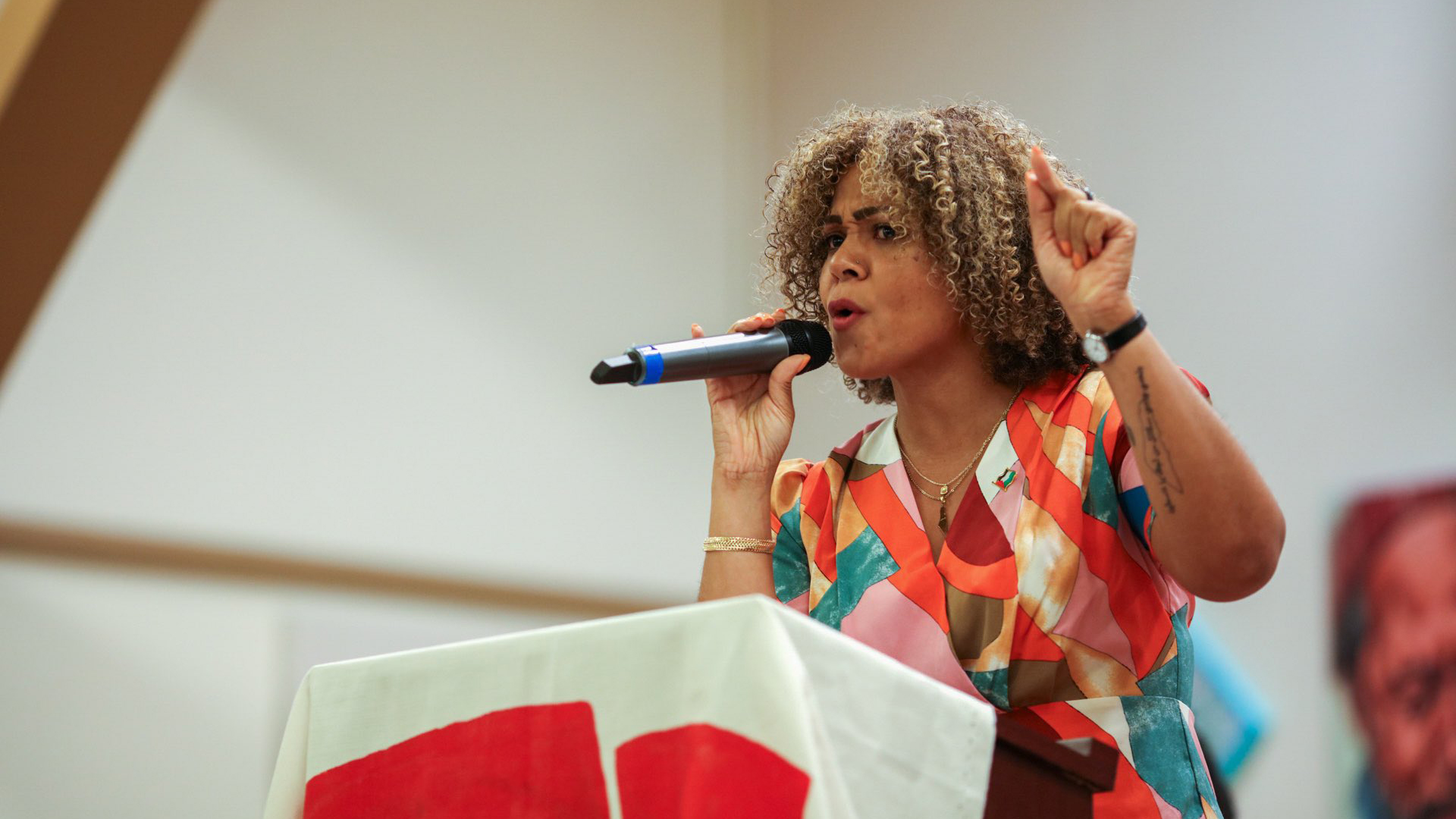
From Linda Sarsour (above), a Palestinian-American community organizer. Re-posted from social media (4/5/2025).

A call in post.

Liberals & national orgs, don’t make the same mistakes over and over and over again and expect different results.

You cannot demand Hands Off Medicare/Medicaid/Social Security/Free speech/etc without also demanding the end to the genocide of the Palestinian people. While our neighbors suffer and can’t meet their basic needs, this government AIDED by Democrats just sent ANOTHER $8.8B to an apartheid regime to annihilate the Palestinians. Genocide cannot be an afterthought. Can’t be something “mentioned”. It has to be core to a movement. It’s the backdrop. It’s the theme. What more needs to happen? How much more complicit do we need to be?

What part of – you cannot separate your domestic demands while your country is aiding and abetting a full blown livestream genocide right now do we not understand? It’s one fight. One struggle.

We have to be intentionally in this together or we will all lose.

MLK was a Radical

MLK
PC: Underwood Archives/UIG/REX/Shutterstock

By Dr. Cornel West, written seven years ago for the 50th anniversary of the assassination of Rev. Dr. Martin Luther King, Jr. (April 4, 1968), originally posted in The Guardian

The major threat of Martin Luther King Jr to us is a spiritual and moral one. King’s courageous and compassionate example shatters the dominant neoliberal soul-craft of smartness, money and bombs. His grand fight against poverty, militarism, materialism and racism undercuts the superficial lip service and pretentious posturing of so-called progressives as well as the candid contempt and proud prejudices of genuine reactionaries. King was neither perfect nor pure in his prophetic witness – but he was the real thing in sharp contrast to the market-driven semblances and simulacra of our day. Continue reading “MLK was a Radical”

Fallow Trees and Falling Cities

A sermon from Jim Perkinson on Luke 13:1-9 (March 23, 2025 at St. Peter’s Episcopal Church in Detroit, MI)

13 There were some present at that very time who told him of the Galileans whose blood Pilate had mingled with their sacrifices. And he answered them, “Do you think that these Galileans were worse sinners than all the other Galileans, because they suffered thus? I tell you, No; but unless you repent you will all likewise perish. Or those eighteen upon whom the tower in Silo′am fell and killed them, do you think that they were worse offenders than all the others who dwelt in Jerusalem? I tell you, No; but unless you repent you will all likewise perish.”

And he told this parable: “A man had a fig tree planted in his vineyard; and he came seeking fruit on it and found none. And he said to the vinedresser, ‘Lo, these three years I have come seeking fruit on this fig tree, and I find none. Cut it down; why should it use up the ground?’ And he answered him, ‘Let it alone, sir, this year also, till I dig about it and put on manure. And if it bears fruit next year, well and good; but if not, you can cut it down.’” (Lk 13:1-9)

You know me, always trying to get down under the meaning, looking for an unforeseen seed going on journey in the soil, suddenly bursting unanticipated from below ground.  Well, it happened here. In today’s text   We read our bibles in English. Which translates the ancient Latin (Vulgate). Which translates the Greek.  Which translates the Aramaic. Which translates the Hebrew.  We are more than four times removed, more than four cultures out of sync with the text.  We can’t really get back there in any pristine form but can at least muse.  Let some things happen with images that provoke consternation or amusement!  So come with me for a minute.

Our indigenous teacher, Martín Prechtel is always telling us, “Pay attention to the etymology, to the sequence of meanings that a given word harbors over time.”  Underneath this word right here, that seems mundane and boring to you, there is an older meaning, and under it an even older meaning, and then another and another and another.  Follow the root of the word back and down and ultimately you come out in place that is likely ancestral and indigenous and very different than here in the seemingly “ordinary” sense the word now conveys.  There are ancestors and grand mysteries up inside many of our words, but deep under their present appearance and sound—like the hair on the side of a root of a mushroom under the soil, leading into a network as wide as an entire forest. 

Continue reading “Fallow Trees and Falling Cities”

The Four Denials

From the Gesturing Collective at decolonialfutures.net.

Our decolonial perspective is informed and inspired by Indigenous analyses and practices that affirm that our current global problems are not related to a lack of knowledge, but to an inherently violent modern-colonial habit of being.

Four denials structure this habit of being:

  • the denial of systemic violence and complicity in harm (the fact that our comforts, securities and enjoyments are subsidized by expropriation and exploitation somewhere else),
  • the denial of the limits of the planet (the fact that the planet cannot sustain exponential growth and consumption),
  • the denial of entanglement (our insistence in seeing ourselves as separate from each other and the land, rather than “entangled” within a living wider metabolism that is bio-intelligent), and
  • denial of the depth and magnitude of the problems that we face:  the tendencies 1) to search for ”hope” in simplistic solutions that make us feel and look good; 2) to turn away from difficult and painful work (e.g. to focus on a “better future” as a way to escape a reality that is perceived as unbearable).

The Plutocrat and the Prophet

By Ched Myers, a few comments about the Gospel texts for the 2nd and 3rd Sundays of Lent, re-posted from Bartimaeus Cooperative Ministries. If you are in Southern California in early April, register to attend the official launch of Ched’s new book here.

In a sequence that runs from Luke 12:35–13:9, Jesus names five examples of brutality endured by poor and working classes who labor and live in the world of wealthy “lords”:

  1. household servants enduring sleeplessness (12:37) and beatings (12:47);
  2. debtor’s prison (12:58–59);
  3. Galileans suffering violence at the hands of Roman authorities (13:1–3);
  4. pedestrians killed by dangerous urban construction (13:4–5); and
  5. oppressive demands on peasants for agricultural production by absentee landlords (13:6–9).

Jesus’s warning to “settle out of court” (2) refers to a judicial system controlled by the landlord class that routinely imprisoned the poor for indebtedness.” Pilate’s massacre of Galileans (3)—perhaps during a Passover pilgrimage, hence the reference to “their sacrifices” (13:1)—could refer to any number of skirmishes between Roman authorities and Judean dissidents during the first century CE, many of which were documented by the Jewish historian Josephus. Urban construction accidents (4) were common, given the notorious working conditions and “code violations” that characterized ambitious and hasty Herodian building projects. Those two incidents might be connected if the Tower of Siloam was part of Roman aqueduct construction, since Josephus reports that Pilate killed a group of Jews who were protesting his seizure of Temple funds to pay for imperial waterworks projects in Jerusalem. . Jesus’s emphatic refrain—“I tell you, unless you repent, you will all perish as they did” (13:3, 5)—implies that unless his people defect from this system, they too would be killed by its oppressions (Luke uses apollumi far more frequently than any other N.T. writer). These are some of many reasons that Jesus repudiates the “peace” of an imperial system that routinely generates such violations (12:51).

Continue reading “The Plutocrat and the Prophet”

Our Moral Imperative

A statement from Mahmoud Khalil, transcribed over the phone to family and friends.

My name is Mahmoud Khalil and I am a political prisoner. I am writing to you from a detention facility in Louisiana where I wake to cold mornings and spend long days bearing witness to the quiet injustices underway against a great many people precluded from the protections of the law.

Who has the right to have rights? It is certainly not the humans crowded into the cells here. It isn’t the Senegalese man I met who has been deprived of his liberty for a year, his legal situation in limbo and his family an ocean away. It isn’t the 21-year-old detainee I met, who stepped foot in this country at age nine, only to be deported without so much as a hearing.

Justice escapes the contours of this nation’s immigration facilities.

On March 8, I was taken by DHS agents who refused to provide a warrant, and accosted my wife and me as we returned from dinner. By now, the footage of that night has been made public. Before I knew what was happening, agents handcuffed and forced me into an unmarked car. At that moment, my only concern was for Noor’s safety. I had no idea if she would be taken too, since the agents had threatened to arrest her for not leaving my side. DHS would not tell me anything for hours — I did not know the cause of my arrest or if I was facing immediate deportation. At 26 Federal Plaza, I slept on the cold floor. In the early morning hours, agents transported me to another facility in Elizabeth, New Jersey. There, I slept on the ground and was refused a blanket despite my request.

Continue reading “Our Moral Imperative”