

If you have not read Marina Magloire’s most recent article in The LA Review of Books, you really must. She explores correspondence between June Jordan and Audre Lorde over their disagreements on Israel/Palestine. It is absolute fire. Here’s an excerpt.
Driven by her grief and outrage at the massacres at Sabra and Shatila in September 1982, in which thousands of Palestinians were murdered by militia groups over the course of two days, Jordan wrote an open letter called “On Israel and Lebanon: A Response to Adrienne Rich from One Black Woman,” dated October 10, 1982. Her address to Rich was both personal (she names Rich alone among the signatories of the two letters) but also pedagogical (it is an open letter to be published in WomanNews and thus intended for public consumption). Using the words “genocide” and “holocaust,” Jordan lays out the shocking array of war crimes committed by Israel over five months—phosphorous bombs, the destruction of civilian infrastructure, the massacre at Sabra and Shatila—and criticizes Rich’s failure to take responsibility for these things as the tangible outcomes of the Zionism she claims to espouse. This idea of responsibility runs through Jordan’s response like a live wire, culminating in this astonishing statement:
I claim responsibility for the Israeli crimes against humanity because I am an American and American monies made these atrocities possible. I claim responsibility for Sabra and Shatilah [sic] because, clearly, I have not done enough to halt heinous episodes of holocaust and genocide around the globe. I accept this responsibility and I work for the day when I may help to save any one other life, in fact.
Because Rich does not take responsibility, Jordan models it for her. This is perhaps the most important rhetorical turn in Jordan’s letter, though it goes unacknowledged in subsequent responses from other readers. Jordan recognizes that being part of an ethnonationalist state, whether born or chosen, carries the obligation to critique its violence. The fact that a Black woman born in this nation can make this statement, with far more humility than Rich’s selective, cherry-picked identification with Israeli statehood, is a testament to the transformative possibilities of Jordan’s identity politics.
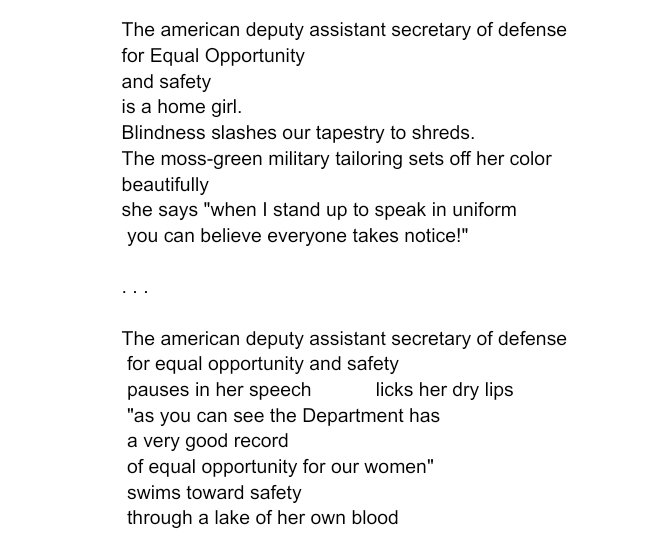

 An excerpt from Audre Lorde’s “
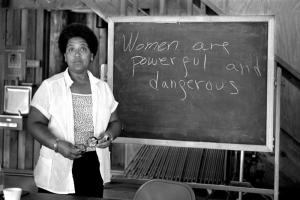
 Today we honor the Lorde with “A Litany for Survival.”
 “Some problems we share as women, some we do not. You fear your children will grow up to join the patriarchy and testify against you; we fear our children will be dragged from a car and shot down in the street, and you will turn your backs on the reasons they are dying.” – Audre Lorde
 Radical Discipleship