
Pâstâhowin: The Cosmic Consequences of Breaking Covenant

aslongBy Ched Myers

Note: This is Ched’s last post in a series of weekly comments on the Lukan gospel readings from the Revised Common Lectionary during Year C, 2016. Thanks to RadicalDiscipleship.net for hosting these gospel commentaries over these last couple of years!

On the day after the election, we awake to an America dominated by what Van Jones (on election night) called “whitelash.”  How resonant, then, is Sunday’s gospel:

“The days will come when not one stone will be left upon another; all will be thrown down….” (Lk 21:6); and

“By your endurance you will gain your souls.” (21:19)

Continue reading “Pâstâhowin: The Cosmic Consequences of Breaking Covenant”

Never Give Up: Faith as Tenacious Agitation

By Ched Myers

Note: This post is part of a series of weekly comments on the Lukan gospel readings from the Revised Common Lectionary during Year C, 2016. [Image below: St. Louis Post-Dispatch, J.B. Forbes/Associated Press, found at http://www.thefeministwire.com/2014/10/fergusonfridays-black-freedom-fighters-men-interview-black-women-front-line-ferguson/.]

ferguson

This Sunday’s gospel lesson is the second of two key stories about “determined prayer” in Luke. As is so characteristic of the third evangelist, this vignette about a woman’s unflagging insistence on being heard corresponds to an earlier one about similar importunate behavior by a man (see Luke 11:5-13). That text came up in the middle of the summer (see Wes and Sue’s comments on “shameless audacity” and its relevance to the Black Lives Matter movement here). Each story has two “onstage” characters (a protagonist and antagonist), with the Divine “comparison” well offstage. But while the earlier object lesson took place in a village setting and concerned neighborly hospitality and mutual aid among social equals, our text for October 16 takes place in the city and pits social opposites; it pertains to the public vocation of tenacious advocacy for justice. These twinned stories together articulate how deeply connected the personal and political were for Luke, and should be for us. Continue reading “Never Give Up: Faith as Tenacious Agitation”

To Reconcile and Restore

mertonFrom Gordon Oyer’s paraphrase of how Thomas Merton would answer the question “What and where is this Word of God?:”
The word of God is a breakthrough into our real, human experience, and it speaks not just from the Bible but from deep within us, within each of our neighbors, within all of creation. It offers us the means to tear down the false identities we have constructed to fit in with a society rooted in ego-centric self-interest. If we choose to engage it, this word engages us with questions about who we really are, about what person it is who seeks dialogue with the word. If we continue to engage its questions, the word of God will ultimately reconcile and restore us to our true self, to the human community, and to the great and mysterious ground of all being from which our core essence originated.

The Rich Man and Lazarus: Warning Tale and Interpretive Key to Luke

fyodorBy Ched Myers, on Luke 16:19-31 (19th Sunday after Pentecost)

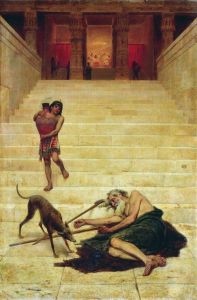
Note: This post is part of a series of weekly comments on the Lukan gospel readings from the Revised Common Lectionary during Year C, 2016. As was the case last week, this is a longer post, because of the importance of Luke 16 to those of us suffering from “Affluenza.” For a recording of a recent webinar Ched did on this gospel text, go here. [Right: Fyodor Bronnikov, “Lazarus at the rich man’s gate,” 1886.]

This Sunday’s gospel completes our journey through Luke 16. How rare it is that the lectionary allows a sustained look at Luke’s narrative argument! Last week’s text was Jesus’ subversive tale of the “defect-ive” discipleship of the beleaguered middle manager of a “filthy rotten system” (16:1-13). I read it as a poignant fable for those who would try to monkey-wrench the dominant economic system to provide a modicum of Jubilee justice for themselves and others.  The “paired” story of Lazarus and the Rich Man represents, in turn, a warning tale about the dark consequences of failing to deconstruct the systems of vast social and economic disparity that hold our world hostage. Continue reading “The Rich Man and Lazarus: Warning Tale and Interpretive Key to Luke”

Discipleship as Defection from the Mammon System: Jesus’ Parable about a “Manager of Injustice”

luke16By Ched Myers, on Luke 16:1-13

Note: This post is part of a series of weekly comments on the Lukan gospel readings from the Revised Common Lectionary during Year C, 2016. This week Ched offers a longer study because of his conviction that this is a crucial text for middle class Christians. A more detailed version of the reflections below can be found here; a webinar exploring these themes can be found here. [Right: “The Wicked Servant,” Ian Pollock, 1972.]

Summary: This Sunday’s gospel can be read as a poignant fable for all who realize that they have been disenfranchised by the dominant economic system, and who would try to “monkeywrench” whatever status they have in it to provide a modicum of Jubilee justice for themselves and others.  This parable illustrates the contemporary strategy of navigating what Wendell Berry calls the “Two Economies” by using capital to build social relations, rather than sacrificing social relations to build capital.  Continue reading “Discipleship as Defection from the Mammon System: Jesus’ Parable about a “Manager of Injustice””

Too Big—and Failing! Jesus’ Cure for Affluenza

DropsyBy Ched Myers, 15th Sunday after Pentecost, Aug 28, 2016 (Luke 14:1-14)

Note: This is part of a series of weekly comments on the Lukan gospel readings from the Revised Common Lectionary during year C, 2016. This week’s gospel text is related to last week’s; see the background comments for last week here. Much of the post below is adapted from a sermon given at Downers Grove (IL) First United Methodist Church on 10/10/10.

Luke 14:2-6 is unaccountably skipped over in the lectionary. Yet it is profoundly germane to last week’s reading, and moreover introduces the theme of the whole sequence through 14:24: namely, the issue of how social power and privilege is mirrored in meals, and what to do about it. So I strongly advocate re-instating this beginning episode as part of this Sunday’s gospel. Continue reading “Too Big—and Failing! Jesus’ Cure for Affluenza”

Healing as Liberation from Crippling Debt

DebtBy Ched Myers, on Luke 13:10-17, for the 14th Sunday after Pentecost

Note: This is part of a series of weekly comments on the Lukan gospel readings from the Revised Common Lectionary during year C, 2016.

This part of Luke’s gospel offers two symbolic stories about the healing of “political bodies” that signify pathology in the body politic: the “bent over” woman (13:10-17) and the “too big” man (14:1-6). Sadly, the second of these is (literally) skipped over by the lectionary. These intimately related healings bracket a series of Jesus’ sayings concerning the Kingdom as surprise and mystery (13:18-21), the “narrow Way” (13:22-30) and the cost of prophetic discipleship (13:31-35). Continue reading “Healing as Liberation from Crippling Debt”

A Fool’s Economics

DollarBy Ched Myers, Eleventh Sunday after Pentecost, July 31, 2016 (Luke 12:13-21)

Note: This is part of a series of weekly comments on the Lukan gospel readings from the Revised Common Lectionary during year C, 2016.

In Luke’s gospel, the deep memory of Sabbath Economics is shown in Jesus’ wilderness feedings of the poor (Lk 9:12-17), and told in the central petition of the Lord’s Prayer:

“Give us today enough bread” (Lk 11:3).

But nowhere is the old vision more clearly asserted than in Jesus’ teaching in Luke 12:13-34. Continue reading “A Fool’s Economics”

To Do Is To Know

the-good-samaritan-1907By Ched Myers, the 8th Sunday after Pentecost (Luke 10:25-37; right: “The Good Samaritan” by Paula Modersohn-Becker)

Note: This is part of a series of weekly comments on the Lukan gospel readings from the Revised Common Lectionary during year C, 2016.

The famous Parable of the Good Samaritan is often sentimentalized, but its subversive character and genuine profundity can never be exhausted. It comes on the heels of Jesus’ sending out of the “seventy,” and his long “missionary discourse” (Lk 10:1-24).  How different the history of Christianity would have been had disciples in every age followed these relatively simple but incisive instructions to travel with the gospel in a vulnerable and provisional mode, rather than a dominating one! But if the unholy joining of mission and empire has been the first pillar of Christendom’s apostasy, surely the second has been the church’s tendency to define faith through dogma. It is this religious bad habit that Luke addresses in this Sunday’s parable. Continue reading “To Do Is To Know”