
 By Ched Myers, for the 5th Sunday of Pentecost (Mk 5:21-43) Note: This is an ongoing series of Ched’s brief comments on the Markan gospel readings from the Revised Common Lectionary during year B, 2015. In Mark’s tale of the Gerasene Demoniac (Mk 5:1-20), Jesus brings dramatic liberation to a man “occupied” by the spirit of Legion (i.e. Roman imperialism) on the Gentile side of the Sea of Galilee. Frustratingly, this powerful story is again deftly avoided by the Revised Common Lectionary (but you can read my comments on it here in “Sea-Changes: Re-Imagining Exodus Liberation as an ‘Exorcism’ of Imperial Militarism” in Challenging Empire: God, Faithfulness and Resistance, edited by Naim Ateek et al, Sabeel Ecumenical Liberation Theology Center). Jesus then returns across the sea to “Jewish” territory (5:21), where the next episode dramatizes how the poor were given priority in the ministry of Jesus. Mark 5:22-43 is yet another example of “sandwich-construction,” which wraps a story within a story in order to compel the reader to interrelate the two. The setting of the first half of this narrative sequence seems to be the “crowd” itself (5:21,24,27,31). Jesus is approached by a synagogue ruler who appeals on behalf of his daughter, who he believes to be “at the point of death” (5:23). Jesus departs with him on this mission, and we fully expect this transaction will be completed. On his way, however, Jesus is hemmed in by the crowds (5:24). The narrative focus suddenly zooms in upon a woman whose condition Mark describes in great detail (5:25f) with a series of descriptive clauses: Continue reading ““TALE OF TWO WOMEN”: The Priority of the Marginalized”
Tag: Ched Myers
A Storm Blowing From Paradise…

By Ched Myers (4 Pentecost: MK 4:35-41)
Note: This is an ongoing series of Ched’s brief comments on the Markan gospel readings from the Revised Common Lectionary during year B, 2015.
This Sunday’s gospel text is the poignant story of Jesus and his disciples caught in a storm at sea, which threatens to drown them. It is a profound, archetypal scenario that Mark narrates twice (again in 6:45-52). Because today is the day that Pope Francis’ historic encyclical on climate crisis is being published, I will focus on how this appeal addresses the storm that is Climate Catastrophe. A month from now I will return to Mark’s sea stories for Pentecost 8 (on which day the Lectionary inexplicably hops over the second boat journey in its piecemeal gospel selection, which we’ll rectify!). Continue reading “A Storm Blowing From Paradise…”
Repentance & Resistance
 Ched Myers (right, at La Posada Sin Fronteras in December 2013) on the importance of repentance and resistance in the lives of radical Christian disciples–from Binding The Strong Man: A Political Reading of Mark’s Story of Jesus (1988).
Repentance is not only the conversion of the heart, but a concrete process of turning away from empire, its distractions and seductions, its hubris and iniquity.
Resistance is shaking off the powerful sedation of a society that rewards ignorance and trivializes everything political, in order to discern and take concrete stands in our historical moment, and to find meaningful ways to impede imperial progress.
Sowing Hope

By Ched Myers, for the 3rd Sunday after Pentecost (Mark 4:26-34)
Note: This is an ongoing series of Ched’s brief comments on the Markan gospel readings from the Revised Common Lectionary during year B, 2015.
This week the lectionary gives us the last third of Jesus’ parables sermon (hopping over the famous parable of the Sower and its allegorical interpretation, Mk 4:2-23). This section begins with a sober warning:
And he said to them, “Take heed what you hear: ‘The measure you give will be the measure you get, and still more will be given you. For to him who has will more be given; and from him who has not, even what he has will be taken away’.” (Mk 4:24-25)
Continue reading “Sowing Hope”
“BINDING THE STRONG MAN”: Jesus’ Master Metaphor
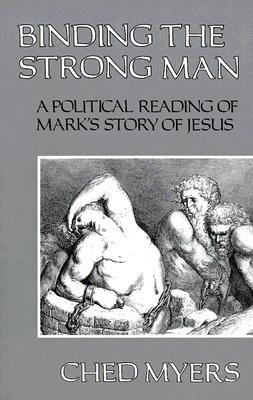 By Ched Myers, for the 2nd Sunday of Pentecost (Mk 3:20-35)
Note: This is an ongoing series of Ched’s brief comments on the Markan gospel readings from the Revised Common Lectionary during year B, 2015.
The first major narrative cycle in Mark’s gospel (1:16-3:6) ends with Jesus’ rejection by the authorities in a Capernaum synagogue. The following episodes serve to regenerate the story by a withdrawal and summary scene (3:7-12) and then by a reconsolidation moment (3:13-19a). The latter mountaintop scene boldly re-contextualizes two of the most revered traditions of Israel: God’s covenant with Moses on Sinai, and Moses’ founding of the free tribal confederacy in the wilderness. Jesus, who has taken the torch from the prophets, prepares to pass it on to twelve disciples he has called, named, and commissioned to proclaim, heal and exorcize (3:14f). Shortly they will be sent out to practice this charge – a second regenerative episode that follows upon another synagogue rejection (6:1-13). Continue reading ““BINDING THE STRONG MAN”: Jesus’ Master Metaphor”
Pentecost: Divine Polyculture vs. Imperial Monoculture (Genesis 11 and Acts 2)
 By Ched Myers
Note: This is part of an ongoing series of Ched’s brief comments on the Revised Common Lectionary during year B, 2015.
How is it that we heard, each of us, in our own native tongue?
Acts 2:8
Since the dawn of colonization, the Americas have been defined by the struggle between dominant culture ideologies of conformity imposed by those in power, and grassroots cultural diversity among those on the margins. This tension between fantasies of racial supremacy and realities of racial diversity remains one of the supreme challenges facing the U.S., and thus our churches, today. The future of North American society depends upon our ability to live peaceably and justly with human diversity — and the same can be said of the human experiment as a whole. The question is whether we can, in church and in society, forge models of coexistence-with-congruence rather than unity-by-uniformity.
Continue reading “Pentecost: Divine Polyculture vs. Imperial Monoculture (Genesis 11 and Acts 2)”
The Pedagogy of Place: The Art of Coping

By Tommy Airey, the first post of a 3-part series about how we learn from our location about what is truly Divine
——————
Every town has the same two malls: the one white people go to and the one white people used to go to.
Chris Rock
About a month ago, I drove just across 8 mile (the border between Detroit and Southfield) to visit the mall that white people used to go to. I went for one reason: it was closing that week and everything was 60-80% off. I was the only white dude in there. It felt good because it was like I was breaking Chris Rock’s rules.
Continue reading “The Pedagogy of Place: The Art of Coping”
“Who Will Roll Away the Stone? A Meditation on Mark’s Easter Story”
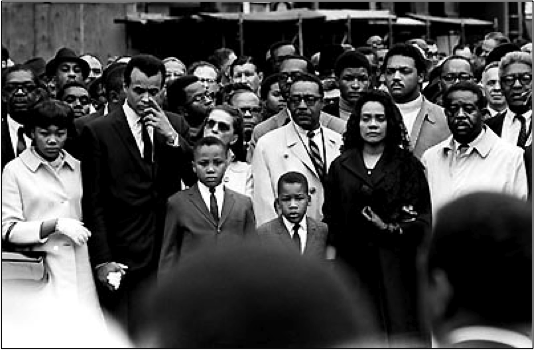 By Ched Myers
Note: This year Easter (Apr 5) falls close to the anniversary of Martin Luther King’s assassination (Apr 4). This is an abridged excerpt from the conclusion of Who Will Roll Away the Stone? Discipleship Queries for First World Christians (Orbis, 1994); it appeared in Sojourners (April 1994, Vol. 23, No. 3, pp. 20-23; King pictures added).
——————-
VERY early on the first day of the week, when the sun had risen, Mary, Mary, and Salome went to Jesus’ tomb (Mark 16:2).
Sooner or later, we who have tried to follow Jesus find ourselves weary and broken like the Galilean women, on our way to bury him. It is the morning we awake to that inconsolable, aching emptiness that comes only from hope crushed. This dawn does not bring a new day, only the numb duty of last respects. Continue reading ““Who Will Roll Away the Stone? A Meditation on Mark’s Easter Story””
What is Radical Discipleship?
 By Ched Myers, excerpted from “What Is Radical Discipleship? An Introduction to the Bartimaeus Kinsler Institute,” Ventura River Watershed, Feb 16, 2015
Radical Discipleship is NOT a dope slogan, or a mobilizing soundbyte, or a hip brand, or an ironic twitter handle. Hell, these terms aren’t even cool anymore. “Radical” is a term as unfashionable today as it was trendy in the 1960s. The notion of “discipleship,” meanwhile, is entirely shrugged off in liberal church circles, and trivialized in conservative ones. So let me explain why this is the handle of this Festival, why we insist on using the phrase. The etymology of the term radical (for the Latin radix, “root”) is the best reason not to concede it to nostalgia. If we want to get to the root of anything we must be radical. No wonder the word has been demonized by our masters and co-opted by marketing hucksters, and no wonder no one in conventional politics would dare to use the word favorably, much less track any problem to its root. Continue reading “What is Radical Discipleship?”
The Festival of Radical Discipleship
 Radical Discipleship is about nothing more and nothing less than laying bare the roots of the personal and socio-political pathologies of our imperial society and its dead-end history, even as we seek to recover the roots of our deep biblical tradition. And what tradition is that? It is the messianic movement of rebellion and restoration, of repentance and renewal, a “Way out of no way” that has been going on since the dawn of resistance to the dusk of empire.
Ched Myers, Opening Ceremony of The Festival of Radical Discipleship, Feb 16, 2015
————–
Last week, Bartimaeus Cooperative Ministries hosted their first ever Festival of Radical Discipleship in the Ventura River Watershed of Southern California. The 60th birthday of Ched Myers, one of the godparents of the Radical Discipleship Movement, provided an ample excuse for 170 of us to get together for inspiration, prayer, strategy, celebration and mayhem. Myers asked, “How might our Movement be more healthy and sustainable if we celebrated each other more often?”
Continue reading “The Festival of Radical Discipleship”
 Radical Discipleship