Land Day

A Holy Week check-in from Ched Myers, movement elder, author and activist.

Holy Tuesday was Land Day in Israel/Palestine, always the occasion for protests and police violence (see here). Almost a decade ago, in 2012, I had the privilege of being on the streets with Sabeel Ecumenical Liberation Theology Center staff Omar Haramy (pictured) during Land Day demonstrations in east Jerusalem. It was a poignant catechism in what our friends are up against (see my blog from that memorable day at https://chedmyers.org/…/blog-2012-03-31-friday-reality…/). Please keep Sabeel folks and all Palestinians organizing for justice especially in your prayers this week.

PALM SUNDAY AS SUBVERSIVE STREET THEATRE: SIXTH SUNDAY IN LENT (MK 11:1-11)

By Ched Myers

Note: This is a re-post from an ongoing series of Ched’s brief comments on the Markan gospel readings from the Revised Common Lectionary during year B, 2015.

Jesus’ long march to Jerusalem takes Mark’s story from the margins of Palestinian society (the Jordan wilderness and Capernaum in Mk 1) to its center. Arriving at the suburb of Bethany (11:1), Jesus prepares to enter the Holy City not as a reverent pilgrim demonstrating allegiance to the Temple, but as a subversive prophet challenging the foundations of State power. Mark 11-12 narrates Jesus’ second “campaign of direct action.” In the first campaign in Galilee (1:20-3:35) he confronted the status quo with his powerful actions of exorcism and healing. Now he takes on the Temple system and its stewards: the Jerusalem clerical establishment. This campaign, like the first, will culminate in polarization and rift, and will conclude with Jesus’ withdrawal to further reflect upon his mission in a second sermon about revolutionary patience (13:1ff; see 4:1ff). Continue reading “PALM SUNDAY AS SUBVERSIVE STREET THEATRE: SIXTH SUNDAY IN LENT (MK 11:1-11)”

There is Still No More Compelling Alternative

Happy Birthday to Ched Myers! Today, we honor this cherished mentor and elder with an excerpt from Binding the Strong Man, Uncle Ched’s groundbreaking political reading of Mark’s Gospel. Written in the late 80s. More relevant than ever!

The radical discipleship movement today is beleaguered and weary. So many of our communities, which struggled so hard to integrate the pastoral and prophetic, the personal and the political, resistance and contemplation, work and recreation, love and justice, are disintegrating. The powerful centrifugal forces of personal and social alienation tear us apart; the “gravity” exerted by imperial culture’s seductions, deadly mediocrities, and deadly codes of conformity pull our aspirations plummeting down. Our economic and political efforts are similarly besieged. The ability of metropolis to either crush or co-opt movements of dissent seems inexhaustible.

Continue reading “There is Still No More Compelling Alternative”

POWER TO SPEAK | WWJD: KIRK CAMERON, CHRISTMAS CAROL PROTESTS AND COVID-19

By Tim Nafziger and Ched Myers, re-posted from Ventura County Reporter (Dec 30, 2020)

“Have you ever sung Christmas carols by candlelight in a time when your state governor has prohibited you from doing that? In America?!”  

These are the opening lines of a video by actor Kirk Cameron on Instagram (viewed 80,000+ times) inviting Ventura County residents to join his second “Christmas caroling peaceful protest” at The Oaks mall in Thousand Oaks. Hundreds of people responded to Cameron’s call and gathered without masks to sing at the mall on the evening of Sunday, Dec. 13 and again on Tuesday, Dec. 22.  A similar “worship protest” is slated to take place in Los Angeles on New Year’s Eve led by self-described “missionary, artist, speaker, author and activist” Sean Feucht. The California Poor People’s Campaign, along with many faith leaders, are calling on Los Angeles elected officials to halt Feucht’s events.

Continue reading “POWER TO SPEAK | WWJD: KIRK CAMERON, CHRISTMAS CAROL PROTESTS AND COVID-19”

Reading History Through the Prophets

ZundAn excerpt from Ched Myers’ classic article “Easter Faith and Empire: Recovering the Prophetic Tradition on the Emmaus Road.” These comments are posted just in time for this weekend’s Gospel text Luke 24:13-35

Luke tells us that Jesus addresses these fit-to-be-tied disciples as “fools”
(24: 25). But the Greek term anontoi refers simply to those who don’t
quite get it, who find the truth as yet unintelligible (cf. Romans 1:14;
Galatians 3:1,3} He knows their hearts are “sluggish” (Greek, bradeis),
as indeed are ours. Because we, like Cleopas and company, forever refuse to embrace the counterintuitive wisdom of the Hebrew prophets.

The prophets tell us to defend the poor, but we lionize the rich. The prophets tell us that horses and chariots cannot save us, but we are transfixed by the apparent omnipotence of modern military technology. The prophets tell us to forgo idolatry, but we compulsively fetishize the work of our own hands, Above all, the prophets warn us that the way to liberation in a world locked down by the spiral of violence, the way to redemption in a world of enslaving addictions, the way to true transformation in a world of deadened conscience and numbing conformity is the way of nonviolent, sacrificial, creative love. But we who are slow of heart–a euphemism for not having courage–instead remain fiercely loyal to ever more fabulous myths of redemptive violence, practices of narcissism, and delusions of our own nobility.

Good Friday’s Warning

chedBy Ched Myers. For Good Friday.

“From noon on, darkness came over the whole land until three in the afternoon.” (Matthew 27:45)

In this greatest of cosmic “signs” in the gospel narrative–the darkening of the world for three hours—our attention is pointed back to the old Exodus story.  There Yahweh, in the war of myths with Pharaoh to free the Hebrew slaves, blots out the sun in Egypt for three days–a repudiation of the imperial order legitimized by the sun god Ra. The rhetoric describing this penultimate plague is evocative: “People could not see one another, and for three days they could not move from where they were” (Ex 10:23). What a trope for collective blindness, denial and paralysis, so fitting to the culture of empire still today! (For more on this, see my piece here.)

This Good Friday falls at or near the peak of the Covid-19 plague in the U.S. At the “apocalyptic moment” of Jesus’ crucifixion, we are supposed to pay attention to the lesson of plagues: they are the dramatic expression of the great struggle between Creation and Empire–and of the God who takes sides.

Maybe at 3 pm today we should be out on our porches banging pots for that

Ched Myers, an ecumenical activist theologian, is a popular educator, writer, teacher and organizer, committed to animating and nurturing church renewal and radical discipleship, and supporting faith-based movements for peace and justice. Find his blog, many articleswebinars and a few audio recordings at chedmyers.org. You can also find out more about his Life & Activism there. Ched’s books are available for purchase on this site.

The Rich Man and Lazarus: Warning Tale and Interpretive Key to Luke

fyodorBy Ched Myers, on Luke 16:19-31, this weekend’s Gospel text
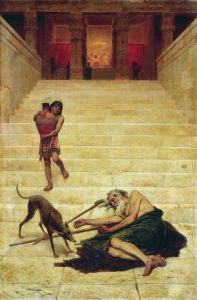
Note: This piece was originally posted to Radical Discipleship in October 2016. As was the case last week, this is a longer post, because of the importance of Luke 16 to those of us suffering from “Affluenza.” For a recording of a recent webinar Ched did on this gospel text, go here. [Right: Fyodor Bronnikov, “Lazarus at the rich man’s gate,” 1886.]

This Sunday’s gospel completes our journey through Luke 16. How rare it is that the lectionary allows a sustained look at Luke’s narrative argument! Last week’s text was Jesus’ subversive tale of the “defect-ive” discipleship of the beleaguered middle manager of a “filthy rotten system” (16:1-13). I read it as a poignant fable for those who would try to monkey-wrench the dominant economic system to provide a modicum of Jubilee justice for themselves and others.  The “paired” story of Lazarus and the Rich Man represents, in turn, a warning tale about the dark consequences of failing to deconstruct the systems of vast social and economic disparity that hold our world hostage. Continue reading “The Rich Man and Lazarus: Warning Tale and Interpretive Key to Luke”

Discipleship as Defection from the Mammon System: Jesus’ Parable about a “Manager of Injustice”

luke16By Ched Myers, on this weekend’s Gospel text Luke 16:1-13

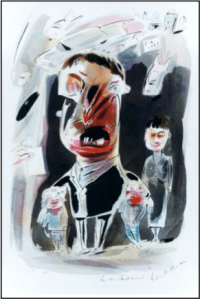
Note: In this piece, originally posted to RadicalDiscipleship.net in September 2016, Ched offers a longer study because of his conviction that this is a crucial text for middle class Christians. A more detailed version of the reflections below can be found here; a webinar exploring these themes can be found here. [Right: “The Wicked Servant,” Ian Pollock, 1972.]

Summary: This Sunday’s gospel can be read as a poignant fable for all who realize that they have been disenfranchised by the dominant economic system, and who would try to “monkeywrench” whatever status they have in it to provide a modicum of Jubilee justice for themselves and others.  This parable illustrates the contemporary strategy of navigating what Wendell Berry calls the “Two Economies” by using capital to build social relations, rather than sacrificing social relations to build capital.  Continue reading “Discipleship as Defection from the Mammon System: Jesus’ Parable about a “Manager of Injustice””

Too Big—and Failing! Jesus’ Cure for Affluenza

DropsyBy Ched Myers, on Luke 14:1-14

Note: This is part of a series of weekly comments on the Lukan gospel readings from the Revised Common Lectionary during year C, 2016. This week’s gospel text is related to last week’s; see the background comments for last week here. Much of the post below is adapted from a sermon given at Downers Grove (IL) First United Methodist Church on 10/10/10.

Luke 14:2-6 is unaccountably skipped over in the lectionary. Yet it is profoundly germane to last week’s reading, and moreover introduces the theme of the whole sequence through 14:24: namely, the issue of how social power and privilege is mirrored in meals, and what to do about it. So I strongly advocate re-instating this beginning episode as part of this Sunday’s gospel. Continue reading “Too Big—and Failing! Jesus’ Cure for Affluenza”

Healing as Liberation from Crippling Debt

DebtBy Ched Myers, on Luke 13:10-17

Note: This is part of a series of weekly comments on the Lukan gospel readings from the Revised Common Lectionary during year C, 2016.

This part of Luke’s gospel offers two symbolic stories about the healing of “political bodies” that signify pathology in the body politic: the “bent over” woman (13:10-17) and the “too big” man (14:1-6). Sadly, the second of these is (literally) skipped over by the lectionary. These intimately related healings bracket a series of Jesus’ sayings concerning the Kingdom as surprise and mystery (13:18-21), the “narrow Way” (13:22-30) and the cost of prophetic discipleship (13:31-35). Continue reading “Healing as Liberation from Crippling Debt”