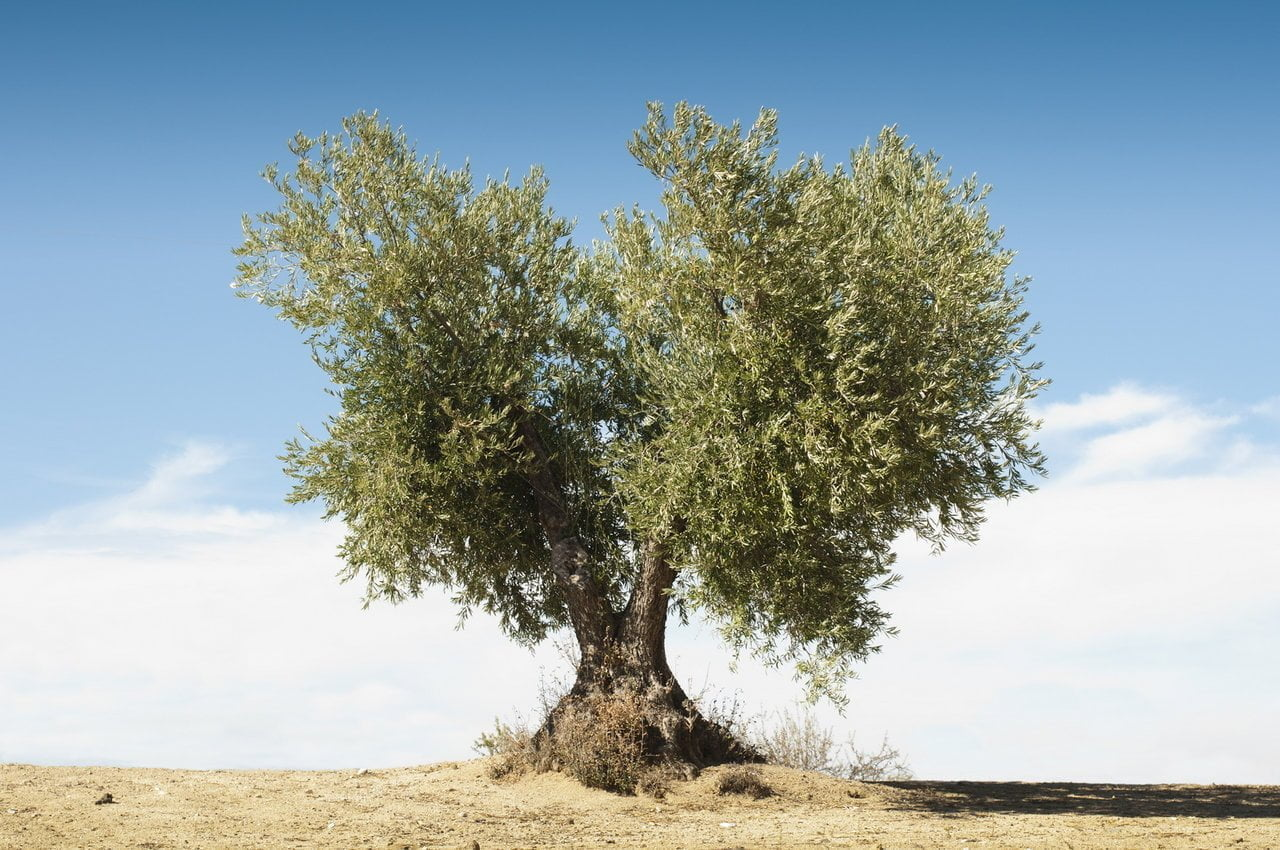
Christianity is a tradition of oil, gift of trees of olives, first used to anoint a slab of stone by Jacob (Gen 28:18), and then by Moses, explicitly directed by YHWH, to anoint a tent, a chest, a table, a lamp, a laver, two altars, multiple utensils, and select humans (Exod 30:22-31). And then in name—but without any written memory of actual pouring on the head in ceremony—of the Nazareth prophet, described as the “living stone,” head of the corner (I Pet 2:4-8). An anointed one, smeared with Life from the fruits of trees quite particular to that local ecology. Trees anchoring human dwelling in such a domain that today, are being ripped up by the thousands—just like State of Michigan settlers cut down birch forests central to Anishinaabe life or US cavalry killed buffalo of plains Indian peoples in the 19th century. All of it designed to break the umbilical between indigenous cultures and local lands, genocidally disappear the human communities thereby “orphaned,” and re-tool the environments for capital.
I start thus, because the question of extraction is at the heart of the question of invasion, occupation, and colonization. Or perhaps more cogently named: the question of technology, of human uptake of other creatures, as armatures and prosthesis and shuttles and fuel for human bodies, claiming supremacies over other species and over other disparaged human communities. Technology is the re-shaping of the entire planetary surface and immediate underground into an enslaved apparatus for a “hungry-ghost” humanity, rampaging insanely, refusing any concern for limit or future.
But it has not always been so. More-than-human creatures can be taken up in modalities of respect and honoring as “tools” and yes, as food for human flourishing—as many indigenous communities know how to do. Indeed, as early Israel in its mix of escaped slaves from Egypt and revolting peasants from Canaanite cite-states knew how to do, re-initiated in such a lifeway in Levantine highlands for generations, before reverting back to abusive, extractive relations as a monarchy in expanding settlements serving hierarchy and seeking surplus.
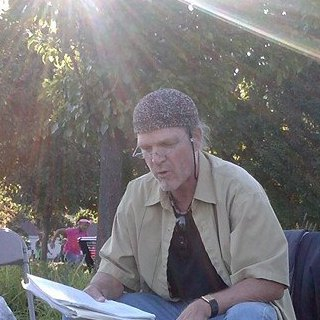
By Jim Perkinson (above), a sermon for St. Peter’s Episcopal Church in Detroit (July 27, 2025)
The disciples want to know how to pray. About time, huh? Actually, there is more going on here than we usually register. This is a typical disciple-request of chosen rabbis in 1st century Palestine. They are really asking for the Teacher to distill the heart of his teaching in a pray-able formula. They want the essence, the unadulterated core of what is being admonished. But here the ante is upped.
Jesus has just set his face to take his show to Jerusalem for the high-noon show-down with the Powers-that-be at the end of chapter 9. They are going for broke—like going up into White House today to shut down operations in protest of Palestinian genocide while carrying a green card from some place called “Galilee.” Jesus has just predicted his death in the process in a huddle with his inner circle. The disciples are beginning to entertain the thought that he might not be around much longer. So, indeed, what is it he is saying to do?
The so-called “Lord’s Prayer”—that the Black Church in this country more accurately calls the “Disciples Prayer”—is a stripped-down version of the more lyrical rendition we meet with in Matthew. And its heart is food and debt. “Give us this day our daily bread” is an invocation of the prime lesson of the Exodus walkout from Egypt when escaped slaves were directed to “gather”—as in hunt-and-gather—”manna,” which literally, in Hebrew, means “what the F is it?”
An excerpt from Jim Perkinson’s sermon on John 6 during the Summer of 2018 called “I Am Wind.”
“God” in Hebrew writ, as we have it from Genesis to Malachi, is double-named, a hyphen-Deity, Elohim of the cool, wet coastal mountains, YHWH of the hot sands south and east. And this is likely because Israel was a hyphen-people, a mixed lot, a creole crowd, partly composed of pastoral nomads following Moses and Joshua, coming into Canaan from the forty years of desert wandering, once crossing the Jordan from the east, joining with rebelling Canaanite peasants, going feral up in the central highlands from seaboard cities on the Mediterranean to the west. A motley crew, each group bringing their God into the stewpot, a Midianite-Canaanite mix, worshipping a YHWH-Elohim amalgam of deities. YHWH is a dust-storm deity encountered by a renegade herder horde on a Sinai desert mountain in lightning and thunder. Elohim is a rain-storm deity encountered by an outlaw peasant crowd on a Canaanite coastal mountain in lightning and thunder. One flashes over the vastness of sand; the other over the expanse of sea. And though the name YHWH comes to predominate, Elohim remains in use more than 2500 times in the Hebrew text.
We could go on if there were time. The word for Wind in Hebrew is “ruach,” which also means “Air,” “Breath,” “Spirit.” Gendered female. These are not fully separable ideas. For many indigenous and antique peoples, the Spirit-World is the Natural World, especially in its fluidity as Air, Wind, Breath. It is not so much the case that the Spirit is in us, as it is we are in the Spirit. It moves through and among us all the time.
Everything is breathing Spirit, in and out, every second. And the bodies that navigate the realm of air, the bodies exquisitely attuned to sense every nuance of wind wafting, whispering, upwelling, down-blowing, scudding or sheering—birds—are quintessentially Spirit-Messengers in culture after culture. We, in the biblical tradition, just freeze-frame them and call them “angels”—winged creatures that sing, and bring messages from heaven!
It is the Wind-Spirit that hovers, Dove-like, over the Great Waters of Chaos in Creation in Genesis 1. It is that same hovering Spirit-Wind-Dove that blows back the Red Sea waters for the escaping slaves. It is the Wind-Cruising-Dove that Noah sends forth from the water-bound ark to find land. It is that Dove-Bodied-One who falls on Jesus coming up from Jordan waters, as the Holy Spirit incarnate, says Luke. God as Dove-Animal, shaped by Wind-Air-Breath, tutoring the Messiah in his wilderness vision-quest and then accompanying him at every step along the way as that Spirit-Bird-Familiar by which he confronts demons and exposes Principalities. Spirit-Wind, if you want, as the Third Person of the Trinity, moving in and out of us and of every other living thing on the planet, at every millisecond!
A sermon from Jim Perkinson on Luke 13:1-9 (March 23, 2025 at St. Peter’s Episcopal Church in Detroit, MI)
13 There were some present at that very time who told him of the Galileans whose blood Pilate had mingled with their sacrifices. 2 And he answered them, “Do you think that these Galileans were worse sinners than all the other Galileans, because they suffered thus? 3 I tell you, No; but unless you repent you will all likewise perish. 4 Or those eighteen upon whom the tower in Silo′am fell and killed them, do you think that they were worse offenders than all the others who dwelt in Jerusalem? 5 I tell you, No; but unless you repent you will all likewise perish.”
6 And he told this parable: “A man had a fig tree planted in his vineyard; and he came seeking fruit on it and found none. 7 And he said to the vinedresser, ‘Lo, these three years I have come seeking fruit on this fig tree, and I find none. Cut it down; why should it use up the ground?’ 8 And he answered him, ‘Let it alone, sir, this year also, till I dig about it and put on manure. 9 And if it bears fruit next year, well and good; but if not, you can cut it down.’” (Lk 13:1-9)
You know me, always trying to get down under the meaning, looking for an unforeseen seed going on journey in the soil, suddenly bursting unanticipated from below ground. Well, it happened here. In today’s text We read our bibles in English. Which translates the ancient Latin (Vulgate). Which translates the Greek. Which translates the Aramaic. Which translates the Hebrew. We are more than four times removed, more than four cultures out of sync with the text. We can’t really get back there in any pristine form but can at least muse. Let some things happen with images that provoke consternation or amusement! So come with me for a minute.
Our indigenous teacher, Martín Prechtel is always telling us, “Pay attention to the etymology, to the sequence of meanings that a given word harbors over time.” Underneath this word right here, that seems mundane and boring to you, there is an older meaning, and under it an even older meaning, and then another and another and another. Follow the root of the word back and down and ultimately you come out in place that is likely ancestral and indigenous and very different than here in the seemingly “ordinary” sense the word now conveys. There are ancestors and grand mysteries up inside many of our words, but deep under their present appearance and sound—like the hair on the side of a root of a mushroom under the soil, leading into a network as wide as an entire forest.
By Jim Perkinson, a sermon on Luke 3:1-6 for St. Peter’s Episcopal Church in Detroit, MI (December 8, 2024)
So, we’ll begin way out in left field. The indigenous teacher my wife and I have been frequenting for more than 12 years now—half white, half Native, growing up among the Pueblo folk of northern New Mexico, adopted into, trained by, and living among the Tzutujil Maya of Guatemala for more than 10 years before being sent back to the States to keep their traditions alive as the civil war there was destroying their culture and indigenous ways—wrote a book a few years ago called The UnlikelyPeace of Cuchumaqiq: The Parallel Lives of People as Plants: Keeping the Seeds Alive. In it, he—Martín Prechtel— recounted his experience of the Feb. 4, 1976 earthquake in Guatemala whose 7.6 rumble on the Richter scale killed more than 22,000 people and displaced some 1.2 million.
Curiously, Prechtel begins that book with stories of Native kids running 15-kilometer races in area high school competitions, through the canyons near the Pueblo, which they almost always won, but refused to win as individuals. Rather they would wait for each other before crossing the finish line, so only the entire Native group of kids, not an individual, would be crowned winner. Or not. Running wasn’t about winning. It was about running. Being magnificent in your movement. Interesting, but why begin a book on a mega-earthquake experience by talking about running? We’ll get to that later.
By Jim Perkinson, a ten-year retrospective on Radical Discipleship
What has significantly changed – in the world and in yourself? What/Who has inspired you or brought you hope? What are the forms of supremacy that you’ve struggled to break rank with?
So, yes, ten years from Obama through Trump to Biden and now looking the rump of the nation straight in the eye! But it ain’t about the leadership as much as the dealership. The global grip of corporate armature and billionaire priority and militant supremacy grows apace. The Elon Musk flush of political theater with digital warp and AI belches of algorithmic inanity seems virtually (!) unstoppable in the short term. In service overwhelmingly—though not exclusively—of white delusion and confusion that pallor is somehow valor and value, rather than weaponized trauma coming out of the European Middle Ages outfitted with a new weapons technology and an old lie!
What has changed in the world is perhaps Time itself—or at least our relationship to it. The onslaught of a pillaging of the more-than-human world into a technological commodification hell bent on re-engineering seemingly everything grabbable on the planetary surface into a human prosthesis, global in extent, accelerating in pace, arguably exercised by a hyperventilating “more” and “faster” that has no imaginable containment other than a resounding “Halt” trumpeted by a no-longer-patient biosphere speaking in the key of climate extremity.
What has changed in me is a night-sky shift towards the oscillating, incubating, jousting-and-composting Mystery of deep dark running from the planetary core to the astral holes centering galaxies and the song that reverberates between. In grief, I lament the loss of half of human life to the dragon’s tail (Rev 12:1) of light-pollution sweeping almost all the stars from urban vision looking for ancestral constellation and consolation above the flickering glow of now. But then NASA has recently hipped us to a new recognition that Black Holes actually “sing,” echoing a B-flat vibe 57 octaves below middle C in a frequency wave 10 million years long, holding on tune for 2 billion years across that orange hazed horizon. So, thus: the Beauty that is—whether I can see it or not! Irreducibly in motion in complexities of gift-economy reciprocation so far beyond our ken that we fill entire blackboards with equations that “explain” something less than 4 % of all that is (chalking the rest up to “Dark Energy” and “Dark Matter”)!
And no surprise then that I still mark my deepest education as an on-going, 40-year baptism in another kind of “Beautiful Blackness” on Detroit’s east side streets, now being rhizomically linked with Native savvy and syncopation here in Anishinaabe smarts about Great Lakes water-wisdom. That combination is complemented by continuous learning (from my wife) of indigenous Ayta resilience on the sides of Pinatubo’s eruptive divinity. And schooled by such, I am propelled back along my own ancestral root, to Celt and Nordic colloquies with Indo-European-profundities dating to pre-Roman humility still rooted in being taught-by our more-than-human kin before such was warped and decimated by imperial domination and rapacity.
So, the supremacy at issue? A three-fold iteration across 5,000 years of elaboration, beginning in Mesopotamian re-organization of smaller-scale lifeways (hunting-and-gathering, subsistence cultivation, village-based pastoralism) into city-state coercion of labor, surplus extraction, imposed taxation, debt, drudgery, and disease evisceration. Gradually elites began to assemble armatures of trade, technology, and architecture that effectively removed and buffered them from hands-on exchange with plants and animals in elevating themselves figuratively and literally out of reciprocal relations with such, to a controlling, plundering, and decimating accumulation of goods and status whose brutality was destined to be promoted and gaslighted ever after as “civilization” (built on the Latin word “civis” for male-propertied “citizen” players in in the on-going pillage).
Some 3,000 years down the road, that elite-anchored “species supremacy” insisting humans alone had status and worth, gave rise to its most potent religious offspring in the form of Christian supremacy, warping and re-configuring a Galilean back-to-the-land movement seeking to enflesh ancient Sabbath and Jubilee traditions of eco-reciprocity and co-communion into a monopolistic privatization of “truth” and of Earth itself. This led after more than a millennium to Doctrine of Christian Discovery genocide (95% on average) of Native Turtle islanders and enslavement of African peoples as tools of produce and wealth assemblage on the stolen land. Yes, in USA self-conceit—going underground and toxic as the spiritual underpinning of a newly-articulated visual regime of white-skin power and predation. This still regnant supremacy continues to vaunt Euro-heritage and visage over all else, even as it remains ideologically and artifactually entwined with the civilizational and religious supremacies it (supposedly) superseded.
And thus we face today, a biospheric blowback ripping the facade off the entire enterprise that will not much longer tolerate the evident fatuity and stupidity. Inspiration towards life and “ways of being” otherwise—in the face of such—for me is a question of track record. Who has the proven experience of living in place over generations without destroying either themselves or everyone and everything else in that place and without having to reach beyond that particular bioregional bounty to plunder an “elsewhere”? The simple answer to such is “indigeneity” and ancestry. How re-learn what they knew and know? And once again, become worthy recipients of—because co-participants with—such amazing Beauty and Magnificence as Life on this planet yet represents and obviously is.
By Jim Perkinson (above), a sermon for St. Peter’s Episcopal Church (Detroit, MI)
And he said to her, “Let the children first be fed, for it is not right to take the children’s bread and throw it to the dogs.” (Mk 7:27)
Note, right up front, how rapidly the subject shifts topic in this Marcan vignette. It goes from unclean spirit to bread to puppies and argues about priorities. Pretty easy for somebody eclectic like me to open up, in response, a fire hydrant of ideas without any hoses attached. So, my title is an attempt to organize the flow a bit. We begin (ha!) with the word “first.”
The sacred Jewish writing known as the Talmud (Brachot 40a) asserts: “It is forbidden for people to eat before they give food to their animals as it says (Dvarim 11:15), ‘I will provide grass in your field for your cattle’ and only then does the verse state ‘and you will eat and be satisfied’” (Rav Yehuda, teaching in the name of Rav, quoted by Halickman)[1]
But, but then in the Gospel of Mark today (as we read), Rabbi Jesus says: “Let the children first be fed; it is not right to take the children’s bread and throw it to the dogs” (Mk 7: 27).
And those “buts” (plus a bunch more) will be central in the riff to follow here—one thing going one way, and then suddenly the same thing going another way, or even a line of anatomy curving around against itself and in “cheeky” fashion, doing so twice. There are buts and then there are “butts.” As we shall note.
By Jim Perkinson, a sermon for St. Peter’s Episcopal Church (October 1, 2023), a
So, land. A big topic. My wife was recently asked to open a Michigan Climate Summit Conference hosted at Oakland University where she teaches with a formal land acknowledgement and after giving greetings in her native tongue of Kapampangan from the Philippines, the traditional homeland of the Ayta, she offered the following:
I’ve been asked to do the Land Acknowledgment to set the tone for our gathering today and it is fitting that I do so because I, too, am a settler here on Turtle Island. As one Mohawk scholar once said to me once, “It doesn’t matter if your people were brought here through historic colonization, as far as Native peoples are concerned, you are still settlers.” Something I’ve had to sit with for a long time and ponder.
And as protocol goes, it is settlers like myself—not Native peoples—who must acknowledge whose land we’re on—that we are here on Native peoples’ stolen land. And we name this truth not just as pro forma, but as part of the discipline of facing into—and beginning to unlearn—our settler privilege—recognizing that our presence here on this land as non-indigenous peoples means we are beneficiaries not only of native genocide and dispossession, but of other kinds of historic oppressions such as African slavery, U.S. imperialism abroad, and the ecocidal clearing of forests and decimation of wildlife habitat in order to build our cities that’s part of what is driving climate change.
By Jim Perkinson, a homily for St. Peter’s Episcopal Church, Detroit, MI (May 28, 2023)
So, Pentecost! We will begin deep in the weeds. Literally. “Pente-cost”—in Greek, the 50th day! But 50th day after what? After Passover. But why 50? Well, 49 + 1. Huh? We scratch our heads. But of course, the early Christians, though working in the language of the Greeks—pentekoste—are translating practice and memory of the Hebrews. So hard this biblical faithfulness business—plunges us straight into serious cross-cultural labors and mistakes. Such a big history of mistakes! More on that later. But the Hebrews! They didn’t call it Pentecost, but Shavuot, the Feast of Weeks. 7 weeks after Passover, but with the counting starting on the 2nd day of Passover—so 49 + 1.
Ok—but then, what anchors Passover, when does it begin? Ah, now we’re getting down to it, yes, getting down, “gettin’ down,” heavy on the down beat! But what is down? What direction? There—pointing to your feet? Yes, but what is down there? A tile floor, you say? And under that? Wood floor joists? And under that? Pipes? Yes, yes, and a basement and then cement. And, and . . . But finally, even in the city, we get to it. Earth. What all of life stands on and grows in. The big assumption. The Big Momma we take for granted again and again!





 Radical Discipleship