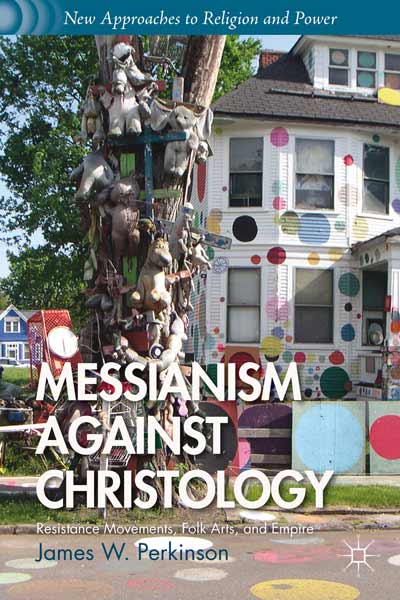
Messianism Against Christology

MessianismBy Tommy Airey

…the undercurrent of a conflict between lifeways haunts the text.
Jim Perkinson, Messianism Against Christology (2014)

*Note: an abridged version of this review was published in the December 2015 issue of Sojourners Magazine

Growing up in the conservative white suburban Evangelical Christian tradition of North America, nothing was more important than the Bible & Jesus. Indeed, is there really anything else? Yet, many like me have grown into adulthood and out of Evangelicalism, not because the Bible & Jesus are no longer important, but because the Bible Answer Men have used their interpretations to justify privilege all over the globe. Continue reading “Messianism Against Christology”


Cultural Appropriation: Of Dreadlocks, Cell Blocks, and Stolen Rocks (like Plymouth)

columbusBy James W. Perkinson, September 29, 2015

Invited by a friend to respond to the recent blog of philosophy professor, Crispin Sartwell, “Should Miley Cyrus Wear Dreadlocks?” I would throw this into the mix. Yes, it is cultural appropriation “all the way down,” but as with ingesting spoiled food, some things come back up. The culture wars rage on, as globalization’s surface sign that something deeper is afoot. The question of taking someone else’s style cannot really be judged except in consideration of the entire regime of planetary “taking” writ large.
Continue reading “Cultural Appropriation: Of Dreadlocks, Cell Blocks, and Stolen Rocks (like Plymouth)”

Somewhere Between Sturgeon, Graffiti, and Jubilee

jimBy James W. Perkinson. Written in preparation for the Detroit Spirit and Roots Gathering this upcoming weekend in Detroit hosted in part by Word and World. Published on On the Edge, a Detroit Catholic Worker Paper.

This summer in Detroit, some of us will attempt a new thing. Tentatively, slowly deliberately—we will convene a dialogue among three communities of inspiration. One is rooted in postindustrial soils, breaking street savvy into spit finesse, spun bodies, and tagged walls. Another is deeply historical, born of peasant resistance against ancient Roman might, itself gone genocidal and colonizing. The third, most rooted, is embedded in soils and waters, seasons and weather, enculturated by the place itself. Hip-hop, Christian, and indigenous by other names—three constituencies roughly demarked, will make common cause in concern for the future of de troit, the strait. We have named it the “Detroit Spirit Roots Gathering” and seek to serve a re-spiriting of the city in part by learning from each other’s stories. Continue reading “Somewhere Between Sturgeon, Graffiti, and Jubilee”

Dylann Roof & Our Myth

DylanThe finger points at us. If we actually do want the country to behave differently towards peoples of color here and abroad—it is “we,” who are white and content, who must change and do so radically. Anything less than the equivalent of real reparations and real political confrontation in the streets is simply more of the same.
—————-
By Jim Perkinson, long-time activist and educator from inner city Detroit & the author of White Theology: Outing Supremacy in Modernity (2004)

One of the great fears of white people in the early 19th century was that if slaves were given any quarter at all, whites would rapidly be enslaved by blacks. So much as one moment of unpunished black response to white domination—even as seemingly minor as merely looking the master in the eyes—would mean, in short order, that the tables would be turned. Thus the “necessary” brutality of the peculiar institution (portrayed, for even Hollywood audiences, in the recent filmic depiction, “Twelve Years a Slave”).
Continue reading “Dylann Roof & Our Myth”

Breakin’ Down Messianism With Dr. Jim Perkinson

messianismJim Perkinson is a long-time activist and educator from inner city Detroit, where he has a history of involvement in various community development initiatives and low-income housing projects. He holds a PhD in theology from the University of Chicago and is in demand as a speaker on a wide variety of topics (especially race, class & colonialism). He is also a recognized artist on the spoken-word poetry scene in the inner city. Many of his works are published. In this interview, we home in on his 2014 work Messianism Against Christology: Resistance Movements, Folk Arts and Empire.
————–
RD: What’s the difference between “messianism” and “christology?”

J-PerkMessianism Against Christology: Resistance Movements, Folk Arts and Empire is a work committed to re-thinking the Christian tradition from the point of view of social movements rather than magnified individuals.   Jesus was a movement man—as were Moses and Elijah before him, and John the Baptist alongside him. “Messianism” is a word drafted into service as a movement term. Rather than focus on a great individual called “Jesus” comprehended as “the Christ,” the book examines his effort as part of a broader resistance initiative. The social movement launched by John was already in motion when Jesus first opts to begin public action. Continue reading “Breakin’ Down Messianism With Dr. Jim Perkinson”

Moses, Jesus, Muhammad, and Martin Were Movement Men: The Demand Before Us Today

J PerkBy. Dr. Jim Perkinson, Keynote at the Islamic House of Wisdom (Detroit, MI, 1-18-15)a
—————
One of those shot in the Charlie Hebdo incident in Paris on Jan. 7 was a Muslim policeman named Ahmed Marabet killed while trying to defend that newspaper’s staff. The next day, Dyab Abou Jahjah, a Belgian news columnist and Muslim, responded to all the “I am Charlie” signs appearing in the Paris streets with a tweet saying: “I am not Charlie, I am Ahmed the dead cop. Charlie ridiculed my faith and culture and I died defending his right to do so.
Continue reading “Moses, Jesus, Muhammad, and Martin Were Movement Men: The Demand Before Us Today”

the strait is not straight

In a paper he delivered at the AMBS Rooted & Grounded Conference last month, the Ecumenical Theological Seminary professor Jim Perkinson reflected on the deep meaning found in the renaming of his beloved Detroit River Watershed in 1701:

“Wawiatonong” the Ojibwa say, the place “where the river goes around,” a name conveying at once respect and locale and abundance. I, however, write from a Detroit become the epitome of thirst and lack. Three centuries ago, the Jesuits came around the bend and re-named the Ojibwa curve a “strait,” “de-troit,” the link between Lakes Erie and Huron, shifting its orientation toward the priority of trade and commodities, a mere conduit in the circuits of global capital, and now the country’s most heavily trafficked “commercial” border.

Continue reading “the strait is not straight”