Wild Lectionary

IMG_9021.JPGcurated by Laurel Dykstra

Martin Luther wrote, “God writes the gospel not in the Bible alone, but on trees and flowers and clouds and stars.” Watershed discipleship communities, forest churches, and farm-to-table faith projects attend in different ways to this Word in creation. But many of us falsely imagine that scripture is focused on divine-human relations and unconcerned with “trees and flowers and clouds and stars.”

The Psalm assigned for January 1 both assumes and demands that all creatures—celestial bodies, spiritual beings, plants, animals, and forces of weather—praise their creator. And the diversity of humankind is just one small part of this glorious chorus of praise. Continue reading “Wild Lectionary”
People and Prayers

laurel-dykstraBy Laurel Dykstra, Salal and Cedar
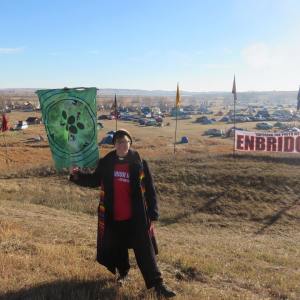
I am home again in Coast Salish Territory praying about how to be an accomplice to the work of Indigenous Water Protectors at Standing Rock, to speak only for myself but centre Indigenous and traditional voices. Greg, of the Cheyenne River Sioux was my host at Oceti Sakowin Camp. When I asked what I should tell people at home, he said, “Pray, keep praying.” And when I asked what they needed he said, “More people and more prayers.”
I am a priest but I have never been any place where they prayed so much—I averaged 5-6 hours per day in prayer and ceremony here doing things that most people think of as prayer—with special words, objects and actions. But prayer here includes healing dance on a critical river crossing that held off police and security, a sweat lodge on the pipeline path, sacred pipes in front of armored vehicles. Prayer is not a limp sending of good feelings that excuses your absence it is practical and concrete. So as Greg is calling for more prayers and you can send them from your wallet here http://www.ocetisakowincamp.org/donate you can bring them with bike locks to your financial institution that funds DAPL, you can head to your centres of government and law enforcement and invite them to sit down and pray with you and refuse to leave until they do.
Greg also called for more people, and to his call out I will add these words from Kelly Sherman, Oglala Lakota: “If you visit Oceti Sacowin please remember you are a guest. Please remember it is not about you. Please remember the traditions and ceremonies you are welcomed into are sacred. Please remember your visit is not a vacation. Please remember some moments are sacred and do not need your camera.Please remember that sacred moment, that sacred time, will be a picture embedded on your soul. Not on your phone. Donations are helpful, social media sharing is helpful. But what Standing Rock needs is your physical presence. However when you are there please remember if you do not know what to do first you listen. Secondly you listen. Thirdly you listen. And if you do not know how to do that…stay home.”
For more information on solidarity and allyship-

Digging

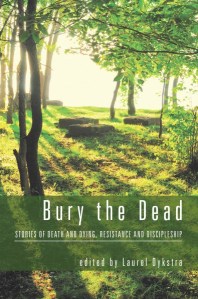
bury-the-deadBy Andrea Ferich. An excerpt from Bury the Dead: Stories of Death and Dying, Resistance and Discipleship

Our bodies and the land are one. Move the earth with your body, dance on it, farm in it, play with it; our final return to it is sacred. The soil is made of clay, like you and me–  hydrocarbon molecules, layers of geological and muscular formations, alive. The soil, mountains, and valleys are layered with time like our layered muscle tissue. We dance on the earth in the face of death, for the healing of ourselves and the healing of the land, connected as farmers, dancers, painters, musicians, and lovers of the goodness of the good green earth moving through lament. Our bodies and the earth are one and their healing and grieving are interconnected. Continue reading “Digging”

New Book- Watershed Discipleship: Reinhabiting Bioregional Faith and Practice

wd book.jpgRadical Discipleship is excited to announce a book hot off the press that is an anthology exploring watershed discipleship. Many of the contributors are regular writers for radicaldiscipleship.net. We hope to have a review coming, but for now check out the book. And let us know if you want to review it!
Edited by Ched Myers
Foreword by Denise M. Nadeau

Contributors: Katerina Friesen, David Pritchett, Jonathan McRay, Lydia Wylie-Kellermann, Erinn Fahey, Sarah Thompson, Matthew Humphrey, Sarah Nolan, Erynn Smith, Reyna Ortega, Sasha Adkins, Vickie Machado, Tevyn East, Jay Beck, and Rose Berger.

This collection introduces and explores “watershed discipleship” as a critical, contextual, and constructive approach to ecological theology and practice, and features emerging voices from a generation that has grown up under the shadow of climate catastrophe. Continue reading “New Book- Watershed Discipleship: Reinhabiting Bioregional Faith and Practice”

Eucharistic Prayer

euchWritten by Salal and Cedar

May God be with you
And also with you
Lift up your hearts
We lift them up
Let us give thanks to God our Creator
It is right to give our thanks and praise

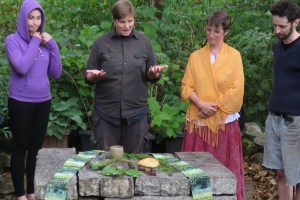
It is right in all times and in all places to thank and praise you Creator of all. We praise you here where the Fraser River meets the Salish Sea, where city and farm, wilderness and industry are side by side. We praise you at a time when the body of earth is broken again and again. Continue reading “Eucharistic Prayer”

Mary and Martha

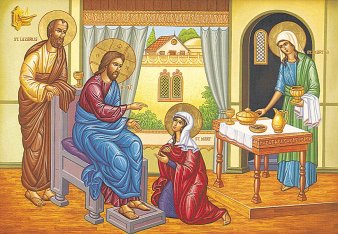
Mary-Martha-Lazarus.jpgBy Laurel Dykstra

Luke 10. 38-42

I don’t like the story of Mary and Martha.

Most of us already know if we are more like Mary, who sits at Jesus’ feet, or more like Martha, who is distracted by her many tasks. And it seems to me that no matter how nice they try to be about it, most of the sermons and commentaries on this passage seem to say, “Yay Mary and Boo Martha” Continue reading “Mary and Martha”

UNDRIP, Christians, and Climate Justice

book 2.jpgBy Laurel Dykstra. This piece is part of a new anthology- Wrongs to Rights: How Churches can Engage the United Nations Declaration on the Rights of Indigenous Peoples

I am the priest of Salal and Cedar a community in the lower Fraser/Salish Sea watershed whose mission is to grow Christian’s capacity to work for environmental justice. In the language of the global Anglican communion, what we do is “strive to safeguard the integrity of creation and sustain and renew the life of the earth.” Continue reading “UNDRIP, Christians, and Climate Justice”