Join Christians across the United States for a mass call this Thursday, February 15th, from 8-9:30pm EST (5-6:30pm PST) to learn about our plan for direct action against the US-funded genocide in Palestine, and the manipulation of Christianity by Christian Zionists.
Our goal is to get 1000 Christians on this call! Sign up today. Register HERE.
We will gather together for a time of lamentation, learning, prayer, and action. We’ll hear from powerful speakers including Palestinian and American Christians, a representative from the Jewish Voice for Peace Rabbinic Council, and leaders of Christians for a Free Palestine.
Together, they’ll speak to the crisis in Gaza and the West Bank, and call for Christians across the U.S. to join the worldwide interfaith movement that is taking public, nonviolent action to stop the genocide and speak out against Christian Zionism, antisemitism, and Islamophobia.
We’ll share specific and concrete ways that you and your community can take public action for a free Palestine, and we’ll announce future trainings and mass organizing calls.
This is a call to action to our Christian community—a call to use our public voice and our collective power to advocate for peace and demand an immediate ceasefire.
In the face of Christian Zionism, using our faith to cheer on this genocide, Christians have a responsibility to use our voices as powerfully as possible for the cause of peace and justice. We are taking public action as Christians.
With your help, we will mobilize over 1000 Christians from across the US to grieve the ongoing violence, call for a ceasefire and an end to Israeli Apartheid, challenge Christian Zionism, and prepare to take action together. Now is the time to get involved.Register for the Feb 15 call HERE.
This is the Introduction of a position paper in solidarity with Palestinian liberation written by NDN Collective and the LANDBACK Team. The full paper is posted here.
When questioning the problems around our communities, Indigenous youth are often told, “it’s a complicated issue”. We see our grandparents’ houses with no electricity or running water while transmission lines run overhead and water lines supply nearby resource extraction projects. Coincidentally, when asking about what is happening in Palestine (named in Arabic, Falasteen), the dominant response is the same. However, neither the questions nor the answers are truly complicated. The current conditions we face as People stem from the root causes of settler colonialism, genocide, and apartheid. Under settler colonialism, settlers do not care about the People or the land. Their relationships are based on extraction and exploitation. Indigenous Peoples protect and defend our land and our communities. The land convenes us and helps to define who we are and what our purpose is. This is our shared relationship and understanding to Indigenous Peoples globally. That is why, we look to our Palestinian Relatives who, like us, continue to demonstrate the power of resistance against colonialism and occupation. This position paper, provides information on the historical relationship between Palestinians and Native Peoples, an overview of the devastating impacts of zionism, and reasons why NDN Collective and the LANDBACK Team stand in full solidarity and commitment to the Right of Return of our Palestinian siblings and full liberation of their homeland. Just as we fight and organize to reclaim land here on Turtle Island, our Palestinian relatives fight and organize to return to the land and for the land to return to the people. It is through our relationships and shared history of resistance against colonialism that we present the position paper: The Right of Return is LANDBACK.
Honestly, I never thought much about Israel before college. Then, during my sophomore year, a prominent New Testament studies scholar had been invited to speak on campus; after it came to light that they were openly critical of the state of Israel, they were summarily disinvited. A few other students and I were still able to meet with the scholar, and we were shocked by the language they were using to describe the conditions in Israel for the Palestinians: “Second-class citizens,” “genocide,” and “apartheid” were the terms that struck me most.
“It can’t be as bad as what Black people have faced in the United States or what they faced in South Africa,” I remember saying to the scholar. “Go and see,” they admonished. And so, one year later, that’s exactly what I did.
In 2012, three other students and I had been invited to attend a conference at Bethlehem Bible College called Christ at the Checkpoint. The mission of this conference, which will be convening for the seventh time in May 2024, was to invite evangelicals to think about Israel and Palestine in ways that prioritized “peace, justice, and reconciliation,” while also explicitly giving voice to Palestinian Christians. And while I’m grateful that I was introduced to authors, theologians, and activists like Munther Isaac, Jonathan Kuttab, and Salim Munayer, nothing was quite as transformational as experiencing a checkpoint for myself.
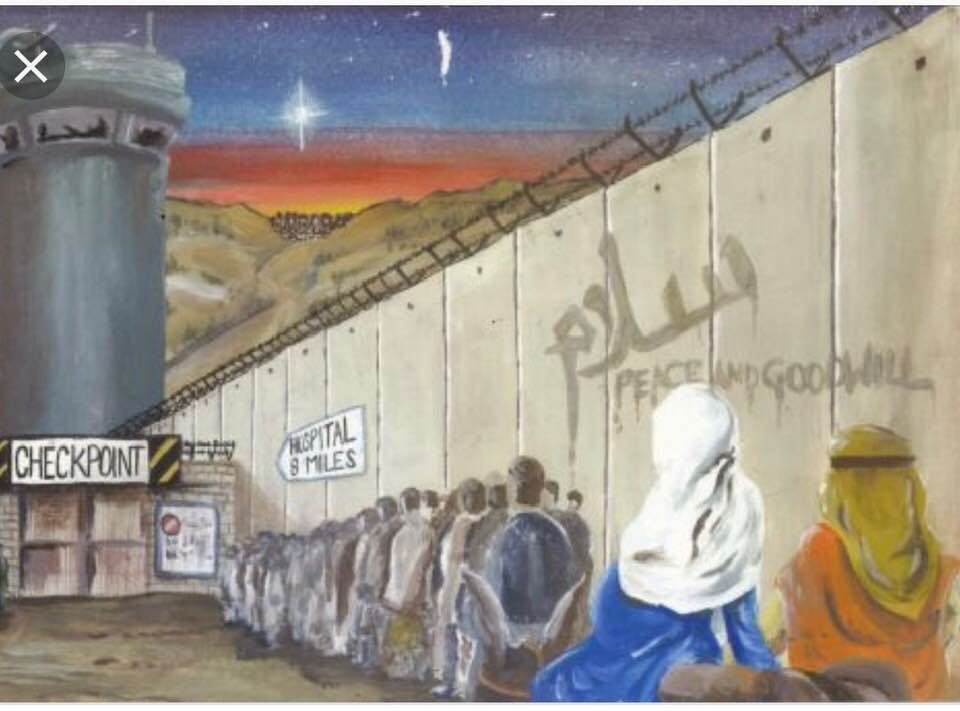
I’d been stopped at police checkpoints in the United States multiple times — either alone or with friends or my dad. During those stops, humiliation, pain, or death always seemed to be a likely outcome. So when I was preparing to pass through one of the checkpoints at Israel’s apartheid wall, I imagined the Israel Defense Forces soldiers would hassle me the same as the Chicago police. But there was no hassling. I handed them my blue U.S. passport and waltzed through the checkpoint. “I feel like the scholar exaggerated a bit,” I thought to myself. But as soon as that thought crossed my mind, I turned around to see a long line of Palestinians, each of them being hassled by an IDF soldier. When I looked into the eyes of those Palestinians, I saw that they, too, felt humiliation, pain, or death was a likely outcome.
To read the interview go to Sojourners Magazine here.
An open letter from a coalition of anti-occupation Jewish students at Brown University. Re-posted from The Brown Daily Herald (November 7, 2023)
“Solidarity is the political version of love.” – Jewish feminist activist Melanie Kaye/Kantrowitz
As of today, it has been a month since the Oct. 7 attacks that have dominated global political consciousness and discourse, not to mention our experiences as young Jewish people. Zionist institutions purport to be representative of all Jews, often using us as a rhetorical shield to support the unconscionable actions of the state of Israel. We feel a particular pain as Jews having to continuously justify our stance against genocide. We are here to make ourselves clear: We stand in solidarity with Brown Students for Justice in Palestine and the Palestine Solidarity Caucus in the pursuit of the liberation of Palestinian peoples. We know intimately that Jewish struggles are necessarily bound up in global struggles for freedom. We are a group of Jewish students who have coalesced around our shared vision of justice, anti-occupation, liberation and community. We ask you to listen to us now:
1. What do we mean when we say, “from the river to the sea”?
“From the river to the sea, Palestine will be free” is not a call for the forced removal of Jews from Palestine or, as it is commonly misconstrued, a call to “throw Jews into the sea;” instead, it is a call for the end to the oppression of all Palestinians — in Gaza, the West Bank and within the Green Line. Liberating all of Palestine requires revolutionary change: not an eradication of Jews from the land, but a total dismantlement of the apartheid regime occupying it. The assumption that this phrase is inherently genocidal falsely conflates liberation with the annihilation of each citizen of the oppressive state and ignores its liberatory intent. Within this conflation, we hear a racist assumption that Palestinians are ruthless “animals” and an intentional obscuring of the violent intent of a neo-fascist government — a characterization shared even by writers in Israel’s newspaper of record. It is not only blatantly false but obscene to frame a call for liberation and justice as genocidal while Israel is carrying out genocide in Gaza funded by billions of American tax dollars. If calling for a future in which Palestinians can live in their homeland unshackled implies an existential threat to the Zionist ideology, it is that ideology that must be called into question — not the call for liberation.
By Rev. Graylan Scott Hagler, re-posted from Mondoweiss, a source of news and opinion on Palestine, Israel and the US
The Bishop William Barber, II, of the Poor People’s Campaign wrote an Op-Ed that appeared in The Guardian on October 13, 2023, entitled, “We must say an emphatic ‘no’ to Hamas a thousand times“. I feel compelled to respond to that Op-Ed. I am hesitant to challenge a friend and a colleague, but on this issue, I must.
I understand Rev. Barber’s need to thread the needle, but in a time like this, we need truth-telling and not outrage when it is politically expedient to do so. As Bishop Barber decries and mourns the killings and atrocities carried out by Hamas, he makes the same error that he has made in the past, by diminishing — and at times ignoring the horrendous history of settler colonialism endured by Palestinians. I am not suggesting equivocation, where a massacre by Hamas in Israel is justified by the long history of Palestinian dispossession and oppression. But I am advocating for the consistent and equal acknowledgment of the long pain and suffering of the Palestinian people. Rev. Barber has not done that historically or even in the structure of his Op-Ed, where he mentions Palestinian suffering in a secondary position to the recent attacks upon Israel.
Rev. Barber seems to want to excuse 75 years of oppression and harm perpetuated by the Israeli regime and aided by a general silence from the world. Through the years, Israelis, Palestinians, Muslims, Christians, and Jews have worked to draw attention to the gross violence and injustices of Israeli occupation. Yet, it seemed that the world was not interested in war crimes, or the genocidal pogroms carried out against the Palestinians. In most cases, the death of a Palestinian child, or the eviction of a Palestinian family did not even amount to a footnote in the concerns of the U.S. government or many religious leaders, including Rev. Barber. Click here to read the rest on Mondoweiss.
CUNY LAW JLSA STATEMENT ON EVENTS IN OCCUPIED PALESTINE(10.10.2023). The statement was originally posted on Google Docs here, but it has been taken down for violating its terms of service (which raises all sorts of important questions).
In this season of renewal and self-reflection, and as we begin the year 5784, the Jewish students at the CUNY School of Law wish to express our uncompromising solidarity with the Palestinian people in their righteous struggle for self-determination. This feeling is accompanied by a profound sense of grief over the lives that have been lost. We are steadfast in our belief that Zionism – as a political ideology predicated on theft and destruction – serves to imperil both Jews and Palestinians, even though its proponents only target the latter.
In his analysis of the global anti-colonial struggle, Frantz Fanon wrote, “We revolt simply because, for many reasons, we can no longer breathe.” Such is the case for the Palestinian people, who have, for generations, been made to suffocate under the deadly weight of the Zionist project. This settler-colonial enterprise, promoted by antisemites within the British Empire following World War I, has taken shape across decades of uninterrupted brutality. In 1948, Zionist militias unleashed a campaign of terror marked by mass murder and systematic sexual violence, razing over 500 Palestinian villages and forcing more than 750 thousand Palestinians off their native lands.
An excerpt from Noura Erakat’s recent piece (“Designing the Future in Palestine”) in Boston Review. Read the full article. It’s so worth it.
…[Palestinians] are moving in tandem with other Indigenous communities increasingly engaged in Indigenous resurgence. This is a phenomenon, explains Cherokee political scientist Jeff Corntasssel, that reframes decolonization by turning away from the state to “focus more fully on the complex interrelationships between Indigenous nationhood, place-based relationships, and community centered practices that reinvigorate everyday acts of renewal and regeneration.” This shift does not reject state-centric diplomacy or abandon the struggle against the settler sovereign. A full pivot away from such engagement would be short-sighted and counterproductive, especially for Palestinians who remain forcibly exiled from their lands and barricaded within militarized ghettoes. Rather, Indigenous resurgence centers Indigenous life and governance alongside other approaches. It seeks to undo the alienating force of colonization by reconnecting “homelands, cultures, and communities.” In particular regard to Palestinians, scholars Nour Joudah, Tareq Radi, Dina Omar, and Randa Wahbe explain, resurgence facilitates a “self-recognition” that transforms “fragmentation into a strength” and “variegated experiences of loss” into “a politics of care.”
If decolonization typically pits native against settler in a struggle for the land, Indigenous resurgence focuses on how to belong most ethically in relationship to one another and to the land.
If each hour brings death
If time is a den of thieves
The breezes carry a scent of evil
And life is just a moving target
you will ask why we sing…
We sing because the river is humming
And when the river hums
The river hums
We sing because cruelty has no name
But we can name its destiny
We sing because the child because everything
Because the future because the people
We sing because the survivors
And our dead want us to sing






 Radical Discipleship