Be Careful

The conclusion of Steven Salaita’s recent piece “Care and Carefulness in Today’s United States.”

People all over the United States are being snatched up, disappeared, imprisoned, and deported. So how can we be careful amid these horrible conditions? Simply put, we can’t. We can be tactically prudent, but there’s no guarantee of safety for anyone serious about Palestine solidarity, or for anyone who is vulnerable by virtue of identity or legal status. There’s no guarantee of safety for anyone, really, in a world that so readily tolerates genocide.

“Be careful” has other uses and connotations. 

For example, I would suggest that you be careful about nostalgia for a democratic polity that never was.  Be careful about activists and organizations appended to the Democratic Party.  Be careful about the podcasters who built an audience by caping for Bernie Sanders.  Be careful about celebrities who moderate support for Palestine under pressure.  Be careful about genocide profiteers in the film and publishing industries.  Be careful about the next shiny young politician who comes out of nowhere to save us.  Be careful about anti-Zionists who ignore Palestinians.  Be careful about anyone who prioritizes the settler’s existential angst.  Be careful about anything that tries to make a place for oppression in this world. 

And, for God’s sake, please be careful about the supposedly radical luminaries interjecting liberal Zionism into conversations about Palestine. 

In these instances, “be careful” isn’t an appeal for you to keep safe; it’s a demand that you seek to protect everyone else. 

Radical Possibilities

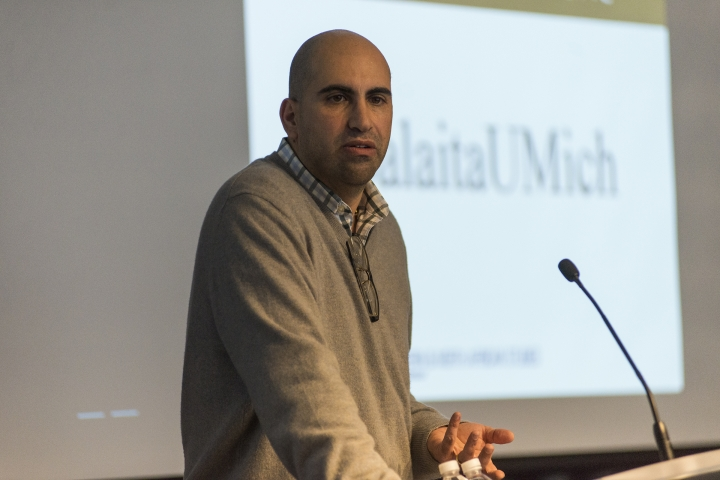
This is an excerpt from Steven Salaita’s recent essay. Salaita is an Arab-American scholar who lost his job at University of Illinois after he tweeted out the truth about Palestine. He is the author of An Honest Living, a book about the ostracism and loneliness and alienation (and vitality and joy and regeneration) that comes from being loyal to the oppressed and downtrodden of this world.

The massive Democratic failure opens some radical possibilities that can only be developed outside the mythic parameters of U.S. democracy.  If we can’t pursue radical possibilities now, after this disaster of an election in which deeply vulnerable people were viciously renounced by purported allies and defenders, then there’s nothing left to do but wait out the decline of our planet.  These electoral spectacles aren’t the sign of a healthy political culture; they’re an ugly business that benefit nobody outside of a corrupt and hermetic ecosystem aggressively devoted to its own proliferation.  

Everyone else, the great majority of people throughout the United States, ends up with a whole lot of disaffection.  Republicans have proved somewhat capable of exploiting this disaffection—they’re certainly more capable than Democrats—but they have limited appeal to the ever-growing number of Americans on the periphery, whose impulse is to avoid the spectacle altogether.  (The viewpoints of this enormous demographic are scarcely represented among the pundit classes.) 

Ignoring professional activists, public intellectuals, sitting politicians, and would-be presidents isn’t simply a survival mechanism; it is an active statement that we deserve something better and are willing to create it ourselves.  Let the technocrats swap business cards and donor money.  Their main concern is and always will be the status quo.  Their occasional fit of conscience is marketing, nothing more. 

We can never lose sight of what brought us to this moment:  bipartisan support of the century’s most hideous atrocities, which would have ended months ago without the constant supply of American weapons.  There’s no coming back from what we’ve witnessed.  The system that allowed it to happen, that encouraged it, must become a target of opposition. 

We’ve known for a long time that electoralism is coercive, anesthetizing, and mendacious.  Now we know that it’s genocidal, as well.