The Male/Female Image of God Made Flesh

SophiaBy Wes Howard-Brook and Sue Ferguson Johnson, commentary on the lectionary for May 22

In this ongoing season of Pentecost, we celebrate the Holy Spirit, not simply as “a spirit,” but as Spirit-infused-flesh in human bodies. This week’s reading from Proverbs 8 connects with the recent sequence of selections from the Johannine Last Supper Discourse (John 13-17) to present us with the perhaps surprising portrait of Jesus as the male-female God-made-flesh. Continue reading “The Male/Female Image of God Made Flesh”

I Will Pour Out my Spirit on All Flesh!

CarnivalBy Wes Howard-Brook and Sue Ferguson Johnson

What transformed Simon Peter, last seen denying his discipleship, into a bold, courageous public speaker and soon-to-be Jesus jailbird? Luke’s exciting, even outrageous, story of the Pentecost outpouring of the Holy Spirit is always at risk of being domesticated as “the birthday of the church.” But heard in the context both of Luke’s two-part narrative and the wider scriptural “religion of creation” story, the Pentecost experience can and must be reclaimed as one of the opening salvos in the confrontation between the Good News of Jesus and the religion of empire. Continue reading “I Will Pour Out my Spirit on All Flesh!”

Proclaiming an Anti-Imperial “Way of salvation”

LydiaBy Wes Howard-Brook and Sue Ferguson Johnson, commentary on the lectionary for May 8, 2016

We offer this reflection in memory and honor of Daniel Berrigan, SJ, who proclaimed and embodied Jesus’s “way of salvation” over the long haul.

This week’s reading from Acts cries out, “In your face, Roman Empire!” Sometimes, Luke keeps his anti-imperial message shrouded in “hidden transcripts,” as when he tells tax collectors basically to quit (by taking the profit out of their hated work, Luke 3.12-13). But in today’s passage, it is all out in the open, thanks to the ironic witness of a slave girl possessed by a spirit not “holy.” Continue reading “Proclaiming an Anti-Imperial “Way of salvation””

Not as the World Gives”: Receiving Jesus’s Gift of Peace

DiscourseBy Wes Howard-Brook and Sue Ferguson Johnson

Readers of radicaldiscipleship.net hardly need to be reminded of the sharp contrast between the pax imperium and pax Christi. It is foundational that Jesus’s messiahship is grounded not in militarism but in love. What it can be easy to forget—or to remember but not practice so well—is the holistic nature of the peace Jesus offers: the “ease of fit” between our inner and outer, our individual and communal lives. Continue reading “Not as the World Gives”: Receiving Jesus’s Gift of Peace”

Look! God’s tent is among humans!

Diane FairfieldBy Wes Howard-Brook and Sue Ferguson Johnson

Powerful images from the Bible’s closing chapters, Revelation 21-22, are featured in these ongoing weeks of Uprising. We focus here on the entirety of Revelation’s vision of “New Jerusalem,” and will return to John’s Gospel and Acts in coming weeks (painting right: “New Jerusalem” by Diane Fairfield).

No New Testament text reverberates more with Hebrew Scripture than Revelation. Almost every image in John of Patmos’ visionary description of New Jerusalem has a scriptural antecedent. The “new heaven and new earth” which he proclaims is indeed new, but also the fulfillment of all the hopes and dreams of God’s people throughout the ages. Continue reading “Look! God’s tent is among humans!”

I give them life of the age to come!

LightBy Wes Howard-Brook & Sue Ferguson Johnson

As we continue through the season of Uprising, the lectionary pulls a passage from John’s gospel totally out of context (John 10.22-30). It finds Jesus in the temple during the festival of Chanukah, the celebration of the military victory of a guerrilla band of Judeans over their Seleucid (Greek) oppressor, some two centuries before Jesus. It is the only mention of Chanukah in the Bible (the books which describe the battles leading to the feast are in 1-2 Maccabees, which are among the Apocrypha and not part of Hebrew Scripture). It comes after a long series of confrontations and challenges in and around the feast of Sukkoth, aka “Tabernacles” or “Booths,” that fills John 7.1-10.21. Chanukah carried no scriptural mandate requiring all male Israelites to journey to Jerusalem, as did the three torah-temple feasts of Pesach (Passover), Sukkoth and Shavuoth (Pentecost), as found in Deuteronomy 16. Thus, we can imagine that those still in Jerusalem during the rainy, winter season would be the “true” Jerusalemites, those most eager to hear a word about a coming “messiah” who would vanquish the Romans with military power and divine authority. Continue reading “I give them life of the age to come!”

My Lord and My God!

Thomas

By Wes Howard-Brook and Sue Ferguson Johnson, Commentary for April 3 (John 20.19-31)

Today, as we continue through the season of Uprising, we encounter a character often known as “doubting Thomas.” Looking closely at the scene, though, we hear no doubt in Thomas at all. Having missed the other disciples’ encounter with the Risen One, he proclaims: “Unless I see the mark of the nails in his hands, and put my finger in the mark of the nails and my hand in his side, I will not [Gk, ou me] believe” (John 20.25). Put a bit more colloquially, one could render his words, “No way I’m going to believe!” Continue reading “My Lord and My God!”

Outrageous Anointing

Mary AnointingBy Wes Howard-Brook and Sue Ferguson Johnson, commentary on the Gospel for Sunday, March 13, 2016
Of all the shocking aspects of Mary’s anointing of Jesus, Judas objects to the supposed waste of money. Why not first, though, object to her apparently shameless unveiling of her hair and intimate engagement with Jesus’ feet? As Lent comes to its climax, we enter into this wildly outrageous story. Continue reading “Outrageous Anointing”

All Are Welcome at God’s Party!

MAFA_SA_C_^_SATURDAY

By Wes Howard-Brook and Sue Ferguson Johnson, commentary on Luke 15, for March 6, 2016

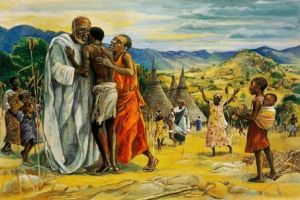
There is probably no Gospel passage more beloved than Luke’s parable of the Prodigal Son. Henri Nouwen and others have rightly emphasized the image of the story’s father as the God of infinite mercy and forgiveness, who runs to meet repentant sinners before they can even confess. Yet, taken in the narrative context of Luke’s broader story, there are other themes in this parable that are important to the journey of Lent. Jesus’ parable is yet another Lucan image of the solution to the problem of exile: the practice of jubilee, with its comprehensive forgiveness and freedom from all the relational breaches that are the “fruit” of attachment to money. Continue reading “All Are Welcome at God’s Party!”

Transfiguration

transfigurationBy Wes Howard-Brook and Sue Ferguson Johnson, Commentary on Readings for Feb 7, Transfiguration Sunday

Then from the cloud came a voice that said, “This is my Son, my Chosen; listen to him!”

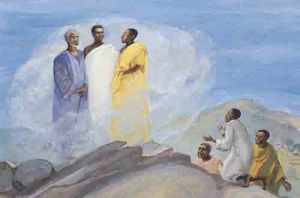
Our gospel this week finds Jesus and a few companions taking some time out on the earth for what Dorothy Day might have called “clarification of thought” or others have called “illumination.” Luke has just shown that the disciples don’t understand who Jesus is. In the wider narrative context, Luke has Jesus ever more clearly revealing that the divine power he embodies and offers to disciples is not that of the warrior “messiah,” but of the suffering Human One (9.20-26). But the disciples, like so many “Christians” through the ages, cling stubbornly to the hope that he would be the military leader who would remove the Romans by force (see Lk 24.21). Even worse, they seem utterly deaf to Jesus’ Good News of radically inclusive hospitality and leadership from below. Surrounding the Transfiguration scene are numerous situations where we see how out of tune they are with the song Jesus is singing. Consider this sequence of encounters: Continue reading “Transfiguration”