What a Difference a Decade Can Make

By Wes Howard-Brook, the author of several books, including Empire Baptized: How the Church Embraced What Jesus Rejected

A decade ago, I was teaching Bible and theology full-time at our local Jesuit school, Seattle University. Now I am retired.

A decade ago, my wife and ministry partner, Sue, were part of our local Mennonite congregation.
Now, we do not attend church.

A decade ago, I identified as a Christian.
Now, I have reclaimed my birth identity as a Jew who loves the Jewish Jesus.

A decade ago, Sue and I were in the midst of an eighteen year stretch of hosting and leading a Scripture group that met every Thursday for two hours in our living room.
Now, it is hosted elsewhere.

There are many reasons for these changes, some which we all share—the pandemic, for instance—and others that are personal to my own journey. But as a result of these choices, I now am experiencing life much differently than I was a decade ago.

Continue reading “What a Difference a Decade Can Make”


Anti-Semitism and Hypocrisy at the Top: a Jewish response

Re-posting this piece by Wes Howard-Brook from February 2019 because it is more relevant than ever. Gotta say that after five-and-a-half years, it has aged quite well.

Three, young, powerful, brash women of color have come down upon the Capitol and left the old while folks there sputtering in their wake. The most well-known—so much so that she already can be recognized by her initials, AOC—Rep. Alexandria Ocasio-Cortez (NY)—has blown the doors off Congress by daring to offer her “Green New Deal” vision. The other two are both Muslim women, Michigan Rep. Rashida Tlaib and Minnesota Rep. Ilhan Omar. Tlaib and Omar have strongly promoted the international “Boycott, Divestment, and Sanction” campaign to pressure the Israeli government to withdraw from West Bank settlements.

AOC has been allowed to thrive as a social media star, despite being treated with despicable condescension by the “senior” congresspeople and their supporters. After all, even the Democratic Party knows that climate change is real and needs immediate action.

But when it comes to criticizing Israel, Dems collectively freak out in an orgy of blatant hypocrisy that might, but probably wouldn’t, make Trump blush. Most immediate, Rep. Omar was quoted in a tweet stating that “Jewish money,” more specifically, the American Israel Public Affairs Committee, influences US policy on Israel. This claim led to instant and widespread condemnation from all sides, for promoting “anti-Jewish tropes.” Rep. Omar was forced to apologize publically.

Continue reading “Anti-Semitism and Hypocrisy at the Top: a Jewish response”

Wild Lectionary: No Peace in Heaven, No Peace on Earth

van-gogh-the-starry-night-1889
Vincent VanGogh’s Starry Night

By Wes Howard-Brook and Sue Ferguson Johnson, a re-post from April 2019

In the fifteenth year of the reign of Emperor Tiberius, when Pontius Pilate was governor of Judea, and Herod was ruler of Galilee, and his brother Philip ruler of the region of Ituraea and Trachonitis, and Lysanias ruler of Abilene, during the high priesthood of Annas and Caiaphas, the word of God came to John son of Zechariah in the wilderness. (Luke 3.1-2)

Do you think that I have come to bring peace to the earth? No, I tell you, but rather division! (Luke 12.51)

As he was now approaching the path down from the Mount of Olives, the whole multitude of the disciples began to praise God joyfully with a loud voice for all the deeds of power that they had seen, 38 saying,
“Blessed is the king

who comes in the name of the Lord!
Peace in heaven,
and glory in the highest heaven!
(Luke 19.37-38)

In imagining ways to hear Scripture from the lens of “wild lectionary,” we tend to jump to details of life on earth: water, trees, animals, mountains. This focus on earth is challenged by this week’s passage from Luke, as Jesus and his disciples enter Jerusalem for what we’ve come to call “Holy Week.” For Luke tells us that “the whole multitude of disciples” proclaimed as Jesus came down the Mount of Olives, not “peace on earth,” but “peace in heaven.” What can they be thinking? What is the relationship between heaven and earth when it comes to making peace? Continue reading “Wild Lectionary: No Peace in Heaven, No Peace on Earth”

Resurrection: The Hope That Vindicates God’s Justice

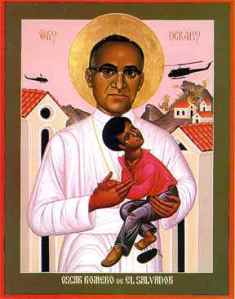
romeroBy Wes Howard-Brook & Sue Ferguson Johnson, a commentary on this weekend’s Gospel text, re-posted from November 2016
There is nothing more radical than resurrection.

From the time Daniel 12 apocalyptically announced that God raises the dead, the intellectual elite in Judea rejected it. Sophisticated skeptics have always scoffed at the notion that life extends beyond the bounds of death, because such a belief threatens to undermine the status quo from which they benefit. Consider, for example, this from Ecclesiastes, a text likely written before Daniel:

The living know that they will die, but the dead know nothing; they have no more reward, and even the memory of them is lost. Their love and their hate and their envy have already perished; never again will they have any share in all that happens under the sun. (Eccles 9.5-6)

Continue reading “Resurrection: The Hope That Vindicates God’s Justice”

The Way Costs Exactly Everything

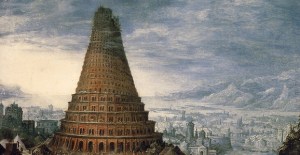
BabelBy Wes Howard-Brook & Sue Ferguson Johnson, a commentary on this weekend’s Gospel text, re-posted from September 1, 2016
It is no mystery who Luke’s audience is in this week’s Gospel (14.25-33): “For which of you, intending to build a tower (Gk, purgon)…” (14.28). Clearly, this is not a building plan envisioned by landless peasants, lepers and other poor and marginalized people. Luke is speaking here to the young elite of the Roman Empire, seeking to instill in them the cost of rejecting their imperial formation and choosing Jesus’ Way of discipleship. Continue reading “The Way Costs Exactly Everything”

The Radical Bible

By Wes Howard-Brook

“Keep these words that I am commanding you today in your heart. Recite them to your children and talk about them when you are at home and when you are away, when you lie down and when you rise.” (Deuteronomy 6.6-7)

What “words” do we keep in our hearts this day? What stories do we tell our children to give them hope and joy amid a world overflowing with violence and suffering?

Winter quarter was my final time teaching the Bible to college students at Seattle University after two decades. One might imagine that folks enrolled at a Jesuit Catholic university might start with some basic biblical literacy, or at least perhaps some curiosity about the stories that are supposed to be foundational for all Christian traditions. Yet I found almost the opposite to be true: most students were not Catholic or Christian in anything more than inherited label, and few had the slightest interest in engaging biblical narratives. I found my experience was common in many places.

Continue reading “The Radical Bible”

Abundant Joy

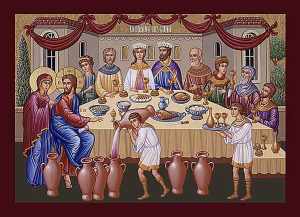
CanaBy Wes Howard-Brook and Sue Ferguson Johnson, commentary on John 2:1-11, re-posted from January 2016
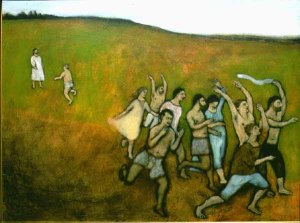
“On the third day there was a wedding in Cana of Galilee…”

The rich beauty of this week’s gospel sets the stage for the journey into God and discipleship which follows. In his first public act in John’s gospel, Jesus transforms a wedding which has run out of wine into an overflowing, abundant celebration of the best wine. Every detail of this packed scene is worth pondering deeply.
Continue reading “Abundant Joy”

Not a Disembodied Hope

Mt Erbal caves
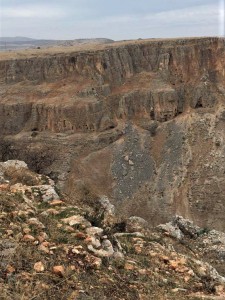
Mt Arbel Caves

By Wes Howard-Brook and Sue Ferguson Johnson, reposted from Advent 3 2017

Just north of Magdala in Galilee stand the cave-pocked cliffs of Mt. Arbel. Twice in a hundred years, Roman soldiers shot fire into the caves to destroy Israelites who refused to give in to imperial rule. The first occasion was the imposition of Herod as king in 40 BCE, while the second was during the Roman-Jewish war of the mid-60s CE.

Continue reading “Not a Disembodied Hope”

Wild Lectionary: The Desert Shall Rejoice and Blossom

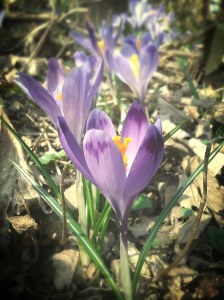
crocuses
Springtime by Alex Kladnik, Creative Commons

Seeking the True Joy of Advent

Advent 3

Isaiah 35:1-10
Matthew 11: 2-11

As they went away, Jesus began to speak to the crowds about John: “What did you go out into the wilderness to look at?”                                                                       Matt 11:7

The wilderness and the dry land shall be glad, the desert shall rejoice and blossom; like the crocus, it shall blossom abundantly, and rejoice with joy and singing.
Isa 35:1-2

by Wes Howard-Brook and Sue Ferguson Johnson

Amid the shadowed darkness of impending winter, our Advent lection from Isaiah envisions springtime joy. We might at first wonder, “What does Isaiah’s imagery have to do with the celebration of the birth of Jesus?” This questions leads to another query: What exactly are we hoping for with the coming of the one we call “messiah” and “lord”? Or as John the Baptist puts it in this week’s gospel, “Are you the one who is to come, or are we to wait for another?” (Matt 11:3) Continue reading “Wild Lectionary: The Desert Shall Rejoice and Blossom”

Have Mercy on Us!

lepersBy Wes Howard-Brook and Sue Ferguson Johnson

*NOTE: this piece was originally posted to Radical Discipleship in October 2016.

The final leg of the journey to Jerusalem begins with this week’s gospel (Lk 17.11-19). Alert readers, though, will note that Jesus and the disciples have not gotten very far. At the very beginning, Luke tells us that “they entered a village of the Samaritans to make ready for him” (9.52). Now, eight chapters later, Luke says, “On the way to Jerusalem Jesus was going through the midst (Gk, dia meson, misleadingly translated by NRSV as “between”) of Samaria and Galilee.” Like the Israelites in the wilderness, they seem to be going in circles in the land north of Judea. Perhaps this is a sly reference to the disciples, like their Israelite ancestors, lacking the faith that the journey they are on will lead to the place of God’s abundant provision. Indeed, as we heard last week, the disciples had just demanded of Jesus, “Increase our faith!” (17.5). Continue reading “Have Mercy on Us!”