Wild Lectionary: The Good Seed

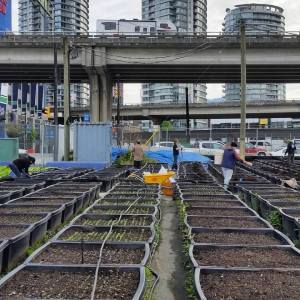
Sole Food pic
Photo credit: Kelsey Brick

Sixth Sunday after Pentecost
Proper 10 (15)
Ps. 65:9-13; Is. 55:10-13; Mt. 13:1-9, 18-23

By Jason Wood

Seeds, seeds, seeds.

Three of six of the appointed texts for today talk about them. The Psalmist refers to seeds implicitly, praising YHWH as the source of life-giving rains, fertile fields, and abundant harvests. Isaiah meditates upon seeds as the inevitable byproduct of the rain watering the earth, assuring his audience that, in the same way, God’s word is fruitful and effective. And Matthew relates one of Jesus’ most well-known parables, one of broad-scattered seed, thwarted growth, and stunningly rich production from the few that fall on good soil. Continue reading “Wild Lectionary: The Good Seed”
Wild Lectionary: Seeking at the Essence

Screen shot 2011-04-02 at 11.49.13 AM
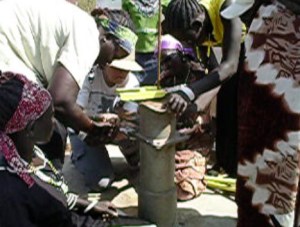
Women at the well in Akot, South Sudan

Fifth Sunday after Pentecost
Proper 9 (14)

Genesis 24:34-38, 42-49, 58-67

By Judith Doll

Water – the essence of life. It is absolutely necessary for all living things to survive and has been since the beginning of time.

Water – Where does it come from? From the rain, falling from the heavens; from the streams, the rivers, the lakes, the ocean, and the rivers under the earth accessible by wells. Continue reading “Wild Lectionary: Seeking at the Essence”

Wild Lectionary: Reintegrating God in Everything

imageBy Naim Edwards

(This post is a Bonus Wild Lectionary Reflection from the readings a month ago)

The God who made the world and everything in it, he who is Lord of heaven and earth, does not live in shrines made by human hands, nor is he served by human hands, as though he needed anything, since he himself gives to all mortals life and breath and all things. Acts 17:24-25

Clifton and Vanessa named me Naim Kenyatta. We are the descendants of Black West Africans (and an Irishmen or two) taken from their homelands and transplanted to these so-called United States of America. Our lineage has been traced back twelve generations geographically all the way to Maryland and Virginia. Besides that, we understand that forced separation from our indigenous language and region has essentially vanquished all direct ties to Africa. My family has been here since before the U.S. was even the U.S. We are more American than America, yet most Black people continue to be treated like second class citizens. Continue reading “Wild Lectionary: Reintegrating God in Everything”

Wild Lectionary: Our Mortal Bodies Are a Part of the Whole of Creation

IMG_6125Proper 8, Year A,
Fourth Sunday after Pentecost Lectionary 13

Romans 6:12-23

By Carmen Retzlaff

Many readers and hearers over the centuries have struggled with, or at least wondered about, Paul’s apparent condescension toward the physical body. It comes into question again in this passage from the letter to the Christian community in Rome. Continue reading “Wild Lectionary: Our Mortal Bodies Are a Part of the Whole of Creation”

Wild Lectionary: She Saw a Well of Water

2272958846_4bf80bc5dd_z(1)
Desert Well by David Winnie, Creative Commons, 2008

Proper 7, Season After Pentecost

Genesis 21:8-21

The biblical portrait(s) of Hagar include surrogacy, power, African identity, patriarchal family, enslavement, physical violence, pregnancy, migration, wilderness, water and the naming of God as one who sees. These are hard subjects and it would be easy to preach on another text. But when migrant bodies, mothers and children, are dying of thirst in the Arizona desert; when African refugees drown by the thousands in the Mediterranean; when corporations like Nestle, Kinder Morgan, and Dakota Access trample Indigenous women’s teaching that Water is Life; when the story of Isaac and Ishmael is used to normalize the Israeli occupation of Palestine; when overt acts of hatred against Muslims are escalating; and when white women’s complicity in criminalizing black bodies and exonerating murderous police is all but invisible, we cannot side-step this heritage that so profoundly speaks to our present. Continue reading “Wild Lectionary: She Saw a Well of Water”

Wild Lectionary: Beware the Cataclysm!

19024614_10154383615946567_367044656_o
Photo by Helen H. Richardson, The Denver Post

By Wes Howard-Brook and Sue Ferguson Johnson, Abide in Me

For readers of Wild Lectionary, there is hardly a Scripture passage more fitting than Genesis’ account of the Flood. The powerful, terrifying narrative is often reduced to a kids’ story, replete as it is with “cute” animals in the Ark. But, of course, beneath the surface is a story of divine near-omnicide, revealing a deep rift between the Creator’s vision and humanity’s response to God’s gift of the earth. In combination with the conclusion of the Sermon on the Mount (Matt 7.21-28), this week’s texts offer a sobering reminder of the cost of human violence to the earth and its creatures, including sapiens. Continue reading “Wild Lectionary: Beware the Cataclysm!”

Wild Lectionary: The Harmony Way

13495384_288455458167725_183598715059083997_o
Randy and students at Eloheh Farm. Credit: Patricia McSherry

Trinity Sunday
Genesis 1:1-2:4a

By Randy Woodley

As a follower of Jesus from a Keetoowah Indian heritage, my “canon” consists of Scripture, creation, and the “Native American Old Testament” (God’s revelation to Native People through generations of culture and tradition.) Continue reading “Wild Lectionary: The Harmony Way”

Wild Lectionary: The Predator Within

2249220298_de45840ab4_o(1)Easter 7

Discipline yourselves, keep alert. Like a roaring lion your adversary the devil prowls around, looking for someone to devour.  –1 Peter 5:8

by Ric Hudgens

We must not domesticate our understanding of the wild. I am not referring to domesticating wild places into civilized spaces. I am noting our tendency to romanticize the wild in a way that removes its sharp edges.  In the rewilding of our theologies we must deconstruct docetic expressions that remove the divine and human from nature. Also, we must keep the divine and human embedded in real nature – not a romanticized Disneyland nature where animals sing and dance or time lapse photography makes change appear sudden.

The natural world which is filled with the divine and the contains the human is also “nature red in tooth and claw,” as Hobbes wrote. There are predators. There are prey. Continue reading “Wild Lectionary: The Predator Within”

Wild Lectionary: Good Shepherd

Catacomb-Art-Shepherd
Earlychurch.com

Good Shepherd Sunday
Acts 2:42-47 • Psalm 23 • 1 Peter 2:19-25 • John 10:1-10
By Noel Moules

A shepherd is a wilderness figure. Distinctive, as they move across the horizon line, while at the same time blending and flowing with and within their surrounding landscape. Always an outsider in terms of mainstream society, yet across the story of human cultures their mystique has left an imprint out of all proportion to their actual power and influence.

Biblically, the concept of the ‘shepherd’ presents a multitude of possible perspectives we might explore, even within the confines of our chosen lectionary passages. However, as a Christian animist I want to focus on a theme of central importance to me, that of ‘relationship’. Continue reading “Wild Lectionary: Good Shepherd”

Wild Lectionary: Homeless, Unrecognized on the Road

11102961_10155455528045714_1366849916479858489_n-1
Emmaus by Melanie Delva

Third Sunday of Easter
Luke 24:13-35

By Ched Myers

The gospel story begins with Jesus’ family fleeing violence as political refugees, pushed around Palestine by the imperial forces of Caesar and Herod (Matt 1–2; Luke 1–2). Continue reading “Wild Lectionary: Homeless, Unrecognized on the Road”