A Way of Perception

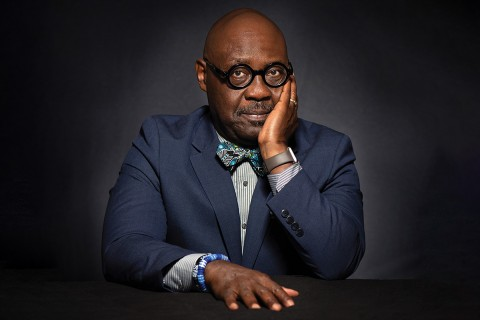
From Dr. Willie Jennings, professor of theology at Yale. This is from an interview he did with The Christian Century in 2021. He was asked what race has to do with theology (photo above from Mara Lavitt for Yale Divinity School).

The modern vision of race would not be possible without Christianity. This is a complicated statement, but I want people to think about this.

Inside the modern racial consciousness there is a Christian architecture, and also there is a racial architecture inside of modern Christian existence. There are three things we have to put on the table in order to understand how deeply race is tied to Chris­tianity. The first brings us back to the very heart of Christianity, the very heart of the story that makes Christian life intelligible.

That story is simply this: through a particular people called Israel, God brought the redemption of the world. That people’s story becomes the means through which we understand who God is and what God has done. Christianity is inside Israel’s story. At a certain point in time, the people who began to believe that story were more than just the people of Israel, more than just Jews. And at some point in time, those new believers, the gentiles, got tired of being told that they were strangers brought into someone else’s story—that this was not their story. They began—very early and very clearly—to push Israel out from its own story. They narrated their Christian existence as if Israel were not crucial to it.

Continue reading “A Way of Perception”

Supporting Actors

By Tommy Airey, above with his nephews in Southern California

The day after an 18-year-old white boy livestreamed his mass murder spree in the only supermarket of a Black neighborhood in Buffalo, I was hosting another men’s group on zoom. We were sharing early memories of when our tears and tenderness were not honored by adults in our lives. One participant said something that stoked vigorous nodding from the rest of us. “It really wasn’t what I was told,” he said, “It was what I wasn’t told.” We were forced to fill in the gaps of all those silences. We came up with our own scripts saying we were not good enough and would never really be loved unless we met a certain standard of “success.”

The silence is a slow trauma that seeds deep feelings of self-doubt and worthlessness. It tills the soil of the gun culture, the rape culture, the corporate culture, the cancel culture. The silence sustains the default dominant culture, what Dr. Willie Jennings calls “the pedagogy of the plantation.” Unless we are intentionally taught otherwise, we are trained up to possess, master and control everything we come across. In America, men are the main characters, the owners of the plantation. It’s not just the passionate men with their man caves and their big trucks and their unregulated firearms—but also the passive men who pride themselves on staying safe, stoic, nice and neutral, above the fray, hiding their feelings as they over-function to “provide for their families.”

Continue reading “Supporting Actors”

Summer Reading Subverting Supremacy Stories

By Tommy Airey, exclusively for RadicalDiscipleship.Net

This summer, Lindsay and I maneuvered a ministry of migration. We pivoted between and beyond the Kirkridge Retreat Center in the Poconos of northeast Pennsylvania, a studio apartment two blocks from the Deschutes River in Central Oregon and a wide stretch of beach on the Pacific Ocean on Acjachemen land in Southern California. I spent some of this time working on a book that lays out a biblical spirituality for white folks and middle-class people breaking rank from the default narratives of dominant culture. Those of us navigating the wilderness that borders both fundamentalism and liberalism need a spiritual training program for the ultra-marathon race of recognizing and resisting the supremacy stories scripted by whiteness, hetero-patriarchy, the profit motive, the penal system and patriotism.

My friend Sarah Nahar says this kind of inner work is like shedding colonial codes of conduct. Rev. Lynice Pinkard compares it to learning another language: speaking treason fluently. I like breaking rank because it sounds so subversive—what spirituality should be. Break rank with supremacy stories and you’ll gain your soul—and lose your social respectability. Try calling out capitalism at your church potluck. It sounds like a conspiracy, which in Latin means “to breathe with.” To grow our souls, us middle-class folk need mouth-to-mouth resuscitation. Because our hearts have stopped. But here’s the rub: we can only get CPR from those chronically oppressed by supremacy stories. So we start breathing with those who are Black and Brown, Indigenous and Immigrant, women and working poor.  

Continue reading “Summer Reading Subverting Supremacy Stories”