Easter, Year B
Acts 10:34-43
Isaiah 25:6-9
Psalm 118:1-2, 14-24
John 20:1-18
Mark 16:1-8
By Jessica Miller
Across the northeast of North America at this season, a wonder is happening. The flowers of Symplocarpus foetidus have begun emerging and blooming from swamps and wet places. These true Easter-lilies—members of the same family of the Calla ‘lily’—are more commonly known as skunk-cabbage. Varieties of the plant also grow in Japan, where the red robe-like blossoms resembling a monk’s hood have gained it the name Zazen-sou, or Zen meditation plant.
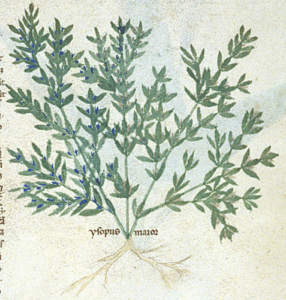
The psalmist says “purge me with hyssop” –clean me with a scrubby aromatic plant.
Mediterranean Hyssop— Hyssopus officinalis is a pungent-leafed bush with blue flowers that is used medicinally, mostly in teas as an expectorant, antiseptic and for cough relief. But the qualities that the bible ascribes to Hyssop: it grows in walls, can hold moisture, has a long, stiff stalk, has a purgative effect, appear in no one plant. Other suggested candidates for biblical Hyssop include caper, Syrian oregano, and za’atar a word which Palestinians use for a family of aromatic herbs (and the ubiquitous condiment made from their dried leaves). Continue reading “Wild Lectionary: Purge Me with Hyssop”→
A little over a year ago as I entered the season of lent, I was feeling close to Jesus in a way I never had before. I was attending Catechism classes at my parish while preparing for my impending baptism- a time in my life that would mark a significant transition. At least that was the transition that I was preparing for publicly. Privately I was preparing for a different kind of transition. I knew that shortly I would be showing my whole self to people for the first time ever. This was the season I spent preparing to be honest with others (and honest with myself) about my gender identity as a trans person. Continue reading “Wild Lectionary: Meeting Myself in the Mountains”→
By Lydia Wylie-Kellermann
Preached at Day House Detroit Catholic Worker, February 18, 2018
Genesis 9:8-15
1Peter 3:18-22
Mark 1:12-15
Who am I?
I am fierce and gentle.
I am life and death.
I am ancient and new.
I am solid and fluid and gas.
I am in you and around you.
I am above you and below you.
I am the snow and the rain,
The creek, the stream,
the river, and the sea. Continue reading “A Sermon, A Poem, A Prayer? To Speak as Water”→
Water flows through our ancient Judeo-Christian texts. Righteousness pours down like a mighty stream (Amos 5:24), and Jesus offers relief to those who thirst (John 4:13–15). Before whales or eagles or humans did, God dwelt among the waters (Gen 1). The creation of heaven and earth commenced through a parting of the seas. Rains fell, destroying all creatures except those aboard an ark, awaiting a rainbow covenant that promised an end to the waters of judgment (Gen 9:11–17). The Israelites flee from their oppressors to freedom through the miracle of a parting sea that offered safe passage from empire into the wilderness (Exod 14). In the Gospels, Jesus was baptized into the wildness of the river Jordan (Mark 1:9f), became living water at the well (John 4), and shed tears over Jerusalem (Luke 19:41). From the beginning, water has offered a call to discipleship. Continue reading “Wild Lectionary: God’s Gonna Trouble the Waters”→
“Six days later, Jesus took with him Peter and James and John, and led them up a high mountain apart, by themselves.” (Mk 9.2)
It has been a long, wet, grey, dark winter so far here in the Issaquah Creek watershed. While we have been spared the intense cold and massive snowfalls visited upon our sisters and brothers to the east, the relentless “parade of storms” from the Pacific Ocean (as local weatherfolk like to call it) can wear away at even the most committed pluviophile. Continue reading “Wild Lectionary: Transfiguration”→
Sometimes I am asked why the Bible, especially the Hebrew Bible, says that we should “fear” God, who is love. Psalm 111:10 The fear of the Lord is the beginning of wisdom; all those who practice it have a good understanding.
“Have you not known, have you not heard?” says God in Isaiah this week. It is God who sits above the circle of the earth. We, the inhabitants of this planet, are like grasshoppers. God stretches a curtain of heaven for us, as a tent. God is reassuring here: this defeat, this moment in history, this war is not the big story. The story is so much bigger. God brings princes to naught and makes rulers of the earth like dead plants blown in the wind. Continue reading “Wild Lectionary: Awe”→
As Jesus passed along the Sea of Galilee, he saw Simon and his brother Andrew casting a net into the sea–for they were fishermen. And Jesus said to them, “Follow me and I will make you fish for people.” And immediately they left their nets and followed him. Mark 1:16-17
As this week’s lectionary readings tell about the fishing families of Galilee, Wild Lectionary talked to ‘Nagmis fisherman Arthur Black. The ‘Namgis First Nation take their name from a halibut-like sea creature who saved a lone human during a flood when water covered the whole world. We asked Arthur to talk to people of faith about fishing on the West Coast of British Columbia and the threats to wild salmon which have been a staple food and source of wealth and culture for indigenous people in this region for millennia.
Wild Lectionary: Can you talk about fishing in your family?
Arthur Black: I am a fourth generation commercial native fisherman, my kids and grandchildren fish commercially with me on our vessel. Growing up I fished on my grandfather’s boat; when I started skippering boats my great-grandfather Harry Brown came out of retirement and fished with us till his passing in1987. Continue reading “Wild Lectionary: For They Were Fishermen”→
My late father, on our traditional Nisga’a fishing territory. Photo credit Tanya Stanley, summer 2011.
Epiphany 3B
Mark 1: 16-18
By: Jeffery Stanley
May the words of my mouth, and the meditation of my heart, be acceptable unto you, Oh God our rock and Redeemer.
“As Jesus passed along the sea of Galilee, he saw Simon and his brother Andrew casting a net into the lake – for they were fishermen. And Jesus said to them ‘follow me and I will make you fish for people.’ And immediately, they left their nets and followed him.”
In the days of Jesus of Nazareth it was the custom for teachers to gather their students from the people of any community and lead them as a company from place to place as they taught. He (a teacher) would from time to time, talk to people and share truths with them. Certain students would be attracted to him and would come to listen to him from time to time. Sometimes they would linger at some favorable spot for awhile and persons would join them to listen and often respond to the message. Gutzke, Manford George. “Plain talk on Mark” pp. 18 Continue reading “Wild Lectionary: Fishing On Our Ancestral Territory”→

 Easter, Year B
 Palm Sunday, Year B
 Lent 5B
 Lent 1B


 Radical Discipleship