
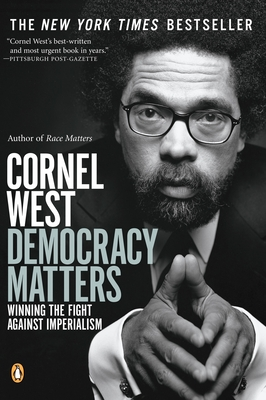
An excerpt from Cornel West’s Democracy Matters (2013).
The problems plaguing our democracy are not only ones of disaffection and disillusionment. The greatest threats come in the form of the rise of three dominating, antidemocratic dogmas. These three dogmas, promoted by the most powerful forces in our world, are rendering American democracy vacuous. The first dogma of free-market fundamentalism posits the unregulated and unfettered market as idol and fetish. This glorification of the market has led to a callous corporate-dominated political economy in which business leaders (their wealth and power) are to be worshipped—even despite the recent scandals—and the most powerful corporations are delegated magical powers of salvation rather than relegated to democratic scrutiny concerning both the ethics of their business practices and their treatment of workers. This largely unexamined and unquestioned dogma that supports the policies of both Democrats and Republicans in the United States—and those of most political parties in other parts of the world—is a major threat to the quality of democratic life and the well-being of most peoples across the globe. It yields an obscene level of wealth inequality, along with its corollary of intensified class hostility and hatred. It also redefines the terms of what we should be striving for in life, glamorizing materialistic gain, narcissistic pleasure, and the pursuit of narrow individualistic preoccupations—especially for young people here and abroad.
Free-market fundamentalism—just as dangerous as the religious fundamentalisms of our day—trivializes the concern for public interest. The overwhelming power and influence of plutocrats and oligarchs in the economy put fear and insecurity in the hearts of anxiety-ridden workers and render money-driven, poll-obsessed elected officials deferential to corporate goals of profit, often at the cost of the common good. This illicit marriage of corporate and political elites—so blatant and flagrant in our time—not only undermines the trust of informed citizens in those who rule over them. It also promotes the pervasive sleepwalking of the populace, who see that the false prophets are handsomely rewarded with money, status, and access to more power. This profit-driven vision is sucking the democratic life out of American society.
In short, the dangerous dogma of free-market fundamentalism turns our attention away from schools to prisons, from workers’ conditions to profit margins, from health clinics to high-tech facial surgeries, from civic associations to pornographic Internet sites, and from children’s care to strip clubs. The fundamentalism of the market puts a premium on the activities of buying and selling, consuming and taking, promoting and advertising, and devalues community, compassionate charity, and improvement of the general quality of life. How ironic that in America we’ve moved so quickly from Martin Luther King Jr.’s “Let Freedom Ring!” to “Bling! Bling!”—as if freedom were reducible to simply having material toys, as dictated by free-market fundamentalism.
The second prevailing dogma of our time is aggressive militarism, of which the new policy of preemptive strike against potential enemies is but an extension. This new doctrine of U.S. foreign policy goes far beyond our former doctrine of preventive war. It green-lights political elites to sacrifice U.S. soldiers—who are disproportionately working class and youth of color—in adventurous crusades. This dogma posits military might as salvific in a world in which he who has the most and biggest weapons is the most moral and masculine, hence worthy of policing others. In practice, this dogma takes the form of unilateral intervention, colonial invasion, and armed occupation abroad. It has fueled a foreign policy that shuns multilateral cooperation of nations and undermines international structures of deliberation. Fashioned out of the cowboy mythology of the American frontier fantasy, the dogma of aggressive militarism is a lone-ranger strategy that employs “spare-no-enemies” tactics. It guarantees a perennial resorting to the immoral and base manner of settling conflict, namely, the perpetration of the very sick and cowardly terrorism it claims to contain and eliminate. On the domestic front, this dogma expands police power, augments the prison-industrial complex, and legitimates unchecked male power (and violence) at home and in the workplace. It views crime as a monstrous enemy to crush (targeting poor people) rather than as an ugly behavior to change (by addressing the conditions that often encourage such behavior).
As with the bully on the block, one’s own interests and aims define what is moral and one’s own anxieties and insecurities dictate what is masculine. Yet the use of naked force to resolve conflict often backfires. The arrogant hubris that usually accompanies this use of force tends to lead toward instability—and even destruction—in the regions where we have sought to impose our will. Violence is readily deployed by those who cloak themselves in innocence—those unwilling to examine themselves and uninterested in counting the number of innocent victims they kill. Note the Bush administration’s callous disregard for both the U.S. soldiers and innocent Iraqis killed in our recent adventurous invasion. The barbaric abuse of prisoners at Abu Ghraib is a flagrant example.
The third prevailing dogma in this historic moment is escalating authoritarianism. This dogma is rooted in our understandable paranoia toward potential terrorists, our traditional fear of too many liberties, and our deep distrust of one another. The Patriot Act is but the peak of an iceberg that has widened the scope of the repression of our hard-earned rights and hard-fought liberties. The Supreme Court has helped lead the way with its support of the Patriot Act. There are, however, determined democrats on the Court who are deeply concerned, as expressed in a recent speech of Justice Ruth Bader Ginsburg: “On important issues,” she said, “like the balance between liberty and security, if the public doesn’t care, then the security side is going to overweigh the other.” The cowardly terrorist attacks of 9/11 have been cannon fodder for the tightening of surveillance. The loosening of legal protection and slow closing of meaningful access to the oversight of governmental activities—measures deemed necessary in the myopic view of many—are justified by the notion that safety trumps liberty and security dictates the perimeters of freedom.
Meanwhile the market-driven media—fueled by our vast ideological polarization and abetted by profit-hungry monopolies—have severely narrowed our political “dialogue.” The major problem is not the vociferous shouting from one camp to the other; rather it is that many have given up even being heard. We are losing the very value of dialogue—especially respectful communication—in the name of the sheer force of naked power. This is the classic triumph of authoritarianism over the kind of questioning, compassion, and hope requisite for any democratic experiment.
We have witnessed similar developments in our schools and universities—increasing monitoring of viewpoints, disrespecting of those with whom one disagrees, and foreclosing of the common ground upon which we can listen and learn. The major culprit here is not “political correctness,” a term coined by those who tend to trivialize the scars of others and minimize the suffering of victims while highlighting their own wounds. Rather the challenge is mustering the courage to scrutinize all forms of dogmatic policing of dialogue and to shatter all authoritarian strategies of silencing voices. We must respect the scars and wounds of each one of us—even if we are sometimes wrong (or right!).
 Radical Discipleship