
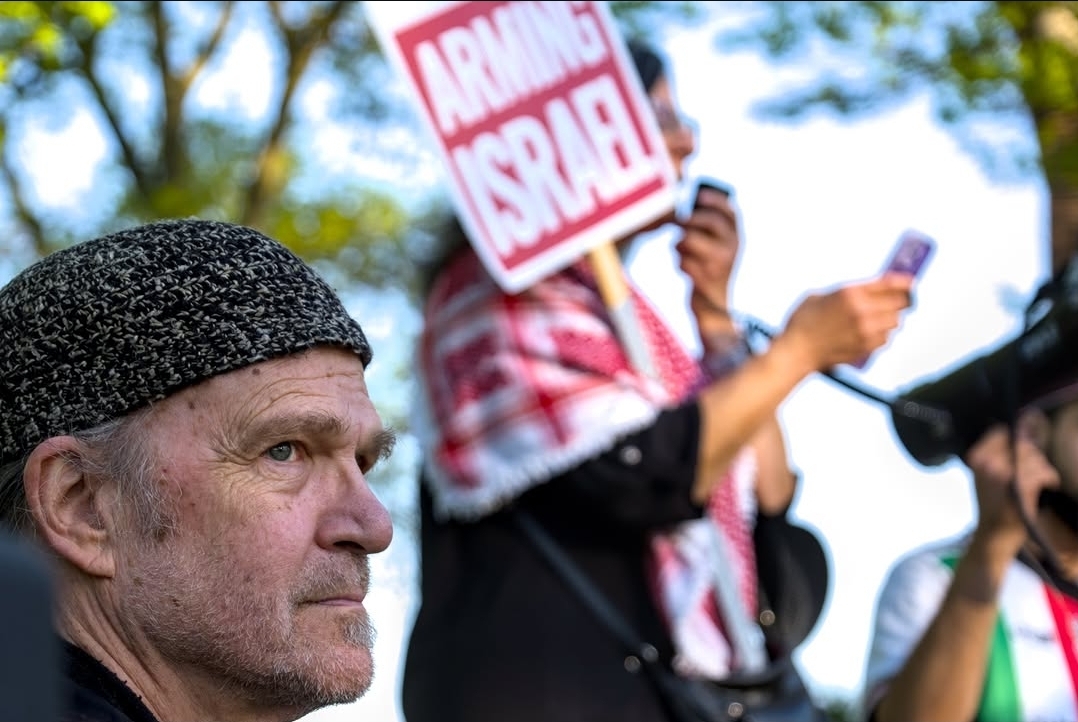
By Dr. Jim Perkinson, a sermon for St. Peter’s Episcopal Church in Detroit (03.22.2026) – pictured above at the annual Nakba Day march in Dearborn, MI (photo credit)
37 The hand of the Lord was upon me, and he brought me out by the Spirit of the Lord, and set me down in the midst of the valley; it was full of bones. 2 And he led me round among them; and behold, there were very many upon the valley; and lo, they were very dry. 3 And he said to me, “Son of man, can these bones live?” And I answered, “O Lord God, thou knowest. . . . 11 Then he said to me, “Son of man, these bones are the whole house of Israel. Behold, they say, ‘Our bones are dried up, and our hope is lost; we are clean cut off.’ 12 Therefore prophesy, and say to them, Thus says the Lord God: Behold, I will open your graves, and raise you from your graves, O my people; and I will bring you home into the land of Israel (Ezek 37:1-3, 11-12).
I’m going to start weird and way out—something new for me, right? But walk with me for a moment. We need some background.
First, I want to suggest that this story of Ezekiel prophesying to bones is ultimately about bones in the right place of burial. And its opposite is bones out of place. If we read just two chapters further on in Ezekiel, we encounter another strange little vignette about bones in or out of place that reads thus:
They will set apart men to pass through the land continually and bury those remaining upon the face of the land, so as to cleanse it; at the end of seven months they will make their search. And when these pass through the land and anyone sees a man’s bone, then he shall set up a sign by it, till the buriers have buried it in the Valley of Manon-gog (“Multitude of Gog”) (Ezek 39:14-15).
And what is in view here are the bones of invaders that are not just allowed to lie around wherever they fell but collected and “placed” in a particular domain previously called “The Valley of Travelers,” now renamed “Valley of the Multitude.” In fact, chapters 37, 38, and 39 of Ezekiel are actually one whole piece of interaction between Ezekiel and YHWH concerning a vision of the Great End Times Battle of Gog and Magog, much later taken up in the Book of Revelation as “Armageddon,” the Final Apocalyptic Catastrophe that supposedly ruptures history as we know it (and which right now is being used by U.S. military commanders to motivate their troops to fight Iran as a prelude to provoking the Second Coming of Jesus). The Valley of Dry Bones episode is actually the Preface to this War scenario. We’ll come back to that in a bit. But for now, Ezekiel is wrestling with an implicit question: where do bones belong?
And we can also remember that this has been an issue from day one for Israel. Moses, in the process of leading the enslaved Hebrews out of Egypt is very careful to take along the bones of ancestor Joseph, who had exacted a deathbed promise from his offspring that such would be done, should they ever leave Egyptian terrain (Exod 13:19; Gen 50: 22-26).
Secondly, I want to tell you a little bit about the teaching my wife and I have been receiving from indigenous teacher, Martín Prechtel, for more than 20 years now. But in order to do that, I first have to tell why it has been so crucial to us to seek out indigenous experience and witness.
I grew up Presbyterian, by 15 regularly skipping church with my brother, until at 19 when Jesus became personally real for me in an evangelical “born again” experience. Within 6 months, I had become hard core charismatic, speaking in tongues and passing out tracts. And I have never since then walked away from that spiritual experience; I speak in tongues to this day—they are just called poems! No, just kidding, my poems are just a way of giving my body over to jazz and hip-hop flavors that I have learned from the Black community. My actual tongues-speaking is way more unintelligible. I have never walked away from that experience but long ago began criticizing the “monopolistic formula” in which Christianity has framed it. And that refusal of Christian monopoly and Christian supremacy continues to today.
Now some 55 years later, re-schooled continuously by Black culture in eastside inner city Detroit—by far my most profound and on-going education—re-schooled continuously again by my wife on Filipino-US colonial relations, wherein our country killed 1/6th of the population of her country in the process of taking it over from Spain at the end of the 19th century, and then, as mentioned, for more than 20 years now with Lily, plunging into indigenous experience and witness. Why the turn to indigenous culture?
Not as a claim about myself, but as an orientation for guidance. Listening to the people who have the only track record of sustainability in our history on the planet. Which is to say, our species before we invented civilization and hierarchy and surplus production, debt foreclosure and distance trading for a profit, rapid technological innovation and just as rapid obsolescence and discarding as garbage at a pace of extraction and pollution that the biosphere cannot handle, and all the smoke and mirrors to try to hide what is really going on: a few people living high-on-the-hog on the backs of everyone and everything else for more than 5,000 years now and forcing the rest of the planet to cooperate or perish. And now forcing the planet over the cliff’s edge of utter chaos and collapse—as we see on virtually every side. The horse we are riding on is going off the cliff.
And that “indigenous turn” does not just enlist indigenous peoples in the litany of folks subjected to oppression and injustice alongside everybody else marginalized, as one more group I need to care about. No. Rather, it involves also actually bothering to listen to what they say about how to live. They don’t foreground human rights, and human revolution, and human liberation.
Those are worthy concerns for them, but profoundly secondary. Most indigenous groups I know point, first of all, to the land and the more-than-human world of creatures that they consider to be their origins and ancestors and elders and future.
Just like Wendsler Nosie, San Carlos Apache chief in Arizona, head of the resistance group, Apache Stronghold, who, with his daughters, has been camped out for more than three years now in two caves on the sacred mountain plateau of Oak Flat, Chíchʼil Bił Dagoteel, which along with Ga’an Canyon (or “Angels Canyon”), is the “Holy Land” of his people, sacred terrain of angel forces and earth spirits birthing them in ancient times from underground protection against flood waters and then nurturing them above ground and receiving them back in the venerable cycle of natural life over millennia (Morin, 2024).
I met Wendsler last fall and six days ago learned from a friend that after a long legal battle, Oak Flat was just handed over by Trump and company to the joint mining venture known as Resolution Copper (subsidiary of Rio Tinto and BHP corporations), to begin a “green energy” project that will cover some 7,000 acres and drill more than a mile down into the ground, using more than 250 billion gallons of water over 40 years in drought-stricken terrain and storing toxic tailings in ponds stretching for miles. For Nosie—as for many, many other indigenous peoples—the first concern for attention today, is the real Mother of us all, the Land and Her creatures, not in general, but in particular, right where they live. He has been putting his body in the way of bulldozers—and the bullets fired at him!—for more than three years now.
Thirdly, our encounter with Anishinaabe/Cree teacher, Prechtel. In 2011, when Lily and I first attended Prechtel’s “school” in Northern New Mexico for one of the twice-per-year, 10-day sessions we committed to for the next decade, we were told to bring with us from our neck of the woods, a fist-sized rock, a few mollusk shells (salt or fresh water), and a piece of flint. Every day for the next ten, we listened to scintillating off-the-cuff lectures for 4 hours or so, ate lunch, and then for the hands-on portion of the training, learned to make beads from our shells, first breaking the shell, then grinding a piece into a round shape on the rock we brought, then by hand, drilling a hole in that roundedness with a little hand-held piece of flint until we had made a “bead’—like this (holding up a bead)! Such a bead might take anywhere between 2-7 hours to make, with our hands getting sore and blistered in the process.
And then we were told—we owed a bead back to the ground from which we had taken the rock in the first place, then a second bead into the waters from which the shell had come, and the third bead to the home of the flint.
Native folk in many parts of the country, now give tobacco for the “things”—the creatures—they take from the land in order to survive—the plants they eat, the animals they kill for meat or skins, the wood to craft, the fire they kindle to warm by, etc. From an indigenous point of view, nature is not there for the purpose of human extraction but for human reciprocity. We rip holes in the fabric of the created beauty all around us just to live—inevitably so, composing our bodies out of other creatures, eating them, drinking them, wearing them for insulation, piling them up for shelter, etc. We owe.
What we owe, is beauty, made uniquely by us, at cost, and then given back with no benefit to us, for all the beauty we regularly take. Or in Prechtel’s words we are bound by any sense of honor and sacrality to feed the wild nature that feeds us.
Tobacco is now a Native favorite. But much older and much more ubiquitous is the tradition of giving beads—going back as far as 140,000 years in Morocco, 120,000 years in Blombos Cave in S. Africa, nearly as long in Maastricht, Netherlands, and indeed, for thousands of years, right here in the Great Lakes region. This is the heart of indigenous notions of economy—not securing comfort or even viability for myself, but giving back, and learning to see why that is absolutely central.
And so, as we ground and drilled these little shells to become our “return offering” for the magnificence that was constantly feeding us, Prechtel would teach, among other things pointing out that indigenous cultures had not built space shuttles and malls and cargo ships, etc. not because they didn’t have the intelligence, but because they understand they must ritually “give back” to nature for everything they take from nature.
In a 2001 interview Prechtel talks about the “cost” to the planet of making a single knife blade and how the Guatemalan Mayan community he married into in the 1970s would handle the forging and smithing involved in creating such a tool (Prechtel, 2001). They would give back to the “wild,” for each of the extracted materials, a number of these handmade beads, each taking hours to craft, offered ritually—some for the ore originally mined, others for the fire kindled to smelt, yet others for the wood needed for the fire, etc. And thus to build a mall or space shuttle would take millions of beads and hundreds of years.
And that is the deepest thing I have to say this morning. Something utterly foreign to our entire sense of existence. We do not get out of bed each morning, immediately thinking “how can I give back to nature what I have just taken or will take today?” No, we get out from under the covers just to take.
And start doing so just by breathing and peeing into a commode, much less by opening our phone or plugging in our computer.
But what is a bead? It is the bone of a mollusk. Interesting creatures—their bones are on the outsides of their bodies; their skin is their skeleton! So. This tradition of giving beauty back for beauty taken, carried out in the form of beads, is indeed about bones in the right place.
And we are actually surrounded by bones on every hand. The bones of trees that make up this table and stand. The bones of the core of the planet that we now call iron and process into steel. The bones of the crust of the earth that have been pulled out of their “flesh” and re-tooled as church arches and walls. It is bones on every side! We just call them tools and buildings and roads and technology.
And their lies the real rub of this sermon, its real conundrum. We are like the octopus in the oceans who grabs up all kinds of empty mollusk shells lying around on the seafloor as a protective skin against shark attacks. It is amazing to see a picture of it if you never have—look it up! An octopus almost unrecognizable, entirely covered in hard shells.
But that is us. Living inside plant fibers and animal skins and rubber-tree sap, and that itself inside another layer of rock bones called buildings that we come-and-go from on sand bones called concrete, inside a great big assemblage of bones called a city—all of it to protect us from all the living wild creatures—animals as big as bears and microbes as small as bacteria, elements as hot as the sun and cold as ice and forceful as floods and fierce as storms and ferocious as winds, blowing every which way. Do we see that? We live covered in bones. Dead skeletons. We just call them by other names. And unlike octopi, keep taking more and more.
Now a fourth point and then back to Ezekiel.
What are bones about? For many indigenous people, bones are the baseline for relation with the land. Listen for a moment to two original Turtle Islanders as offered by Lakota/Dakota lawyer/theologian Vine Deloria, Jr. In his book, For This Land, Deloria quotes a Crow chief who when
told that the [U.S.] government owned his land, said that they could not own it because the first several feet down consisted of the bones of his ancestors and the dust of the previous generations of Crow people (Deloria, 253).
And then a few paragraphs later, Deloria continues,
Luther Standing Bear once remarked that a people had to be born, reborn, and reborn again on a piece of land before beginning to come to grips with its rhythms. Thus, in addition to the general contribution of long occupation, comes the coincident requirement that people must have freely given of themselves to the land at specific places in order to understand it (Deloria, 253, emphasis JP).
Another Turtle Island voice—White Earth Anishinaabe organizer, writer, visionary Winona LaDuke—once framed the concerns thus. In an interview on a podcast with some radical left activists, one of the other interviewees offered that we needed to get radical in dismantling capitalism and return to a notion of the “commons,” insisting the true disposition of our species should be to recognize that “we own everything in common, that land belongs to all of us as a shared good.”
LaDuke instantly disagreed, saying, “No, among our Native peoples the question is not whether the land belongs to us in common, but whether we belong to the land.” It is ultimately the land that is the “owner” of everything walking on it, and the question is whether we live in such a way that that particular land, that unique topography and ecozone of life, is willing to “own” us, to claim us as belonging to Her (pronoun intended), the particular Mother who has birthed, nurtured, and re-interred our particular community over an extended length of time.
Turning from all this, back to the bible, we need to note a number of things.
Just in passing, an interesting bit of Hebrew expression in the Cain and Abel story. First, once ancient farmer Cain kills ancient herder Abel, Genesis depicts the ancient Deity YHWH saying:
What have you done? The voice of your brother’s blood is crying to me from the ground. 11 And now you are cursed from the ground, which has opened its mouth to receive your brother’s blood from your hand (Gen 4:10-11).
From the Hebrew point of view, land has lips—a mouth that can both eat and speak.
And then secondly, once cursed by the land, Cain laments his situation by saying, literally, in the Hebrew, even though English translations erase it:
My punishment is greater than I can bear. 14 Behold, thou hast driven me this day away from the face of the ground; and from thy face I shall be hidden; and I shall be a fugitive and a wanderer on the earth, and whoever finds me will slay me (Gen 4: 13-14).
In ancient Hebrew accounting, the ground has a face and that face is roughly equated with the face of God. And Cain, fleeing from continued relationship with the land to become the first city builder, embarks on a life hidden from that dual countenance. And I would suggest, in much of the biblical witness, that is exactly what a city is—an armature against the Face of both God and ground.
Now finally, Ezekiel. Holding chapters 37, 38, and 39 together, the great calamity of the Gog and Magog War.
If we read those three chapters out loud here, and you paid attention, you would discover all of the agency in this conflict is that of YHWH striking weapons from hands of invaders, provoking a massive earthquake, bringing pestilence and chaos, flooding the armies with torrential rain and hailstones, fire and brimstone, and then, just before the season of bone-gathering we already mentioned, Ezekiel is told to speak to the birds and to the beasts to come and feast.
The image in this cataclysm is of a village-centered, shepherd-led,[1] land-accommodated people much like early Israel before it betrayed its vocation and insisted, against all wise counsel, on satisfying its craving for power and bling by anointing a king for itself and becoming just like the peoples around it. That choice, utterly castigated verbally and censured if not cursed ritually by Samuel (I Sam 8-12), resulted in a monarchical history full of slaughter, betrayal, manipulation, exploitation, extraction, and destruction just like any other kingship we know.
Saul as disaster; David as murderer-adulterer; Solomon as luxury-obsessed, Epstein-like trafficker in harem-women, both of these latter imposing hated heavy-duty taxation and forced-labor obligations (Hudson, 183-184), the whole thing coming apart in 931 BCE with the Solomon’s military commander, Jeroboam, breaking covenant and moving north to found Israel while his son, Rehoboam, continued ruling Judah in the south, until after some 200 years, Assyria invaded the northern state in 722, carting off the upper classes into exile (some 27,280 folks; Elayi, 50), never to return, and harassed the southern state with continuous threat.
By 597, the successor empire to Assyria, Babylon, has invaded the southern kingdom, Judah, and taken its elites off into exile, with Ezekiel among them. Another incursion in 587, destroys Solomon’s Temple in Jerusalem and ends the anomaly of this people as an independent hierarchical state up until 1948. And shortly after this conclusive event, Ezekiel, in exile near Nippur in present-day Iraq, has his jarring bone encounter.
But what is it about? To really get at it, we’d need a couple of decades of interpretive work, so in what remains here I can only hint and suggest. But I do want to assert, as strongly as I can, that in view is the ultimate question of human existence on this planet. And that is the relationship of any given community to the land under its feet anywhere we have ever dwelt.
I am trying to be as provocative as I can here. Land. Not spirit. Not belief. Not human well-being. Land. The Great Big Living Elder on whose back we stand, from whose belly we emerge, to whose embrace we return, and to Whom we owe behavior that is just, reciprocal, and as hospitable to strangers as the Land has been hospitable to us as strangers.
In Leviticus, Israel is very clear that the people don’t own the land; YHWH does. And counter what Christian and Jewish Zionism say, those people dwell in it contingently, depending on their appropriate behavior, as “quests and strangers” says Leviticus (Lev 25: 18-24)—judged especially by how they treat strangers in their midst.
And in the vision given Ezekiel of the Great Final Battle of Gog and Magog, Israel is depicted as living, very quietly, on the land, in villages, without walls or bars or gates, not lifting a single finger in its own defense! (Ezek 38). The exact opposite of what we see Israel doing today! But that is a whole other sermon—which I did write in the process of hatching this one—for some other time.
But here a few quick final points on Ezekiel.
One: Whose bones are we talking about here? Not those of Ezekiel’s fellow Judean exiles, but of Israel of the north, exiled by Assyria 140 years earlier. A mere decade into Judah’s Babylonian exile would not have yet resulted in an entire valley of grave-entombed skeletons.
Two: Who is Ezekiel commanded to speak to in his prophesies? Ha! Very telling! To bones. To breath-that-is-wind. To birds. And to beasts. Not to human beings—
except when in between these More-Than-Human addresses, he prophesies against Gog, at a great distance, not as actual communication, but as a kind of “air-grenade” launched northwards to various nations hundreds of miles away who will be gathered for this big monstrous foreign invasion of Israel that will end in utter calamity for the invaders, who are subdued by YHWH in the form of earthquake, pestilence, torrential rains, hailstones, fire and brimstone. Again, this is a God who shows up most often incarnate as one or another natural force.
Three: What is the issue? Most immediately, exile. And more specifically, what they are supposed to learn from it. Why are Ezekiel and his Judean compatriots in exile? Why northern Israel elites before them? Most immediately—precisely because they are elites. That is to say—because they were living off the exploitation of what is known in the bible as the ‘am ha’aretz, the “people of the land.” The farmers, and herders, and day laborers, and cooks, and bakers, and dressmakers, etc. And the land itself. And here there is a lot of smoke and mirrors, and actual misdirection. But both Assyria and Babylon deported only elites—those who could be re-deployed inside imperial “home” territory to increase the conquerors’ economic wherewithal, who might otherwise organize revolt. The people of the land were left alone as not being a threat or worth the effort of relocation.
But as Annie discussed two weeks ago, we need to read, “savvy” and “critical.” The bible is not infallible—for all kinds of very common-sense reasons I would be happy to enumerate later at the potluck. The bible is rather the imagination of a very particular strata of the Jewish community, over time, in very different situations, trying to understand who God might be and who they “wanna be,” given current dilemmas and emergencies.
Why do I mention “strata”? Because most people in the ancient world of scripture couldn’t read and write. They were too preoccupied making ends meet. The written text is produced by scribal elites, themselves fed and sponsored by royal patrons, to produce—like every mainstream media we are aware of—narratives that secure that ruling class and their funders in their power and privilege. Understanding the experience and point of view of common laborers and poor farmers and struggling herders and strangers and widows and orphans, etc. requires reading “between the lines.” Even when we read “the Prophets” who are supposedly championing those who are marginal and oppressed! Even they—even Ezekiel—can be bought off or sidetracked.
If we read through the prophetic material, we will find in some of the writers, an emphasis on idolatry, on using the wrong name in ritual, as the prime source of divine offense. But the scholarship is now pretty clear: early Israel was a mix of peoples, Abrahamic and Canaanitic, worshiping a mix of deities, YHWH, El, Elohim, Asherah, Astarte, Baal, Anat.
The move to monotheism was a move relatively “late”—beginning in the mid-8th century with Hosea in the north, but really fomented by Josiah in Judah in the later 7th century, aping the imperial power, Assyria, that had already crushed Israel in 722, and now looming over his own southern kingdom, Judah.
Elite classes in Judah were sending sons and daughters to Assyrian establishments to learn their overlord’s culture as faithful subjects thereof, hoping to become like them and to sidestep invasion.
The emphasis on idolatry was a particularly imperial preoccupation, demanding subject peoples swear an oath to the overlord as a god-endorsed ruler, and any deviation from such devotion, was treated as treason. But I would suggest, the real abomination was exploitation and oppression, mistreating the soil, coercing goods and land out of peasants’ hands and into elite coffers and control. Read Amos and listen to the reason for the literal earthquake he predicted.
The issue was not belief, but behavior; not misnaming, but mistreating. Big, big topic; no time. We go back to the bones.
And just to get very concrete in closing—the issue with bones is eating. We eat in order to live. I am not primarily a human being, but rather a brief human conjunction of all kinds of other creatures, taken in through my nostrils, my mouth, my eyes, my ears, and my pores, who have had an unimaginably long history pre-dating me, as all kinds of “other beings,” beginning as chemicals cooked up in supernova-ed stars, raining down as waters from clouds, growing up as trees, dwelling as iron or minerals in rock, etc., before ever so briefly, startlingly, agreeing to hang together for a season as “Jim Perkinson.” But their destiny is not “me.” Indeed, my destiny is not “me.” In fact, I am not primarily “me.” In spite of what our culture invites us to embrace, performing our lives as a social-media-fetishized, feature movie, starring, at its center, ME, ME, ME! And everything else as backdrop, mere stage prop.
No.
I am a living conjunction, an animate entanglement, and amazingly, a minority in my own body, hosting something like 380 trillion viruses and 38 trillion bacteria, who, if they are not present and doing their thing, then neither am I present, doing my thing.
My body is a constant metabolism. I am ever eating and digesting other creatures whose beauty, taken from the earth by me, demands that I live worthy of them, by living “beautifully” myself—not in a Hollywood sense, but in a wild, natural sense, ordinary, little, but like a peacock spider momentarily standing on a human thumb, flaring up in amazing grandeur and magnificence and color, even if no bigger than mung bean.
And here is the real rub. I am destined to be eaten myself. In spite of the attempt of our species to re-configure the entirety of creation so we only eat and are never eaten. We are hell bent on putting everything else on the menu without ever being on it ourselves. Pure delusion! We will be eaten. As even the preeminent biblical human being named Jesus said: “Eat me.!” That is also our eminent vocation.
We too will be eaten. No matter how thick the sides of the coffin. The only question is whether we will be a good meal. Or toxic.
And it is this reality that indigenous cultures have understood—and understand—so much more profoundly and wisely than anything a civilization run by a class of elite imbeciles have ever managed. We owe the land. What do we owe the land? Food. First, in the form of ritual beauty that we regularly create and give like beads. But all of that as prep for the final offering. Our bodies. Given—at the right time. Not the wrong time, dispatched by war or murder. That results not in food, but “hungry ghosts.” Another big topic; no time. But at the right time—our bodies. As nurture for land. Literally, our bones! Their minerals, the calcium and phosphorus, in literal fact, nurture other creatures and the soil itself—soil that in natural healthy state is home to more than a billion life-forms per teaspoon! This is what is looming underneath the Ezekiel vision—whether he understood it or not. To get the bones of northern kingdom elites, having paid the price of their betrayal of their own calling, back to the land to which they belong, not as a claim to rights of occupation and ownership but as an offering of a return-gift to that land for having nurtured them in the first place. Bones. As food we owe. To the land.
Bibliography
Elayi, Josette. 2017. Sargon II, King of Assyria, Atlanta: Society of Biblical Literature Press, 50.
Hudson, Michael. 2018. …and forgive them their debts: Lending, Foreclosure, and Redemption from Bronze Age Finance to the Jubilee Year. Dresden: ISLET-Verlag.
Morin, Brandi. 2024. “The Apache stronghold standing in the way of a massive copper mine,” TheRealNews (5/17/24), https://therealnews.com/brandi-morin-the-apache-stronghold-standing-in-the-way-of-a-massive-copper-mine?utm_medium=email&utm_source=The+Real+News+Network&utm_campaign=c6ba9822fd-EMAIL_CAMPAIGN_2024_05_20_01_59_Brandi_Morin&utm_term=0_-c6ba9822fd-[LIST_EMAIL_ID]
Prechtel, Martín (Interview by Derrick Jensen). 2001. “Saving the Indigenous Soul: An Interview with Martin Prechtel,” The Sun Magazine, 4/2001, viewed 6/14/18, http://www.thesunmagazine.org/issues/304/saving_the_indigenous_soul Sarlo, Daniel. 2013. “The Economics of Mass Deportation in the Neo-Assyrian Period under Tiglath-Pileser III (744-727 BCE),” https://www.academia.edu/3463490/The_Economics_of_Mass_Deportation_in_the_Neo_Assyrian_Empire_under_Tiglath_Pileser_III
[1] Ezek 37:24 can be read as referencing a “king” like a shepherd (i.e., “David” before he settled into urban hierarchy and machinations), whose “domain” is herder-grasslands, not a palatial estate (cf. words for “sanctuary” and “tabernacle” in 37:26-28, מִקְדָּשׁ/miqdash and מִשְׁכָּן/mishkan, and not “temple,” הֵיכָל/ heykal, which are “sanctified” קָדַשׁ/qadash by YHWH as in Moses’ mobile Tent of Meeting).

