
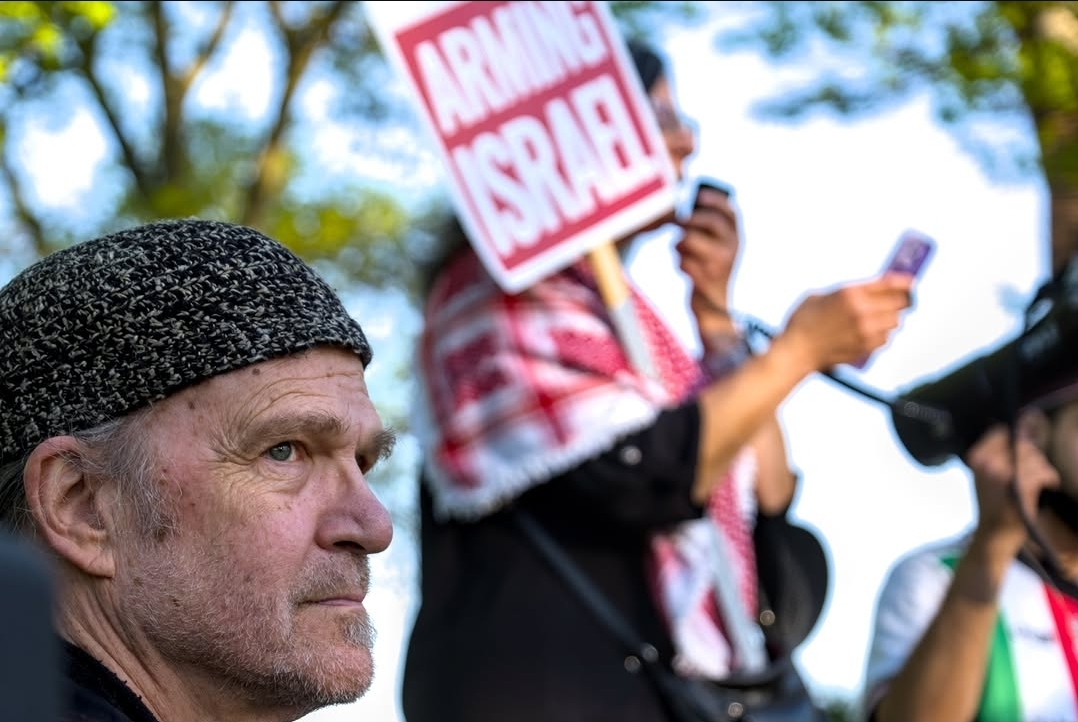
By Jim Perkinson (above), a sermon preached at St. Peter’s Episcopal Church in Detroit last weekend. Click here to check out (and suscribe to!) Dr. Perkinson’s new Substack newsletter.
I’ll begin retrospectively. A month ago, we had a lectionary passage from Genesis about humans being given “dominion” over the animals and plants of the planet. Four days before that I had just gotten back from leading a bible study at Kirkridge Retreat Center in eastern Pennsylvania, 544 miles one way by car from Detroit. And I could not help instantly relating the two things—the scripture passage and my “passage” to and from Kirkridge. As I had driven east on I-80 to get there, I counted the number of deer, lying in grotesque postures, killed by autos careening across the landscape. I stopped at 26. That is our dominion over deer.
And with every one of them that I passed at 78 miles per hour—staying just under the speed at which I know police would pull me over in a 70-mile-per-hour zone—I loathed my behavior. If I really lived what I believe, I would not dare pass by such a supine body without stopping and at least burying the departed one with appropriate ritual, if not more respectfully skinning the body, gathering the bones, preserving the back strap and ligaments, removing the horns—making sure every feature of that magnificent creature was being honored and lived up to in gratitude for its unwilling gift. Instead, I held myself responsible to cry out to each and every one I passed—as well as all the smaller-sized little ones also lying by the side of the road—“I’m so sorry, I lament my kind doing this, please go over to the Other Side, be healed, find peace!” And in every instance, I would find tears flushing my eyes and often dribbling down my cheek.
And then after the Kirkridge time, I came back to a Motor City in full levity, celebrating the Grand Prix auto fest. We use the French pronunciation to give it seeming status, but I would rather pronounce the “x” in “Prix” as an English “x.” Pricks”! Yes, celebrating the Grand Pricks, the Big Dicks, the high-tech MFs plundering the planet for ever greater speed, going . . . around in circles (the planet is round after all)! Even when we are already energy-strapped and facing fuel crises! What could be more indicative of our insanity!
I don’t believe in dominion. But I live it. I drove to church today. I lament much of what I do every day—but I don’t stop doing it. I am part of the plundering and killing of the planet.
A different word for what we are doing is “sacrifice”—like in the Genesis text today. Abraham with his son Isaac. Or according to some Muslims, Ishmael. The supposed great willingness to “obey” God to the point of “forfeiting” or “immolating” one’s most beloved “gift,” the offspring of one’s body. And here we need to go many directions—far back and far around—to come again to here and now. And this will be a continuation of the on-going St. Peter’s tradition of preaching against some texts of the bible in the name of other texts of the bible. Which for me, is the genius of the bible: a book explicitly at odds with itself!
On May 27, one day after getting back from Kirkridge, a few of us with the activist group, Christians for a Free Palestine, went to Dearborn to the Performing Arts Center there, to link arms and stand along Michigan Ave as supposed “protection” while thousands of Muslims offered prayer out on the multi-acre lawn in celebration of Eid al-Adha, “The Feast of Abraham’s Sacrifice”—one of the two most prominent festivals in Islam. Islam uses the lunar calendar of 354 days rather than the solar calendar of Christianity, so the feast days shift each year, compared to the Christian date. But whichever—here, a focus on Abraham’s sacrifice, whether late May or now in late June. And the profound irony of a handful of Christians “standing guard” for Muslims while they pray.
Who was offering “sanctuary” to whom is an open question, who is actually sacrificing for whom is not. I get to stand full-bellied and well-clothed in the late May sun because I still pay taxes to fund swarms of drones and storms of bombs on the heads of “Muslim” Palestinians, Lebanese, and Iranians daily. Never mind that some of those crushed in the rubble are also Christian. This too is dominion, as well as sacrifice. I live Abraham’s story. But I choose my own ram—precisely by not adequately refusing the ram chosen for me. I resist, but not enough to alter which ram gets the knife. Or drone.
I look in the mirror, but I see only blood. My face, my hands, red, dripping . . . I would seek to find some consolation, going to the park for an afternoon, removing shoes to let toes relish the living grass. But between my naked feet and the glistening blades—there too, blood, a veritable river of such, Turtle Islander in origin. An invisible red river, perhaps 100 million bodies deep.
So, I go to the bar, “Let me sip to slip away from the conundrum, the horror.” But there too, dripping red premonition. I can’t get away from it.
We turn to scripture for comfort. But the report there is also blatant! And kaleidoscopic! The Book of Revelation ends with a full-blown panorama of the fall of Babylon—not an anonymously wicked city, but an archetype of every city there has ever been. The city falls, because as the text says, “in her was found the blood of prophets and saints, and of all those who have been slain on earth” (Rev 18:24).
But where? Where is the blood? In the infrastructure, the walls, the streets, the architecture. The list in the passage in suggestive: it includes “cargo, gold, silver, jewels and pearls, fine linen, purple, silk and scarlet, all kinds of scented wood, bronze, iron and marble, cinnamon, spice, incense, myrrh, frankincense, wine, oil, fine flour and wheat, cattle and sheep, horses and chariots, and slaves, that is human souls” (Rev 18:12-13). Dripping crimson.
It does not mention deer—but if written today, it would have.
Do we see? The bar on Willis Street, or up on Cass, or out on Warren is not different. It does not just drip beer; it drips blood. Where? In all the materials; in the glass and bottles and cement and steel and wood and rubber and fiber-cable and copper lines of electricity and, and, and. And yes, in all the cars and trucks and bulldozers and airplanes and ships and fossil fuels and concrete necessary to get those materials from their place of wild natural origin to the place where I go sit and sip. And it is the same for my house in Lafayette Park. Or the church where I stand preaching, now.
Yes, my mind is running wild again, as usual. Dearborn. Deer-borne. Me being borne up by deer being put down. Domination. Sacrifice. Abraham and Isaac and rams in thickets. And blood. Everywhere, the signature of blood.
What do we do with a passage like today’s? A God who requires sacrifice—if not of one’s own offspring then of some substitute—someone else’s offspring. For most of us, the idea that a father would bind his son and lay him on a heap of wood to be burnt as a “sacrifice” out of “obedience” to God is undoubtedly at least horrific, if not utterly obscene and insane.
But then, that is exactly how we talk about God and God’s own offspring—supposedly sent to earth to die for our sins. I do not buy it. Big topic—a sermon in itself. I have written at length about such in an article now 15 years old that I would be happy to make available if of interest (Perkinson, 2010, 101-102).
But I understand the incarnation to have been primarily about a prophetic mission to confront the injustice of the powers-that-be, hoping against hope that they would halt, repent, and cease—not a cosmic plan, worked out from before the beginning to “sacrifice” for all human beings. Jesus come to earth to die—to push folk to the point where they kill him? No. To do that, to give up, up front, on the possibility people might choose not to carry out their worst responses is not actually loving them but rather a counsel of despair locking them into self-and-other-harming violence. Jesus came to advocate for change, not to provoke his own murder at the hands of others. Yes, willing to go so far as to die in the effort, but not as the intention up front! I understand Jesus’s death not as primarily substitutionary but solidary—not going bail for us but offering an example that we are meant to follow.
But that does not entirely evacuate the subject of sacrifice from our concerns here. And it is something we desperately need to face. I will do so in terms of the way the indigenous teacher my wife and I learn from talks about it. Surprise, surprise, huh, Perkinson referencing Prechtel again. So be it. But his rendition is shorthand for what serious research is showing up on every side. Our trajectory as a species we now call homo sapiens—“wise humans”—has run through a history of some 300,000 years, for 95% of which we lived in hunter-gatherer band societies of typically 150 people or less, shaped by a given ecosystem that was not primarily bent to human intentions but embraced as Mother, Teacher, Nurturer, Wisdom Counsellor laying down limits. Most of our time on the planet we did not adapt wild nature to us but us to wild nature.
Then we invented agriculture, began to coerce plants to do our bidding—make a field grow only one crop (wheat, barley, rice, corn, etc.) and annihilate all other plants continuously (we now just call it “weeding”—never mind that both our chosen plant of wheat or barley and we, ourselves, are actually “invasives” that we otherwise designate as “weeds”). And coercing plants is hard work. So we quickly also began coercing animals to help us bend the plants to our will.
And the rest is history—a now 10,000-year history of grabbing up more and more of the wild world, reengineering it, slicing it, dicing it, mining it, melting it, breaking it, etc. to become technology serving us until discarded as “garbage.” In the wild, there is no such thing as “garbage,” only mutual limiting, mutual flourishing, and mutual withering and perishing to make room for new life, emerging in new forms of mutuality. Which is how we lived for most of our time on the planet. But, in the evolutionary eyeblink of the last 10,000 years, we have become convinced that the more-than-human world of fellow creatures is primarily there as “tools” not “kin.” We use, abuse, use up, and then throw away, once what we’ve used is made toxic and broken.
What does this have to do with Abraham and Isaac and sacrifice you ask? This. For that 95% of our time we existed as what I am going to call “indigenous” folk living within natural limits—primarily hunter-gatherer, but also later on small-scale agriculturalists—we dwelt as “offering” cultures. The understanding was that we constantly ripped holes in the fabric of the beautiful creation around us—and necessarily so! You have to kill to live. You have to eat to survive. You consume other creatures—plants and animals. Even if vegan, the 38 trillion microbes that make up your body are regularly dying inside you so you can live. In fact, “life” and “death” are not actually opposites but are each other. The living body of any given creature is simultaneously the dying of some other creatures that they eat.
In reality, life and death cannot be separated.
We have to rip other creatures out of their natural context in order to compose our own bodies. Which means we owe. The real deal is not original sin (that is not actually there in Genesis but is a much later—and I would suggest, “destructive”—invention by Paul). The real deal is original debt. We owe.
What do we owe? Offerings of beauty back for the beauty taken. Which is exactly what many indigenous cultures will say. The Diné (Navajo) call it the Beauty Way. We need to devote some big portion of our lives to making beauty with thumb and tongue that we ritually give back to the wild for what we regularly take. And then, finally give our own bodies back, as themselves a “beauty offering.”
Our destiny, as I have said before, is to be eaten. And you will be. Doesn’t matter how hard the coffin sides are, you will be eaten—by microbes themselves eaten by worms, those eaten by birds, then bigger animals, etc. Some parts of you bleeding out of the grave to become part of ground water and air and tree roots and grass, etc. You will re-circulate. You will be eaten. The only question is will you be a good meal?
Indigenous cultures historically devoted themselves to making sure they remembered and honored all of the wild beings they regularly grabbed up by constantly offering beauty back in ritual “return-gifts”—in the form of tobacco if Native American; in the form of beads if African, Asian, European, and Native; in the form of huge dances, elaborate song-fests, etc., etc. And then at the end of the day offering their own bodies as a form of give-back. “Offering” cultures. Embracing limitations. Living out gratitude in regular gifts given back to Nature in forms that did not materially benefit the human community.
And then we invented agriculture and began to take more from any given local ecology than could be regenerated with regularity. Plants, Animals, Rocks. Metals. Etc. But still carrying a memory of how ancestors lived, these now top-heavy cultures still tried to make offerings, but out of an inchoate sense of having gone too far, the impulse of offering moved over to sacrifice.
To make up for taking too much we began to sacrifice other living creatures—lambs, cows, bulls, horses, various kinds of plant creatures. And yes, humans—usually (but not always) captured “outsider” humans, enslaved humans, “lesser” humans.
We moved from being “offering cultures” to being “sacrifice cultures.”
Still carried out ritually, but increasingly “over the top” in excess—because of all the excess being taken out of wild nature and re-made as human food, human architecture, human transport, human technology, human weapons, human entertainment. You can see it archeologically all over the world—cities come into being and big sacrifice comes into being, including sacrifices of humans. And war (where there had been no large-scale collective violence before; occasional individual violence, but not group-against-group violence). And the history in very many of those places is quickly one of revolt against aggressive city extraction and hierarchy and return to something much smaller scale and more sustainable.
Until we get to the modern scientific era and industrial production and now digitalization. Now we no longer even pretend, ritually. We live in ever larger settlements, ever less-skilled in autonomous survival, ever-more embedded in a global “superorganism” mainlining electricity and fossil fuel and ever more precariously quivering at the edge of collapse and utter chaos if not extinction. A single EMP attack wiping out electricity over a national topography would wipe out 90% of that population within a year. And all the while, we pride ourselves on not engaging in such a horrifically “primitive” practice as animal or human sacrifice.
And yet we are the premier of sacrifice cultures—rendering expendable virtually any and everything not human and any human not billionaire and white. But we don’t do it ritually. We just do it. And call it “progress.” 50 % loss of plant biomass since we started agriculture 10,000 years ago. 83% of wild mammals and 50 % of fish gone since civilization began, 6,000 ago (Proceedings of National Academy of Sciences, 5-21-2018). Almost 70 % drop in wildlife populations since 1970 (World Wildlife Fund, 10-13-2022). Agriculture threatening 90 % of remaining animal species habitat by 2050 (Yale Environment 360, 12-21-2021). And yes, something like 100 million Native folk genocidally dispatched, and 30-50 million African folk killed in the slave enterprise and 6 million Jews during WWII and now Palestinians and Lebanese and Sudanese and Rohingya, etc. So much that could be said and needs to be said.
But back to Abraham and Isaac and the biblical text. The bible is obviously a product of a city-state system: there is no writing until there is surplus production, controlled by elites, shoving some of it in the direction of scribes to write the PR that describes the elites as “God’s representatives” in that neck of the woods. Which is to say, David and Solomon and all the subsequent kings of Israel and Judah for the next 400 years—none of them the guardians of justice and equality and sustainability if you look beyond the PR and ask about their actual track record (Hudson, 182-184). The Abraham story in Genesis is actually incorporated into the growing Hebrew canon of scripture centuries after Israel betrays its vocation by opting for a kingship model of political organization (instead of the loose-knit tribal federation it had adopted when it first came into being as a reaction against Canaanite and Egyptian forms of city-state oppression and kingship). Not surprising then that “sacrifice” is therein touted as divinely-inspired “obedience.” That is typical city-state and monarchical “editorial.”
But as with all things city-state and hierarchical, there is underneath that surface-representation, somewhere back in the pre-history, an older practice and understanding that once was indigenous and venerable. Many indigenous cultures organize their elder-orchestrated rites of passage for adolescents transitioning from childhood into adulthood in one form or another of ritually-mediated encounter with Death. Prechtel describes the Tzutujil Mayan version that he helped guide young “budding” males through once their hormones had kicked into gear and they were beginning to exhibit typical romance-crazed behavior towards their own newly sought-out love-interests (Prechtel, 271; 239-241, 280-284, 304, 356-362, 383). The process involved abstention from such relations for a year of learning community myths and rituals, culminating in a week-long pilgrimage from the highlands village in which they lived, down towards the coast, which walk-about was in the company of elders and ritually mapped at every step.
And preliminary to that coast-pilgrimage, each young man was assigned an older widow in the village whose grief and partner-loss that young one was charged with serving and remediating. The climax of the walk was a terrifying encounter with the figure of Death, imaged as a cigar-puffing monster whose countenance was hard and posture threatening. The young initiate was required to secure from that figure the death-imprisoned “soul” and lost life-energies of his assigned widow’s lost life partner by negotiating with Death for the release of that “soul” in exchange for beauty offered by the initiate.
The “Beauty Gift” took the form of poetry recited full in the face of the cigar-smoke-shrouded face looking on with disdain, until the Death-figure finally said, “Ok, I will not kill you on the spot as I could and probably should, but will release the old spouse’s soul to you as long as you promise forever afterwards regularly to offer me this kind of ritual beauty and then when your turn comes, not resist your own death on the day it summons you.” I’m not speaking here of death that comes untimely as murder or war—that is to be resisted. But death as part of the natural cycle, as a return-gift for what has fed you.
All of which is to say, adult maturity among the Tzutujil could only be embraced on the other side of encounter with, and full acceptance of, one’s own death. And then—only in service of an old grief-wrenched widow, in which teenage romance was ritually refocused on a love-object co-extensive with Wild Nature itself and compelling even in the form of a wizened old woman still lurching with love-tears for her long-lost partner. Genius! Yes. Romance. With a capital “R.” What defies Death!
But the Real Romance for our species is the Big Woman of Wild Nature for male-identified personas; or the Big Man of Wild Nature for female-identified; or a Big Wild “Them” for the gender fluid.
Trans people of our day are raising an issue about desire and bodies that is addressed to the culture at large and must be taken seriously as such. But from our ancestral indigenously-rooted point of view, the ultimate trans-challenge is not merely trans-gender, but trans-species. Can we recognize that the deep DNA rhizome of our desire-haunted body is actually a Romance of the entire range of Wild bodies of a local ecosystem (Perkinson, 2022)? One lone human partner may well channel that big-D desire fairly regularly but won’t do so every moment of every day for a lifetime. But no problem if we have actually been initiated into a much bigger Body-Fetishism whose real Love-Partner is never absent but throbbing and thrashing and singing and keening around us all the time.
There are some scholars who would say that the Abraham/Isaac sacrifice story is actually a late city-state warping of a much older memory of initiation going back to ancient indigenous engagement with the Levantine ecosystem, long-since mis-remembered and re-figured. But deep in its intimations. Yes, rams are sacrificed for us humans. Or cows. Or chickens. Or wheat or beans or corn or apples. Necessarily so! But how measure up to those on-going giftings of lives given for our own? How honor such with regular return-gifts of beauty? And give up the delusion of eating without ever being on the menu? How prepare to be a good meal oneself?
How not simply speed by the deer-massacres on every night-driven road on the planet, but work to turn away from our wanton assault on all other life forms and our sacrifice of such without so much as a whisper of prayer or a tear of grief? I am, as you are, “Deer-Borne”—not in metaphor but in the most materialistic and somatic sense possible. But how now return the gift? Not dominion but co-communion. Not sacrifice but offering. Not property or human right but Gift. For a gift. Even in the face of apocalypse. Or extinction. Is there a ram in the thicket? Yes. But are you also ready, at the right time, for it to be you?
Bibliography
Hudson, Michael. 2018. . . . . and forgive them their debts: Lending, Foreclosure and Redemption from Bronze Age Finance to the Jubilee Year. Dresden: ISLET-Verlag.
Perkinson, James W. 2010. “Theology and the City: Learning to Cry, Struggling to See.” In M. Byrne (Ed.). North Wall Our University: Doing Theology As If Poor People Matter (pp. 45-58). Dublin: Martin Byrne.
Perkinson James W. 2022. “Courting and Romancing and Widows and Dams,” Radical Discipleship Blog (3-11-22). https://radicaldiscipleship.net/2022/03/11/courting-and-romancing-and-widows-and-dams/#more-19144
Prechtel, Martín. 2004 (1999). Long Life, Honey in the Heart: A Story of Initiation and Eloquence from the Shores of a Mayan Lake, Berkeley, CA: North Atlantic Books.

