
“There is naught that you can do, other than to resist, with hope or without it. But you do not stand alone. You will learn that your trouble is but part of the trouble of all the western world.” – Elrond, J.R.R Tolkein, The Fellowship of the Ring
Author: RadicalDiscipleship
“I am, We are, He/She/It is”: Learnings from the South Pacific
 by Talitha Fraser with Kaumatua Gregg Morris
Allow me to invite you to join in for a game of kilikiti, to sing and dance with us, to walkabout… sit here at the campfire and I will tell you story…
Coranderrk was one of several Aboriginal missions set up in Victoria . Wurundjeri leaders William Barak and Simon Wonga advocated for Aboriginal people to live in their own place, their own way. Many times to petition the Victorian Government Barak and Wonga would gather a delegation together, speak to motivate and inspire them, then they would walk together the 60 miles (12 hours) to deliver the message: “Please leave us alone, give us our land back, don’t take it away again”. Leaders of one people to another, approaching as equal and in person. Continue reading ““I am, We are, He/She/It is”: Learnings from the South Pacific”
Wild Lectionary: The Very Edges of Your Field
 Seventh Sunday After the Epiphany
“When you reap the harvest of your land, you shall not reap to the very edges of your field, or gather the gleanings of your harvest. You shall not strip your vineyard bare, or gather the fallen grapes of your vineyard; you shall leave them for the poor and the stranger: I am YHWH, your God.” (Lev 19.9-10)
By Wes Howard-Brook and Sue Ferguson Johnson
More than any other biblical text, the book of Leviticus claims to express the direct voice of YHWH. Of the 160 uses of the phrase, “I am YHWH” in the Hebrew Bible, 49 uses are in Leviticus. And yet, the book may be among the least respected or understood scriptural texts. It is to this very chapter in Leviticus that Jesus turns when asked about the greatest commandments. Just a few verses down from the quote above we find: “You shall not take vengeance or bear a grudge against any of your people, but you shall love your neighbor as yourself: I am the LORD” (Lev 19.18; cf. Mk 12.31). Indeed, not only Jesus, but also Paul and James—made into opponents of each other in the post-Reformation culture wars—cite Lev 19.9 as central to discipleship (Rom 13.9; Gal 5.14; James 2.8). Continue reading “Wild Lectionary: The Very Edges of Your Field”
Prophetic Moral Challenge
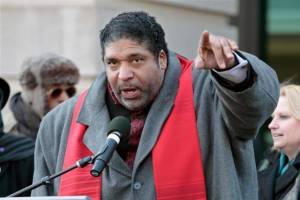 From the Intro to Rev. William Barber’s recent Op-Ed:
President Trump’s first appearance at the National Prayer Breakfast met awkward silence on Thursday (Feb 2) as he began his comments by touting ratings when he was on “The Apprentice.” Unpracticed in the public performance of piety, the candidate who was praised for “telling it like it is” made even his white evangelical base momentarily uneasy as he demonstrated the impotence of their religion to overcome his narcissism. Excused as a “baby Christian” during his campaign, the teen-like Trump continues to expose the hypocrisy of white evangelicalism. Continue reading “Prophetic Moral Challenge”
Sermon:On Practicing a Mystical Anarchist Ethic
 By Joanna Shenk, February 5, 2017, First Mennonite Church of San Francisco
Isaiah 58:1-12
When my older brother went to college, I remember being taken aback when he said his roommate’s mom was an anarchist. I felt so sorry for his roommate and figured he probably had a terrible childhood. In my mind, being an anarchist meant something related to the anti-christ. It was all one category to me because I thought it was all related to the same word. Continue reading “Sermon:On Practicing a Mystical Anarchist Ethic”
#FaithJustice: Sacred Right to Rest
 By Grecia Lopez-Reyes, Organizer with Clergy and Laity United for Economic Justice, originally posted on the Law At The Margins blog
For the past year and half I have worked as a Faith-Rooted Organize for Clergy and Laity United for Economic Justice (CLUE). I educate, organize, and mobilize the community of faith to walk in intimate solidarity with workers and their families fighting for a living wage, respect, and better working conditions in industries such as the Ports of Los Angeles and Long Beach. The ports are an industry that thrives from the sweat and labor of misclassified Port Truck Drivers. Due to misclassification, drivers are considered independent contractors and not employees, which requires for workers to be responsible for paying the lease of their trucks, maintenance, insurance, and fuel to name a few of the costs. Misclassification makes these drivers vulnerable to wage theft, while also denying them of benefits such as overtime pay, worker compensation, and health care. Read more here: “The BIG RIG Poverty, Pollution, and the Misclassification of Truck Drivers at America’s Ports a survey and research report.” Continue reading “#FaithJustice: Sacred Right to Rest”
Saviors
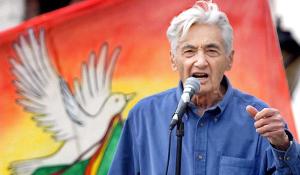 From Howard Zinn’s The People’s History of the United States (1980):
The idea of saviors has been built into the entire culture, beyond politics. We have learned to look to stars, leaders, experts in every field, thus surrendering our own strength, demeaning our own ability, obliterating our own selves. But from time to time, Americans reject that idea and rebel.
Revolutionary
 From Fannie Lou Hamer:
Christianity is being concerned about your fellow man, not building a million-dollar church while people are starving right around the corner. Christ was a revolutionary person, out there where it was happening. That’s what God is all about, and that’s where I get my strength.
Nana’s Cabbage Soup
 By Em Jacoby. Part of our series on food and discipleship
Nana is incomprehensible these days. We can laugh together, and occasionally a name will come from her lips that connects to a person in her long life, but most of the time we are laughing because she talks as much as ever and it is beyond recognition. Last time I visited her, I laughed until I wept. I pray for her to leave this earth, but Alzheimers has its cruel course and I must witness it. Continue reading “Nana’s Cabbage Soup”
Radical Friendship
 An exclusive RadicalDiscipleship.Net interview with Ryan Newson, professor of religion, philosophy and ethics at Campbell University. He is the author of Radical Friendship: The Politics of Communal Discernment, coming out on April 1.
RD: Describe how this project started.
RN: This project began during my doctoral studies when I was immersed in Anabaptist theology and political theology, respectively. As I read Anabaptist theologians in depth, I was drawn to a communal form of reasoning about spiritual and moral questions that seemed to haunt that tradition—always lurking even if it was not always perfectly implemented. This picture of radical disciples drawing near one another in order to figure out what God would have them do, or who God would have them be, was magnetic. It reminded me of the form of Christianity that had always appealed to me, and that I had seen practiced by house churches in Camden, NJ, and New Monastic communities in Durham, NC, and Catholic Worker communities in Silk Hope, NC. In particular, I was attracted to the way in which this practice had the potential to guide communities into new waters without fear, acquiescence, or retreat. It certainly carried much more power, it seemed to me, than the way many of my fellow Christians approached questions of discernment: through a wooden, legalistic application of scripture. Continue reading “Radical Friendship”

