Unbroken Connection

DinaFor Indigenous Peoples Day, an excerpt from Dina Gilio-Whitaker’s brilliant new release As Long As Grass Grows: The Indigenous Fight for Environmental Justice, from Colonization to Standing Rock (2019).

The very thing that distinguishes Indigenous peoples from settler societies is their unbroken connection to ancestral homelands. Their cultures and identities are linked to their original places in ways that define them: they  are reflected in language, place names and cosmology (origin stories). In Indigenous worldviews, there is no separation between people and land, between people and other life forms, or between people and their ancient ancestors whose bones are infused in the land they inhabit and whose spirits permeate place.

Power, Accountability and Brett Favre

By Danté Stewart, re-posted from The Atlantic Magazine

I played Division I football as a cornerback at Clemson University. The players provide America with many things. We give fans memories and celebrations, we give them a time to escape the problems of America, and we give our audiences and white teammates the illusion that we are equal on and off the field.

“I know from being in an NFL locker room for 20 years, regardless of race, background, money you grew up with, we were all brothers; it didn’t matter,” the Hall of Fame quarterback Brett Favre once told a reporter at USA Today.

But although Favre may be happy to declare his kinship with Black people, I’ve never heard him mention the injustices we face daily. Rather, he has publicly criticized Black athletes for kneeling in protest during the national anthem. He said the athletes’ demonstration “created more turmoil than good.” Recently, we learned that he has been accused of misusing funds intended to help the poorest residents of his native state, who are disproportionately Black. Read the rest of the article here.

Between Red Bird Songs and Brown Squirrel “Skalds”: Learning from the Poetry Outside My Door

By Jim Perkinson, a sermon for St. Peter’s Episcopal, a riff on Luke 12:22-31 for “Animal Sunday” in the Season of Creation Readings: Year C

I woke up this morning an old man—an experience recurrent over recent months here at the far end of pandemic shifts in life and schedule and interaction.  I have not the energy I had before my classrooms miniaturized from a 20 by 30 ft space of animated bodies to a 12 by 15 inch screen flattened into pixelated colors and shapes.  I cannot strut and gesture, advance and retreat with my ideas taking on flesh and then resounding, reverberating, up-thrusting like rock or quieting like mist in the rhythmic back and forth of in-person engagement.  My body is bereft and grieving.  And that grief is but a minute fragment of what ghosts my bones now, as I become ever more aware of what I have lost—not just in recent years, but recent centuries and indeed millennia, that yet echo as traces and sighs, unspoken and unspeakable in my veins and hair, my nose and ear—ancestors that whisper and pulse and haunt, whose own grief and jubilation has no anatomical muscle adequate to its tones and cadence. 

Continue reading “Between Red Bird Songs and Brown Squirrel “Skalds”: Learning from the Poetry Outside My Door”

Be a Poll Chaplain

A message from Sojourners Magazine.

Our vote and democracy are under attack in every state across this union. But on November 8th, we as a people of faith must be on the frontline to fight this Goliath that is trying to destroy our democracy. We cannot sit out the Midterm election.

The late John Lewis said best: “A vote is the most powerful non-violent tool we have – almost sacred.” For us, voting is rooted in the belief that everyone is created in the image of God and deserves to vote their values in free, fair, and safe elections. 

Continue reading “Be a Poll Chaplain”

Upstream

By Tommy Airey

“There is no bad luck in the world but whitefolks.” – Toni Morrison, Beloved

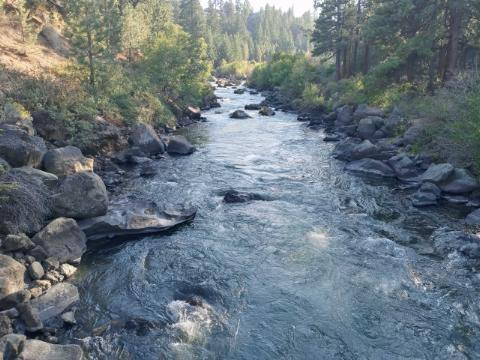
Last weekend, I hiked with friends on traditional land of Watlala people, about fifty miles southeast of Portland, Oregon. At the trailhead, there were a half dozen Chinook Salmon swimming in the cold shallow water below. They were traveling upstream, from the Pacific to the Columbia to the Sandy to the Zig Zag to Camp Creek. The females, returning to the place of their birth, were preparing to lay their eggs – and then die four days later. Despite all the dams that have been built, there are still a few of these Beings, so sacred to Native people here, who have the strength to swim against the current, teaching us how to give up our lives for the next generation.  

On my two-hour drive back to the Deschutes River, I was pondering the contrast between Chinook Salmon who swim upstream and those who built the dams, white people conditioned by conformity, always moving with the current, not against it. I was thinking about the white people I know who now refer to “wokeness” as a bad word, as a kind of far-left cult that is extreme and dangerous, existing only to shame white people. The conservative talking points are penetrating the language of white moderates and liberals. Right-wing strategists know what they are doing! Wokeness is the perfect pinata for people unwilling to swim upstream and shed their own whiteness.

Continue reading “Upstream”

Normalize

A repost from @mia.mingus on IG.

All Biden’s words have done is make clear–abundantly clear–what we already have known: that we are on our own for the pandemic and the little that still remain (for some), will be gone soon (obvi wealthy folks will be able access whatever they want whenever as per usual).

Our work now should be cultural changes, so that we can get (our) folks to get boosted, wear masks and continue other safety precautions. We should be *normalizing* masks. Taking pictures (esp with others) with your masks ON.

Continue reading “Normalize”

Prodigal Prodigality Versus Village Party: On Not Killing the Fatted Calf

By Jim Perkinson

One of the effects of the irruption of Global South thought into Global North theology in the last half century is a re-reading of the bible from within the experience of poverty.  Not least among the new insights occasioned by this re-reading is that concerning the parables.  Scholars like Walter Wink and William Herzog and popular cultural educators like Ched Myers have made us aware that such folk stories, read in social context rather than spiritualized and universalized, have the character of political cartoons.  Rather than allegories offering us characterizations of God or Jesus, they are better understood as politically-coded riddles, inviting their hearers to judge for themselves the situations they find themselves in.  In 1st century Palestine among an oppressed people, they often served a function of consciousness-raising, provoking peasant listeners to dare risk thinking and voicing their own interpretation of events and discover their own wisdom.  Only indirectly and obliquely do the parables speak about God, and then only by way of unmasking domination and uncovering the cry of anguish it silences.  The results of such a contextual reading can be startling. 

Continue reading “Prodigal Prodigality Versus Village Party: On Not Killing the Fatted Calf”