Let Us Imagine

ZinnFrom Chapter 24 of Howard Zinn’s A People’s History of the United States (2000).

Let us imagine the prospect-for the first time in the nation’s history–of a population united for fundamental change. Would the elite turn as so often before, to its ultimate weapon–foreign intervention–to unite the people with the Establishment, in war? It tried to do that in 1991, with the war against Iraq. But, as June Jordan said, it was “a hit the same way that crack is, and it doesn’t last long.” Continue reading “Let Us Imagine”

A Lynching that Cuts to the Heart

5c11c24dc4ab2.image
Source: https://www.dailysentinel.com/news/local/article_776357e2-4dae-5c90-b9c8-6b7b96adb1c4.html

This sermon was delivered by Rev. Luke Hansen, S.J. on May 3, 2020, the Fourth Sunday of Easter, at Bellarmine Chapel, Cincinnati. The liturgy was livestream and is available here.

Lectionary readings: Acts 2:14a, 36-41; Psalm 23; 1 Peter 2:20b-25; John 10:1-10

In early March, before the world changed, I traveled to Alabama with a group of Xavier University students. We were on a “civil rights immersion,” visiting Selma, Birmingham and Montgomery.

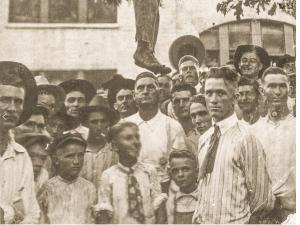
In Montgomery, the Equal Justice Initiative has built a memorial for the victims of lynching and a legacy museum that tells the story of racial violence, from slavery to mass incarceration. Continue reading “A Lynching that Cuts to the Heart”

Interrogation of Everything

D18_185_015Sheldon C. Good, executive director of The Mennonite, Inc., interviewed Ibram X. Kendi about antiracism and the church by email Sept. 3. The interview, edited for clarity, appears below. The editorial in the October issue of The Mennoniteavailable here, includes part of the interview.

Kendi is author of How to Be an Antiracist. He won the 2016 National Book Award for Nonfiction for his book Stamped from the Beginning. He is the founding director of the Antiracist Research and Policy Center at American University in Washington, D.C.

1. You make the case in How to Be an Antiracist that the word “racist” has been removed from its proper usage. How did that happen?

The most virulent racists define racist as anyone who uses the r-words, race or racism. They say, racist is a pejorative term, it is the equivalent of saying I don’t like you, as Richard Spencer once said. Anyone who categorizes people by race, who calls someone racist, is the real racist, they say. Obviously, they are deeply defensive, and deeply in denial. As such, they don’t want to be called racist. They shut down and close up when they do. Some racial reformers have agreed and view “racist” as an attack. So they don’t use the term either. But racist is a descriptive term, not an attack. It describes when a person is saying there is something wrong or right with a racial group. It describes when a person is supporting racist policy with their action or inaction. Continue reading “Interrogation of Everything”

Emmaus Road Litany

Farm Church
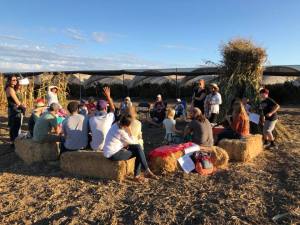
A Farm Church gathering in pre-pandemic times.

Inspired by Ched’s “Easter Faith and Empire” article, Katerina Friesen wrote the following litany for Farm Church (Ventura River Watershed in California) on Sunday, April 26 for an adapted “Bread of Life” communion time.

El Peregrino camina con nosotr@s (The Sojourner walks with us)
When we are confused, disillusioned after hopes of revolution,
Disappointed by loss after loss, Jesus opens our minds. Continue reading “Emmaus Road Litany”

A Kind of Consciousness

anzalduaGloria Anzaldúa describing “the new Mestiza” in her book Borderlands/ La Frontera: The New Mestiza (1987).

She puts history through a sieve, winnows out the lies, looks at the forces that we as a race, as women, have been a part of. . . She reinterprets history and, using new symbols, she shapes new myths. She adopts new perspectives toward the dark-skinned, women and queers. She strengthens her tolerance (and intolerance) for ambiguity. She is willing to share, to make herself vulnerable to foreign ways of seeing and thinking. She surrenders all notions of safety, of the familiar. Deconstruct, construct. She becomes a nahual, able to transform herself into a tree, a coyote, into another person. She learns to transform the small “I” into the total self.

**In an interview in 1991, Anzaldúa elaborated:

Typically, for me, the “new Mestiza” is a kind of border woman who is able to negotiate between different cultures and cross over from one to the other and therefore has a perspective of all those different worlds that someone who is mono-cultural cannot have. And because she has that kind of perspective, tiene conocimiento: she has an understanding of what’s going on in all these different terrains. And so her interpretation is based on perceiving more about the different realities in this world than someone who is just mono-cultural…The new Mestiza for me is a feminist, is definitely a feminist, whether she calls herself that or not. And she’s different from the old mestiza because it’s no longer just a question of blood, it’s no longer a matter of one being Indian or black or Asian or Spanish; you may have those bloods and be raised in a white, middle-class world, or you may be a white woman but be raised in a Chicano community. So it goes beyond just the biological mestiza… there’s such a thing as a cultural mestiza. It’s a kind of consciousness.

Reading History Through the Prophets

ZundAn excerpt from Ched Myers’ classic article “Easter Faith and Empire: Recovering the Prophetic Tradition on the Emmaus Road.” These comments are posted just in time for this weekend’s Gospel text Luke 24:13-35

Luke tells us that Jesus addresses these fit-to-be-tied disciples as “fools”
(24: 25). But the Greek term anontoi refers simply to those who don’t
quite get it, who find the truth as yet unintelligible (cf. Romans 1:14;
Galatians 3:1,3} He knows their hearts are “sluggish” (Greek, bradeis),
as indeed are ours. Because we, like Cleopas and company, forever refuse to embrace the counterintuitive wisdom of the Hebrew prophets.

The prophets tell us to defend the poor, but we lionize the rich. The prophets tell us that horses and chariots cannot save us, but we are transfixed by the apparent omnipotence of modern military technology. The prophets tell us to forgo idolatry, but we compulsively fetishize the work of our own hands, Above all, the prophets warn us that the way to liberation in a world locked down by the spiral of violence, the way to redemption in a world of enslaving addictions, the way to true transformation in a world of deadened conscience and numbing conformity is the way of nonviolent, sacrificial, creative love. But we who are slow of heart–a euphemism for not having courage–instead remain fiercely loyal to ever more fabulous myths of redemptive violence, practices of narcissism, and delusions of our own nobility.

Mender’s Mud

20528720818_e4fc6d665f_c
Flickr, cc, Protopian Pickle Jar

By Bill Ramsey, April 17, 2020

0nce, on a dry and rocky footpath,
a dab of sacred saliva dampened dust.
Silently, the mender’s hands kneaded,
molded and applied the curious blend.
Mudded eyes opened. Vision restored.

These days, we walk mired down,
slogging mucky tracks, traversing
our first New England mud season,
distanced, sheltered, masked, waiting
for healing, solace and renewed balance.

April’s earth underneath our boots
is dew dampened, drizzle drenched,
thaw soaked and oh so mud mucked.
Bogged down in this deadly pandemic,
we yearn for a closure, less muddled. Continue reading “Mender’s Mud”

the wind from the tomb

JPerk
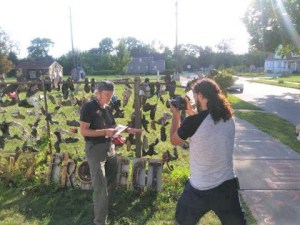
Dr. Jim Perkinson offering a spoken word at the Heidelberg Project in Detroit, MI

by jim perkinson, 04.19.2020, St. Peter’s Episcopal Church (Detroit, MI)

we worry now
about breath
where it has been
whose kiss it carries and whose
nostril-curl in zephyr-spins
of night or day or twirling
door-gush rushing to the street
and we now see how primal
is the air of earth, the river
whence we cruise and where
we move, like fish-in-flow or
a swallow on the wing at dusk—we,
feet on dust, head up-thrust and strolling Continue reading “the wind from the tomb”

Never Forget

Deschutes National ForestBy Ric Hudgens, Quarantine Essay #22, originally posted to Facebook on April 18, 2020. Ric is posted all his essays to Medium

Every day for the past month, something has stunned me. I’ve been unable to respond. I’m astonished by the news stories I’m hearing. I see and hear horrifying things.

The world has never been an entirely pleasant place. Horrifying things happen all the time. But now perhaps I’ve slowed down enough to feel and see the full weight of them.

I’m not surprised by the inequalities revealed in this crisis. They have been there for anyone to see who wanted to look. The callous disregard for human life by those who claim to be “pro-life” doesn’t surprise me. Their understanding of “life” has always been very narrow, partisan, and racist. Continue reading “Never Forget”