Your tears know where they come from.

lix nBy Sarah Matsui

For: Liz Nicolas, one of my dearest people and one of the most distinctly human individuals I know.

Dear friend, your way of seeing can be
as much burden as gift; I know
you know.

When tears threaten to swallow you whole:
Know you will not be overcome. Learn and relearn to
find the counterweight you need. Continue reading “Your tears know where they come from.”

The Pedagogy of Place: The Art of Coping

By Tommy Airey, the first post of a 3-part series about how we learn from our location about what is truly Divine
——————
Every town has the same two malls: the one white people go to and the one white people used to go to.
Chris Rock

About a month ago, I drove just across 8 mile (the border between Detroit and Southfield) to visit the mall that white people used to go to. I went for one reason: it was closing that week and everything was 60-80% off. I was the only white dude in there. It felt good because it was like I was breaking Chris Rock’s rules.
Continue reading “The Pedagogy of Place: The Art of Coping”

Repenting White Supremacy

decolonizeBy Lydia Wylie-Kellermann. Originally printed in On the Edge.

I am sorry. I am sorry for speaking too quickly. For saying the wrong thing. Or not saying anything. For speaking unaware out of my own white supremacy.

I am sorry for not learning the history. For the large blind spots I carry. For all the people and creatures hurt along my way.
Continue reading “Repenting White Supremacy”

Shoah

shoahFrom Ken Sehested of Prayer & Politiks:

Yom HaShoah (aka “Holocaust Remembrance Day,” more formally “Holocaust Martyrs’ and Heroes’ Remembrance Day”) is observed one week after the end of Passover, this year beginning at sundown on Wednesday 15 April, the date linked to the anniversary of the 1943 Warsaw Ghetto uprising. Increasingly, the word Shoah (“calamity”) is preferred because holocaust has historical roots in the Hebrew word olah, meaning “completely burnt offering to God,” with the implication that Jews and other “undesirables” murdered by the Nazis during World War II were a sacrifice to God…

Sehested included this powerful quote from Etty Hillesum, a Dutch Jew, Hillesum who died at age 29 in Auschwitz, the Nazi concentration camp, in 1943:

I have looked our destruction, our miserable end, straight in the eye and accepted it into my life, and my love of life has not been diminished. I am not bitter or rebellious, or in any way discouraged. . . . My life has been extended by death, by accepting destruction as part of life and no longer wasting my energies on fear of death or refusal to acknowledge its inevitability. It sounds paradoxical: by excluding death from our life we cannot live a full life, and by admitting death into our life we enlarge and enrich it.

70 Years Later: Dietrich Bonhoeffer

bonhoefferTomorrow is the 70th anniversary of the execution of German theologian and martyr Dietrich Bonhoeffer. During his short time in America, Bonhoeffer was a trailblazer in learning from his African-American brothers and sisters, as reported by James Cone in The Cross & The Lynching Tree (2011):

In contrast to [Reinhold] Niebuhr and other professors at Union Seminary, the German theologian Dietrich Bonhoeffer, during his year of study at Union (1930-31), showed an existential interest in blacks, befriending a black student named Franklin Fisher, attending and teaching Bible study and Sunday school, and even preaching at Abyssianian Baptist Church in Harlem. Bonhoeffer also read widely in African American history and literature, including Walter White’s Rope and Faggot on the history of lynching, read about the burning of Raymond Gunn in Maryville, Missouri (Jan 12, 1931) , in the Literary Digest, “the first lynching in 1931,” and expressed his outrage over the “infamous Scottsboro trial.” He also wrote about the “Negro Church,” the “black Christ” and “white Christ” in the writings of the black poet Countee Cullen, read Alain Locke and Langston Hughes, and regarded the spirituals” as the “most influential contribution made by the negro to American Christianity.” Some of Bonhoeffer’s white friends wondered whether he was becoming too involved in the Negro community.

The Feast of Bonhoeffer

RNS-DIETRICH-BONHOEFFERBy Bill Wylie-Kellermann
—————–
We have for once learnt to see the great events of world history from below, from the perspective of the outcast, the suspects, the maltreated, the power-less, the oppressed, the reviled – in short, from the perspective of those who suffer.
Dietrich Bonhoeffer, Christmas letter to friends and co-conspirators (1942)

Seventy years ago today, just weeks before the fall of Berlin in 1945, Dietrich Bonhoeffer was marched naked into the yard of Flossenberg Concentration Camp and hanged with piano wire for being an enemy of the Nazi state. He was 39.
Continue reading “The Feast of Bonhoeffer”

Upstream Swimming Made Easy: Resisting the God of Personal Health & Being Re-arranged by Beloved Community

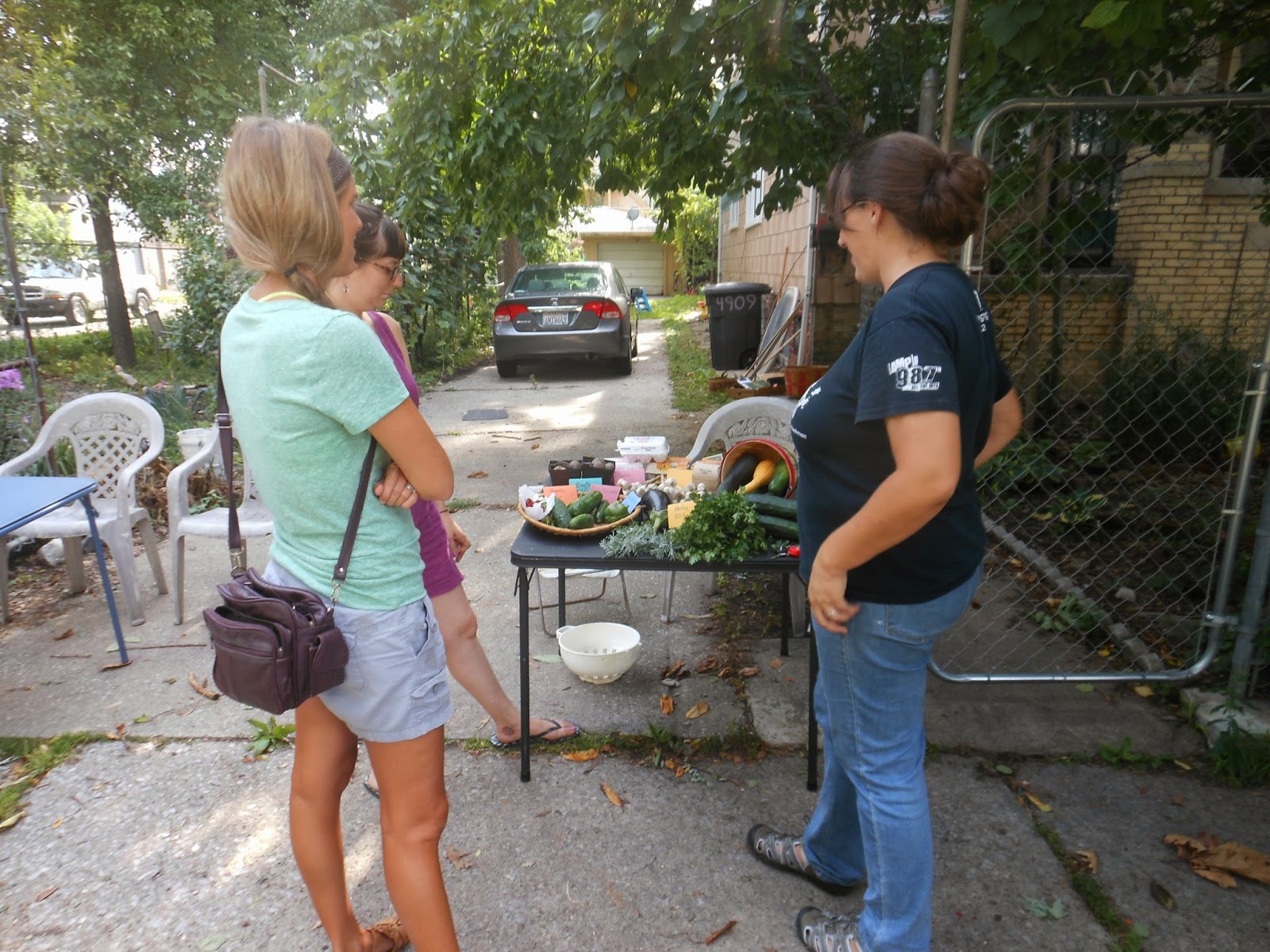
neighborhood gardenBy Lindsay Airey

When I walked past the magazine racks at the CVS the other day, I inadvertently glanced at a magazine that had a nondescript, mid-30’s, white woman on the front cover. She was scantily clad in sports bra and spandex, totally toned, abs of steel and zero body fat. You know the cover I’m talking about. You’ve seen one, you’ve seen them all—placed and marketed strategically and relentlessly around every corner to make all us women feel bad enough about ourselves that we will become better consumers of the latest diet fad or work-out craze.
Continue reading “Upstream Swimming Made Easy: Resisting the God of Personal Health & Being Re-arranged by Beloved Community”

Learning from Laughter: Fish Funeral

shovelBy Lydia Wylie-Kellermann

“Keep your eye on these fish for a few days. You don’t want him to be around if one of them dies,” she whispers so Isaac can’t hear.

For his two year old birthday, we got three fish which he quickly named “Two, Baubee, and Three.” He’s learning to count and there really isn’t anything more exciting at the moment than the numbers two and three. He can tell them apart and feeds them every day. And when bedtime comes around he refuses to turn off their light because, he insists, the fish do not want to go to bed- just like him.

Yesterday, one of them did died. It started growing something gross on its face and by the time we got home, Baubee was gone. The store attendant’s voice was ringing in my head, “you don’t want him to see if one of them dies.” Actually, I think we do. Continue reading “Learning from Laughter: Fish Funeral”

Learning from Laughter: Blessed by Sand

sandboxBy Lydia Wylie-Kellermann

I was pruning these same apple trees and grape vines when I first felt the pull of contractions. Today, it is a two year old that calls me down. “Mooommy,” he calls. He’s standing in the green turtle box filled with sand he collected with his grandpa from the shores of Lake Huron last summer. He stands there barefoot having demanded to take his shoes off even though it’s the middle of March and the snow has not yet fully melted. Continue reading “Learning from Laughter: Blessed by Sand”