
“The [victims] say to each of us, black and white alike, that we must substitute courage for caution. They say to us that we must be concerned not merely with about who murdered them, but about the system, the way of life and the philosophy which produces murderers.” – Martin Luther King, Jr at the eulogy for the victims of the Birmingham Church bombings.
Category: Cloud of Witnesses

The Fellowship of Heretics
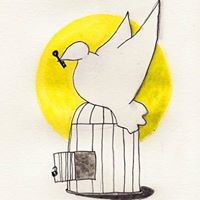 We are a community of faith, rooted in justice and peacemaking, guided by the Holy Spirit to express God’s unbiased love for all of creation by providing a Christian framework for social righteousness in the Southeast.
The statement of purpose written by the Mercy Junction community
Compelling Christian community is percolating down South in Chattanooga at the Mercy Junction Justice & Peace Center. They are recruiting 100 radical disciples by September 1 for their Fellowship of Heretics. See details below copied from their Facebook Events Page.
—————
The “Fellowship of Heretics” is a community of good-hearted rabble-rousers, rebels, malcontents, radicals and other cool people supporting the Justice and Peace Center by being card-carrying heretics. This is our first membership drive for the “Fellowship of Heretics” and we’re aiming to grow the Fellowship to 100 members by Sept. 1. Continue reading “The Fellowship of Heretics”
A Post Evangelical Pilgrimage, Part III
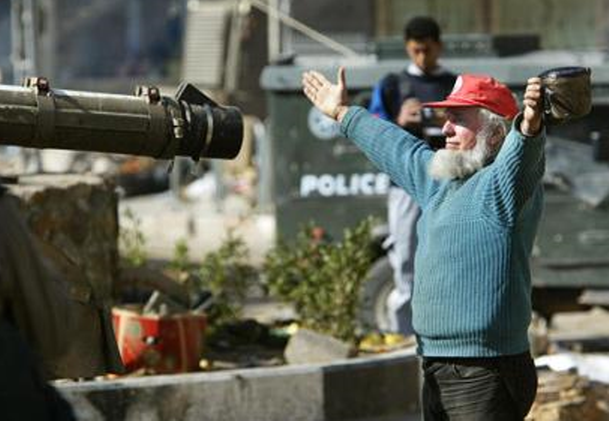
John Main
*This is the final post in a three-part series exploring more compelling ways to follow Jesus.
During the summer of 2013, Lindsay and I took a 75-day, 12,000-mile road trip. We simply wanted to meet people whose lives of faith were compelling. We wanted to get a taste test of what some might call “Movement Christianity” or “Radical Discipleship” (radical in Latin means “roots”), a particular strand of faith and action that goes all the way back to the roots of Judeo-Christian faith: Moses’ contemplative meeting with the Divine at the burning bush and his ensuing confrontation with the beastly bastards of Egyptian Empire, calling the underdogs out of enslavement and into a whole new Way of being.
Continue reading “A Post Evangelical Pilgrimage, Part III”
The Great Stories
 From Arundhati Roy in The God of Small Things (2008):
…the secret of the Great Stories is that they have no secrets. The Great Stories are the ones you have heard and want to hear again. The ones you can enter anywhere and inhabit comfortably. They don’t deceive you with thrills and trick endings. They don’t surprise you with the unforeseen. They are as familiar as the house you live in. Or the smell of your lover’s skin. You know how they end, yet you listen as though you don’t. In the way that although you know that one day you will die, you live as though you won’t. In the Great Stories you know who lives, who dies, who finds love, who doesn’t. And yet you want to know again.
That is their mystery and their magic.
81 Years Later: The Barmen Declaration
 We reject the false doctrine that the Church could have permission to hand over the form of its message and of its order to whatever it itself might wish or to the vicissitudes of the prevailing ideological and political convictions of the day.
An Excerpt from the Barmen Declaration, May 29-31, 1934
This weekend, we celebrate the anniversary of the birth of the “confessing church” in Germany, standing up against the idolatry of the State. This is a nice summary from the United Church of Christ “beliefs” page:
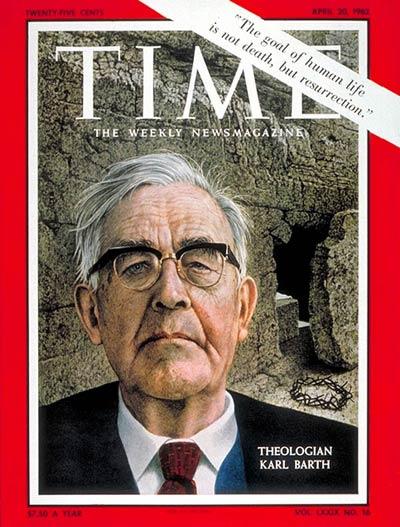
The Barmen Declaration, 1934, was a call to resistance against the theological claims of the Nazi state. Almost immediately after Hitler’s seizure of power in 1933, Protestant Christians faced pressure to “aryanize” the Church, expel Jewish Christians from the ordained ministry and adopt the Nazi “Führer Principle” as the organizing principle of church government. In general, the churches succumbed to these pressures, and some Christians embraced them willingly. The pro-Nazi “German Christian” movement became a force in the church. They glorified Adolf Hitler as a “German prophet” and preached that racial consciousness was a source of revelation alongside the Bible. But many Christians in Germany—including Lutheran and Reformed, liberal and neo-orthodox—opposed the encroachment of Nazi ideology on the Church’s proclamation. At Barmen, this emerging “Confessing Church” adopted a declaration drafted by Reformed theologian Karl Barth (above photo) and Lutheran theologian Hans Asmussen, which expressly repudiated the claim that other powers apart from Christ could be sources of God’s revelation. Not all Christians courageously resisted the regime, but many who did—like the Protestant pastor Dietrich Bonhoeffer and the Roman Catholic priest Bernhard Lichtenberg—were arrested and executed in concentration camps. The spirituality of the Barmen Declaration profoundly influenced many of the first generation of pastors and laypeople who formed the United Church of Christ in 1957
47 Years Later: The Catonsville Nine
 Today is the anniversary of the Catonsville 9 action in 1968. Here’s how Howard Zinn chronicles it in his classic The People’s History of the United States (1980):
The following May, Philip Berrigan-out on bail in the Baltimore case-was joined in a second action by his brother Daniel, a Jesuit priest who had visited North Vietnam and seen the effects of U.S. bombing. They and seven other people went into a draft board office in Catonsville, Maryland, removed records, and set them afire outside in the presence of reporters and onlookers. They were convicted and sentenced to prison, and became famous as the “Catonsville Nine.” Dan Berrigan wrote a “Meditation” at the time of the Catonsville incident:
Our apologies, good friends, for the fracture of good order, the burning of paper instead of children, the angering of the orderlies in the front parlor of the charnel house. We could not, so help us God, do otherwise…. We say: killing is disorder, life and gentleness and community and unselfishness is the only order we recognize. For the sake of that order, we risk our liberty, our good name. The time is past when good men can remain silent, when obedience can segregate men from public risk, when the poor can die without defense.
Ask Me What I Live For
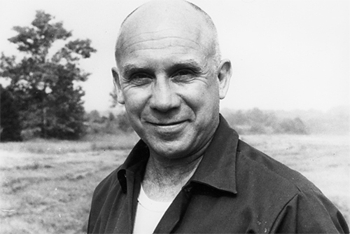 From Thomas Merton, mystic & prophet:
…if you want to know me, don’t ask where I live, what I like to eat, how I part my hair; rather, ask me what I live for, in every detail, and ask me what in my view prevents me from living fully for the thing I really want to live for.
What Can The White Man Say To The Black Woman?
 From Alice Walker, poet, activist and the author of many works including The Color Purple (1982). This was the conclusion of a piece published in the recent 150th anniversary edition of The Nation:
What can the white man say to the black woman?
Only one thing that the black woman might hear.
Yes, indeed, the white man can say, your children have the right to life. Therefore I will call back from the dead those 30 million who were tossed overboard during the centuries of the slave trade. And the other millions who died in my cotton fields and hanging from my trees.
Continue reading “What Can The White Man Say To The Black Woman?”
From The Prison Library
 From Kathy Kelly, just before she finished serving a three-month prison sentence for protesting the U.S. drone war at a military base in Missouri. Originally posted on the Voices For Creative Nonviolence website here.
—————-
Thanks to generosity of people “outside,” I’ve been able to read about two dozen books here in Atwood Hall. Many other books have been sent. Books I had already read were given to other prisoners or donated, as gifts, to the prison library. Still others remain in my locker and under my bed, waiting to be read. Many thanks! The books have generated interesting conversations and helped build a lovely “book club” atmosphere which I’ll genuinely miss.
Continue reading “From The Prison Library”
The Race for Presidency Has Begun
 A recent post from Movement giant Ruby Sales, co-founder of The SpiritHouse Project:
Calling friends and shakers and movers for justice. The race for the presidency has begun. Spirithouse Project wants to make it plain that no presidential candidate will make it to the White House on the back of Black people by using anti Black rhetoric to organize and mobilize White people. Nor will anyone get to the White House without addressing racism as a national problem that feeds state sanctioned murders, economic disenfranchisement and the state of Black youth. The road to the White House will not be built on false issues. Rather we demand solutions to the real systemic issues of the day. Race. Economics. Medical industrial complex. Prison industrial complex. Growing homelessness. Corporate monopolies. State sanctioned violence. War on Black people, etc. ADD YOUR ITEM TO THE LIST.
Ruby vigilantly updates her page Breaking The Silence Against Modern Day Lynching on Facebook, a site that documents and records the issues, comments, articles, photographs of the rising rate of modern day lynchings, beatings, drownings (torture) by White police and vigilantes.
 Radical Discipleship