25 Years Later by a Long Shot

RiotsBy Tommy Airey

We have come over a way that with tears have been watered,
We have come, treading our path through the blood of the slaughtered,
Out from the gloomy past,
Till now we stand at last
Where the white gleam of our bright star is cast.

James Weldon Johnson, “Lift Every Voice and Sing”

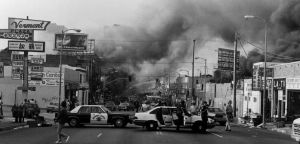
Last month, we posted up in the pews of an old black Baptist church in Watts for the 50th anniversary of Martin Luther King’s powerful “Beyond Vietnam” speech. We belted out James Weldon Johnson’s “Lift Every Voice and Sing,” the so-called “Black National Anthem,” a song I first heard before the last college basketball game I ever played in (at L.A. Southwest Community College, just a few miles from where we sang in Watts).

A few days later, we joined up with Bartimaeus Cooperative Ministries to help staff “Commemorating the 25th Anniversary of the L.A. Uprising,” organized by a group called ReconciliAsian, spearheaded by Sue and Hyun Hur, a Korean-American couple who pastor a Mennonite church in Southern California (keep Hyun in your prayers as he heads to North Korea this week). This space provided story-telling from different leaders (black, Latina, Asian and white) bearing witness to those chaotic days in the aftermath of the acquittal of three police officers in the Rodney King beating trial. Continue reading “25 Years Later by a Long Shot”

Morally Coherent & Socially Irresistible

Michael Eric DysonExcerpted from Michael Eric-Dyson’s “Abraham, Isaac and Us,” reposted from OnBeing.org:

The only meaningful interpretation of transcendence we might propose is to strip the term of its philosophical and theological orthodoxy and offer instead a more forceful definition. Truth can be described as transcendent if it illumines the time and place of its emergence as well as other places and periods. Truth’s transcendence is not pegged to its authoritative reflection of an unchanging reality that everyone would agree on if they had access to it. Truth happens when we recognize the expression of a compelling and irrefutable description of reality. Truth is not irrefutable because it appeals to ideals that escape the fingerprints of time and reason. Truth is irrefutable because it is morally coherent and socially irresistible. Continue reading “Morally Coherent & Socially Irresistible”

Place-Based Resurrection

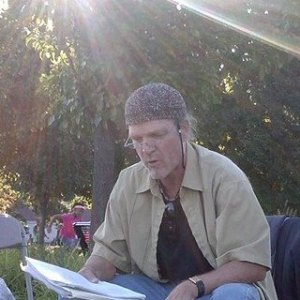
PerkBy Dr. James Perkinson (right), a sermon on Luke 24:13-35

I want to begin with a word of prayer before we jump into the gospel for today, but to facilitate that, first—a story about prayer and some necessary preliminaries. I have a half-Filipino poet friend in Detroit who tells of his first experiences of the Lord’s prayer, while growing up. Whenever he heard “Our Father who art in Heaven,” his five-year-old vernacular ears could not compute “art” as anything other than what happened when you put paint on paper, so his five year-old mind supplied a little slurred “n” in there, and what he actually thought he heard was “Our Father, who aren’t in heaven.” And it rattled him; he couldn’t figure it out; he says he kept thinking, “Well, where is he then?” If not there, then where? But he gradually came to hear it as a positive affirmation: a God who “aren’t” in heaven, because that God’s “place” is really right here, with us. A deep intuition, I would say, for all—what I would call place-based confession. Continue reading “Place-Based Resurrection”

Always Vigilant

audreFrom Audre Lorde’s “Learning from the 60’s,” a talk delivered at Malcolm X weekend, Harvard University, February 1982:

Revolution is not a one-time event. It is becoming always vigilant for the smallest opportunity to make a genuine change in established, outgrown responses; for instance, it is learning to address each other’s difference with respect. Continue reading “Always Vigilant”

A Knowledge Gap

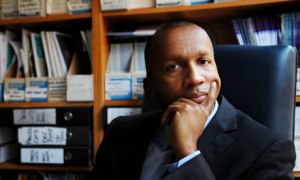
StevensonFrom Christina Gregg in an article entitled “Bryan Stevenson: America’s failure to deal with history of slavery and Jim Crow has manifested” reposted from AOL.com:

As a white nationalist says President Trump incited him to shove a black female protester at a campaign rally last March, a new museum in Montgomery, Alabama aims to advance truth and reconciliation while addressing the often unspoken reality of racial horror in America.

Burning black people alive, hanging them, mutilating their bodies — the graphic history of U.S. racial violence is a shameful and difficult thing to confront, says Equal Justice Initiative founder and executive director Bryan Stevenson, adding racially-driven hatred present today is “a manifestation of our failure to deal effectively” with that past. Continue reading “A Knowledge Gap”

A Market-Driven Soulcraft

A recent report from Matthew Albright on Dr. Cornel West’s recent speech at University of Delaware, originally posted at The Delaware News Journal:

America is facing a “Westspiritual blackout” because of its obsession with money and must recommit to “soulcraft,” Cornel West preached to a crowd at the University of Delaware in Newark on Tuesday.

“A society ruled by big money, big banks, big corporations, the commodification of culture, the commercialization of our culture,” he fired off. “How do you talk about integrity in the face of that ubiquitous cupidity?” Continue reading “A Market-Driven Soulcraft”

A Struggle of Interpretation

ElsaDay 46 of our Lenten Journey beyond “Beyond Vietnam.”  From Costa Rican biblical scholar Elsa Tamez, an excerpt from an article entitled “The Bible and Five Hundred Years of Conquest” (2005).
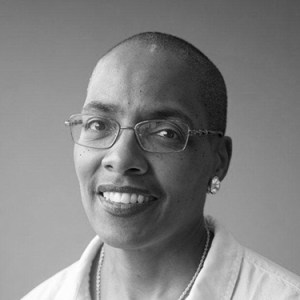
We see that for five hundred years we have been involved in a struggle of interpretation: some from a liberating perspective and others from a legitimating perspective of oppression. The struggle for a liberating reading of the Bible is good, nevertheless, it seems to me. After taking a look at history and seeing ourselves there as in a mirror, we need to go beyond the hermeneutical struggle. We should revise the discourse of our written canon and the logic of Christian thought; maybe there is a deeper problem that facilitates the rapid inversion of values. I am referring to aspects such as the biblical conception of time, that is, infinite progression toward the final victory (the Day of the Lord, the battle of Armageddon, the crushing of the enemy). These can be a double-edged sword—or the idea of a universalist, tolerant, egalitarian God, which is projected in the following scheme: “God is good for all; for that reason, all are good for God.” There is no distinguishing the difference. The sacrificial discourse, principally christological, sometimes degenerates into demands of unnecessary sacrifices or into the logic of crucifying the crucifiers; others such as the Elect of God, the Holy War, and so on need to be reworked. This is a matter not just of intellectual concern but of honesty before unjust practices that are easily legitimated with the Bible and theology. All of this leads us to rethink popular hermeneutics and to rework in great depth the significance of biblical authority.

Those Most Othered

KBDDay 45 of our Lenten Journey beyond “Beyond Vietnam.”  A Good Friday meditation from theologian Kelly Brown-Douglas, excerpted from a post on the Feminism and Religion blog.

In Jesus’ first century Roman world crucifixion was reserved for slaves, enemy soldiers and those held in the highest contempt and with lowest regard in society. To be crucified was, for the most part, an indication of how worthless and devalued by established power an individual was.  It also indicated how much of a threat that person was believed to be to the order of things. There was a decided crucified class of people. These were essentially the castigated and demonized as well as the ones who defied the status quo of power. It is in this respect that I believe Jesus’ crucifixion affirms his identification with the marginalized and outcasts. Indeed, on the cross Jesus fully divests himself of all pretensions to power and anything that would compromise his bond with those most othered in the world. The reality of the cross further affirms the profundity of god’s bond with put-upon bodies.. Continue reading “Those Most Othered”

Here’s the Rub

michelleDay 44 of our Lenten Journey beyond “Beyond Vietnam” continues.  An excerpt from Michelle Alexander’s recent comments on Mark Lewis Taylor’s re-release of The Executed God (2001), part of a longer back-and-forth dialogue that is well worth reading.

The truth is that I am still struggling to figure out what I believe about the nature of God and what it means to say that anyone has a “personal relationship” with God. I am just beginning my journey with theology, and therefore I have mostly questions — not answers or critiques.

What I do know is that I can no longer proceed as though mass incarceration is a purely political or legal problem that can be solved through forms of organizing, advocacy, movement-building and protest that lack a strong moral and spiritual foundation. The fact that Taylor offers a rigorous argument for spiritually-grounded actions that will force a national reckoning with our criminal injustice system is a cause for celebration. I wholeheartedly agree with him that political organizing and movement-building among faith communities is essential, and I also agree that political insurrection can be healing and transformative for those who have been traumatized, abused, and violated. Continue reading “Here’s the Rub”

More Spending, Of Course

Sharon KyleDay 42 in our Lenten Journey beyond “Beyond Vietnam.”  From Sharon Kyle, publisher of the LA Progressive and a professor of law at Peoples College of Law in L.A., excerpted from “Is Racism a Racket?” in the L.A. Progressive:

What struck me was that Dr. King almost laid bare the notion that racism is a racket. Not to say that racism doesn’t exist but that it’s continued existence serves an elite few.

In a similar assertion, Smedley Butler—a career military man who received 16 medals, five for heroism, and is one of 19 men to receive the Medal of Honor twice— wrote a book entitled, “War Is a Racket” because he felt that his years of experience showed him that American corporations and other imperialist motivations were behind our wars. He came to see through the PR campaigns that prime the public — that set the stage for war.  After retiring from service, he became a popular activist, speaking at meetings organized by veterans, pacifists, and church groups. Continue reading “More Spending, Of Course”