On The Idolatry of Hoping for an Easy-Fix With a Hero

An authentic cross-post from Heidi Thompson, the CEO of Religion News Service:

I’m ashamed to admit that I was a fan of Michelle Rhee when she first arrived.

In 2006 when I got to town, DC schools, like so many of our big city public schools, were (and in many cases, still are) horrible warehouses of despair and corruption. Previous school officials had been found guilty of stealing from the kids they were supposed to be helping. The elementary school around the corner from my first DC apartment looked more like a prison than anything else – bars on the windows and a concrete pad overgrown with weeds for a play area. Close to 40 percent of the kids in the city didn’t graduate from high school.

I wanted someone to kick butt and take names. I wanted a hero, someone who could bring powerful change that would help kids. Looking back, I can see now the sin of my thinking. It was idolatry, plain and simple. It was idolatrous to think that one person could turn around that much neglect and dysfunction.

But the sin I and lots of others committed was even worse than the idolatry of hoping for an easy-fix with a hero. What Rhee and her kind of so-called “reformers” have done is distract all of us from dealing with child poverty. In Rhee’s world, we as a nation can tolerate the astronomical rate of child poverty in this country (something like 20% of kids are in families where there is weekly food insecurity) if we just get rid bad teachers and bad schools. Rhee and her corporate donors would much rather have us talk about anything other than the deep re-ordering of our national priorities it would take to make sure every American kid got an excellent education.

This piece lays it all out. And reading it, I knew the shame belongs to me, too.

On The Run

“Together, the chapters make the case that historically high imprisonment rates and the intensive policing and surveillance that have accompanied them are transforming poor Black neighborhoods into communities of suspects and fugitives. A climate of fear and suspicion pervades everyday life, and many residents live with the daily concern that the authorities will seize them and take them away. A new social fabric is emerging under the threat of confinement: one woven in suspicion, distrust, and the paranoiac practices of secrecy, evasion, and unpredictability.”Alice Goffman, On the Run: Fugitive Life in an American City (2014)

A Prayer From/For Iraq

Lord, 
The plight of our country
is deep and the suffering of Christians
is severe and frightening.
Therefore, we ask you Lord
to spare our lives, and to grant us patience, 
and courage to continue our witness of Christian values
with trust and hope.
Lord, peace is the foundation of life;
Grant us the peace and stability that will enable us
to live with each other without fear and anxiety,
and with dignity and joy.
Glory be to you forever.
Prayer by Chaldean Catholic Patriarch of Iraq, 
His Beatitude Louis Rafael Sako

Openings At The Minneapolis Mennonite Worker

Exciting opportunity from the Mennonite Worker in Minneapolis:

We have residential openings in September or October: preferably a couple or folks who are willing to share a room. Please spread word: we’re moving into some exciting new directions as a community and would love to be joined with folks who not only want to live in an intentional Christian community, but would like to help give shape to our next season of ministry. In the next several months, we’ll be launching the Gene Stoltzfus Center for Creative Peacemaking, starting a community business (more on that below), and releasing a new educational initiative…

The Mennonite Worker is an urban intentional community committed to following Jesus’ way of hospitality, simplicity, prayer, peacemaking, and resistance. We are a Mennonite congregation whose way of life together is deeply influenced by the Catholic Worker movement.

Read more here. Apply here.

A Day of Mourning

Today, we lament the 69th anniversary of the atomic bombing of Hiroshima in 1945. This is a reflection from John Dear, posted last year over at Huff Post:

In 1981, while traveling in Europe, some friends and I visited Dachau, the Nazi concentration camp outside of Munich. Most of it was razed to the ground, but the original fences and barbed wire remained, along with a few buildings. That was enough to send chills down the spine. It was too much for me to take in. It’s still too much for me to take in.

Upon leaving, I noticed the beautiful suburban neighborhood surrounding Dachau. The houses, green trees, streets, shrubs, shops–it could have been any suburb in the U.S.–and it was right next to the Nazi concentration camp. I was shocked and asked the officials, “Was Dachau like this 35 years ago? Were these homes here?” Yes, they answered. They smelled the smoke–and went on with their lives.

The normality of evil! The suburban life of evil, the resigned acceptance of the big business of death right in one’s backyard–that’s what I saw in Dachau, and that’s what I saw again on Sunday as I drove up the mountain to join the annual Hiroshima commemoration peace vigil at Los Alamos, New Mexico, the birthplace of the atomic bomb, and headquarters of the U.S. nuclear weapons industry. I think it’s the most evil place on earth.

It’s also one of the most stunning locations in North America–the steep red cliffs, the pine trees, the Rio Grande down below, the distant mountains. And on the mesa, this beautiful, normal every town with its Starbucks, restaurants, hotels, churches, and hospital–and nuclear weapons labs which work overtime to prepare the end of the world.

Los Alamos is in the second richest county in the nation, with more millionaires per capita than anywhere else, even though the surrounding counties are some of the poorest. New Mexico recently returned to first place in child hunger and child poverty among the fifty states. Yet at Los Alamos, we spend billions building weapons of mass destruction. It’s the world’s most dangerous terrorist camp.

It’s a cliché to speak of the normality of evil, not to mention its banality or legality, but in Los Alamos, the big business of death surrounds you like nowhere else. Everyone is given over to death. They’ve gotten used to death, they’ve made peace with the bomb. They’ve become possessed by “Lord Nuke,” and they don’t know it. It’s like walking into a zombie movie, like stepping into “Invasion of the Body Snatchers.”

It was pouring rain, with thunder and lightning, on Sunday, so we did not process through town on our regular peace march. Instead our little crowd gathered in the stone shelter overlooking Ashley Pond, the exact place where the Hiroshima bomb was built. As in the past, we recalled the book of Jonah, put on sackcloth and ashes, and sat in silence for thirty minutes to “repent of the mortal sin of war and nuclear weapons and beg the God of peace for the gift of nuclear disarmament.”

After our silent sitting, I offered a few reflections. Then we turned to one another and shared our feelings about our prayer, Los Alamos, Hiroshima, our warmaking country, and the Gospel of peace. Then we had a conversation and a closing prayer.

“You and I are trying to wake up and stay awake, to open our eyes and keep our eyes open, to be conscious of the fullness of life and the evil in our midst,” I said. “We’re trying to non-cooperate with evil, to wake others up, to call for the abolition of nuclear weapons and the reallocation of these billions of dollars for death instead for pro-human services–for food for the hungry, homes for the homeless, universal healthcare, education and decent jobs and dignity and well-funded international nonviolent conflict resolution. This is the holy task God has given us–to be abnormal people of nonviolence in a world of normalized violence.”

Among the disturbing aspects of Los Alamos are the packed churches. The nuclear weapons Labs are made up predominantly of Christians with the full support of the local churches, including the rich, large Catholic parish of the Immaculate Heart of Mary. This is an incomparable blindness, or worse, it is comparable to the packed churches in the neighborhoods of Dachau and Auschwitz, where Mass and prayers were attended regularly by the Nazi officials who then spent the rest of their days killing our sisters and brothers.

This is a great blasphemy, and we need to name it as such. Jesus was nonviolent and called us to be peacemakers and to love our enemies, I pointed out; all Christians and all Christian churches are called to be nonviolent and to love enemies, not to support preparations to vaporize them. Christians who work at the Labs, like everyone there, should quit their jobs and find new nonviolent, life-giving work and join the movement to abolish nuclear weapons.

Silent contemplative prayer is perhaps the best response to the culture of death which is Los Alamos. Sitting in sackcloth and ashes centers us in mindfulness and brings us to a clearer realization that we are all in this together, that we all share some complicity with this culture of death, that none of us are exempt. We tried to repent like the people of Nineveh, to take responsibility for our part in the culture of war, and to ask our Higher Power for the sobriety of nonviolence. It was, of course, a modest gesture, but it’s a start.

“God of peace, bless us as we repent of the sin of nuclear weapons and war,” we prayed at the end. “Bless everyone here in Los Alamos and the world. Bless us all with the gift of a world without war, poverty and nuclear weapons.” In the end, we felt our prayer was heard.

And that was the surprise. Everyone left consoled, renewed and hopeful. Why? Perhaps because we were not alone. If we had gone there on our own, we would have felt despair, or worse, we would have turned away and felt nothing like walking zombies. But sitting together in a communal spirit of peace and prayer, we felt uplifted. Perhaps it was because we were addressing reality, the proverbial dead elephant in the room. Perhaps most of all, it was because we tried to engage the God of peace about this work of ultimate evil. The consolation everyone felt was God’s response. That was a great blessing.

August 6th marks the 68th anniversary of the U.S. atomic bombing of Hiroshima, and August 9th, marks Nagasaki. These dates invite us to reflect on the “normalcy” of our culture of death, and how much we fit into it. Do we want to be like the suburban people of Dachau or Los Alamos, or can we peacefully say no to the culture of death, try to help each other wake up to the fullness of life, and turn to the God of peace for the gift of nuclear disarmament?

That’s what Hiroshima asks of each one of us.
——————————————–
And Courtesy of Veteran’s For Peace:

Praying in Front of the Pentagon

The Dorothy Day Catholic Worker House in Washington D.C. has maintained a weekly peace vigil at the Pentagon since 1987. This is an excerpt from a piece that Art Laffin wrote for the The National Catholic Reporter in October:

This morning I was alone there and had an opportunity to be present to hundreds of civilian and military Pentagon workers, a number of whom acknowledged my “Good Morning” greeting.

During the vigil I prayed in repentance for my own complicity in our culture of violence and for a conversion of my own heart to the Gospel. I prayed, too, that all who work at the Pentagon as well as in the larger military-industrial complex, and who are responsible for directing, planning, and implementing overt and covert military interventions throughout the world have a conversion of heart away from war, weapons, killing and torture, and towards God’s way of nonviolence, justice and peace.

I also prayed for and remembered the victims of U.S. warmaking and poverty, past and present. And I prayed for all those seeking peace and reconciliation in war zones, all peace prisoners and all who are held captive, including those detained in Guantanamo, some of whom are still on a hunger strike.

I finally prayed that the Pentagon would one day be converted and that each of the five sides of the building be transformed into: a center for nonviolent conflict resolution training; a center for developing and providing alternative and renewable energy sources; a medical treatment center; a daycare center; and a bakery.

Organizing to Stop Detroit Water Shut-Offs

From Rev. Bill Wylie-Kellermann, reporting from Detroit:

An Open Letter from Detroit Religious Leaders and Allies
July 24, 2014

Ho, everyone who thirsts, come to the waters
Let the one who has no money, come… (Isaiah 55:1)

Friends in Faith and Fellow Citizens:

In our traditions water is a free grace, part of the great gift that underlies all creation. We drink it as life itself. We wade through it to freedom. And in conversion we are immersed and sprinkled and cleansed. We wash our feet, so to pray. In season we know to honor it even by fasting from it. It is the lifeblood of the planet, circulating as river and rain. Water is the very emblem of the commons, what we hold together as one. We share it beholden to local indigenous peoples who understood, understand this deeply. For governments which serve the people, a water system is a public trust, held in trust for this generation and those to come. For the United Nations access to clean potable water is counted a human right.

In Detroit the largest basin of fresh water in the world flows by us through the river, “the strait.”
But in Detroit, under emergency management, as many as 150,000 homes are threatened with shut-off, up to 3,000 per week, largely by private contractors. People, including children, the elderly and infirm, wake up in the morning to find themselves unable to drink, cook, wash, or flush toilets. In fact, two thirds of these homes are occupied by children. People without water fear losing their children to protective services. They can be driven from their homes, their neighborhood, their city.

On June 18, 2014 a complaint charging a violation of human rights was filed with the United Nations. Three Special Rapporteurs have already responded in a written statement, stressing the urgency of the situation: “Disconnection of water services because of failure to pay due to lack of means constitutes a violation of the human right to water and other international human rights.”

As religious leaders and communities we join our voices to say: In the name of humanity stop the shut-offs.

To Detroiters we say, alert, defend and protect your neighbors from shut-off. To Faith communities we say, become stations of water distribution (for information and guidance on this call 1-844-42WATER), as well as places of education, community and resistance. To Water workers, we say refuse to cut off your fellow citizens. To the Water Board, we say reverse this inhuman policy: turn their water back on. To the City Council, we say stop compounding this travesty with rate increases and other complicity. Revive and implement the Water Affordability Program. To the Governor we say: cease privatization and call off this action taken under emergency management.

To our God we pray, defend the children, the least, the poor. Help us to do so this day. Let your justice roll down like waters and righteousness like an ever flowing stream.

Civil Disobedience At Hancock Air Base

Repost from Ched Myers at Bartimaeus Cooperative Ministries:

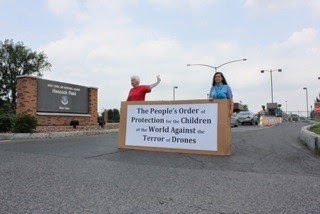
Earlier today our dear mentor Liz McAlister (below) and eight Atlantic Life Community activists were arrested protesting at the main gate of Hancock Air Base, in Syracuse, New York. Hancock is the home of the 174th Attack Wing of the New York State Air National Guard, which pilots weaponized MQ9 Reaper drones over Afghanistan – killing and terrorizing an uncountable number of civilians. We pray for these dear friends of ALC.