Our Most Sacred Relative

Jim BearAn excerpt from Rev. Jim Bear Jacobs’ powerful Thursday morning sermon at the February 2019 Bartimaeus Kinsler Institute on Chumash land (“Oak View, CA”). Listen to all 40 minutes of challenge and inspiration here.

The principle of non-Indigenous environmental justice work could be summarized like this:

The earth is our greatest natural resource and it is incumbent upon us to protect it.

Sounds good, but it is wrong. Because when viewed from an Indigenous perspective, we would state it like this:

The earth is our most sacred relative and it is incumbent upon us to protect her.

The Earth has an identity. The Earth lives. She breathes. She moves. She thunders. She nourishes.

The Traumatic Somatic

MamieTillFrom the conclusion of a sermon that Ched Myers preached at Garret Evangelical Theological Seminary Chapel on April 24, 2019. Access the entire sermon here

Our gospel text—and the excruciating lesson of Emmet Till’s funeral, which launched the most significant social movement in U.S. history—challenge us to embrace the beat up bodies of both marginalized people and degraded places around our earth mother. As we do so, we will be motivated also to embrace the militant evangelistic vocation Jesus leaves his companions at the end of Luke’s Emmaus narrative: to “proclaim repentance and forgiveness of sins in my name to all nations, beginning from Jerusalem” (24:47). It is we who must continue the prophetic struggle to turn history around from its captivity to our terminal addictions and compulsions—that’s the meaning of “repentance.” Resurrection as Insurrection! And as Jesus notes, this good news is not just for individuals, but nations and systems, starting at the centers of power— for Luke, Jerusalem, for us, Washington DC. Continue reading “The Traumatic Somatic”

This Sacred Work

TeresaIn April 2016, Teresa Grady joined the Ancestors after 88 years of resisting and rising above the colonial script. This is an excerpt from the eulogy given by her granddaughter Cait De Mott Grady at the funeral mass at Immaculate Conception Church in Ithaca, New York.
My grandma who found cracks in empire and planted seeds in the rich and fertile soil that’s there. My grandma knew in her gut, in her bones, in her heart, in her spirit, that it is imperative that each of us say something, do something, speak from our specific position within the interlocking systems of oppression — patriarchy, white supremacy, capitalism, racism, militarism, materialism — systems that work to strip us all of our humanity. And that this sacred work starts with relationships.

Teresa Grady: Presente!

The Ghosts America Has Kept At Bay

BayoAnother pressing social media post from Bayo Akomolafe (April 30, 2019).

An older gentleman in Iowa asked me:

As a non-American, what do you think is our greatest problem in America today?

I replied, “I’m not sure about it being the ‘greatest’, but I would say immigration.”

He nodded his head as if in agreement, so I drove the real point home: Continue reading “The Ghosts America Has Kept At Bay”

Eastertide: the Outing of the Church

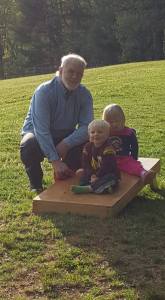
KenBy Ken Sehested (photo right with grandchildren), curator of prayerandpolitiks.org

Some years ago, writing in the days leading up to Easter, I realized important though tragic anniversaries arrived in the days immediately following that Sunday.

“Even before our resurrection flowers have wilted, we will be confronted again with the presence of evil. Since Easter falls early in the calendar this year, in the coming resurrection week we will be forced to remember the enduring power of death. In 1945, Dietrich Bonhoeffer, a German pastor and theologian, was executed by the Nazis two days after Easter Sunday. This next Thursday, April 4, we will remember the 1968 assassination of Dr. Martin Luther King Jr. right here in Memphis.” —continue reading “Open Letter to My Daughter: Easter morning, with the stench of death still in the air

What it is

We have entered Eastertide, the liturgical season beginning with Easter and ending 50 days later on Pentecost (aka Whitsunday). The formulation of this season parallels the period in Judaism between the first day of Pesach (Passover, marking their liberation from Egypt) and the feast of Shavu’ot (Feast of Weeks, both a harvest festival and a commemoration of the giving of Torah at Mount Sinai). Parallel resurrection moments, setting the stage for resulting resurrection movements. Continue reading “Eastertide: the Outing of the Church”

It Was Out of My Heart That I Spoke

MonicaA few summers ago in Detroit, a circle of high school students from a local church gathered with community organizer Monica Lewis-Patrick, executive director of the grassroots We The People of Detroit. The conversation flowed into what it looks like for faith to infuse political action when the odds are stacked against justice, freedom and equity. This is an excerpt.

All we have to do is start connecting the dots and telling the truth. When I started working in social justice, I was working in education, with children that were mentally impaired and extremely violent. What I found out really quickly was that the people at the table didn’t give a damn about the children. It was about the dollars. Because I cared about the children, I had to educate myself in terms of how I influence the policy—or the people who drive the policies—to help my people get the change they need. To help the children I served. That meant going to meetings where sometimes I would be the only one there speaking on behalf of the population that I thought was most vulnerable and most in need. Was I scared? Yes I was. Did I always get the language right? No I didn’t. Did I always have the data on hand that they had? No I didn’t. But it was out of my heart that I spoke. And then from there what would happen is that somebody would give me a card or somebody would say, “You know, I didn’t know that part” or “Can we talk?” And then I had to dig up from my spiritual history or family history and muster up enough energy to go meet with somebody that has a title—that seems to have power—and say to that person “We don’t like this.”

We’re Not Alone in This Commitment

FletcherFrom Jeannine Hill Fletcher, Professor of Theology at Fordham University, Bronx NY and author of The Sin of White Supremacy:  Christianity, Racism and Religious Diversity in America (Orbis, 2017). This is an excerpt from a sermon originally posted in June 2018 at Catholic Women Preach entitled “Body and Blood of Christ.” Read the sermon in its entirety here.

When Christians drink the cup of the covenant, we insert ourselves in the final meal of the One who gave over his body and his blood in the stand against the systems of violence in his world, committing his blood to reveal that things could be different.  And we’re not alone in this commitment.  In 1953, Mamie Till raised her son Emmett to an international gaze when she had the courage to show how the sin of White supremacy made the blood of her only son flow to his death.  In 2018, from out of the aftermath of the blood that flowed from a code red active shooter, Emma Gonzalez had the courage to name how blood is meant for life.  In Charlottesville, and Philadelphia, and New York City, people are finding the courage to stand and to march, to show up and stand against the blood the flows from White insecurities and White supremacies which refuse to acknowledge that Black Lives Matter.  Christians are committing to the life blood of fathers, uncles and mothers threatened when ICE decides that no space is sacred.  In response to the triple threat of racism, materialism and militarism, the many movements in our day carry on the work of the Rev. Dr. Martin Luther King who witnessed with his blood what it looks like to be in covenantal relationship with the God who dwells in human beings, responding to violence with peace; even if it means giving over one’s life.

The Powers of Death and Life, Lies and Truth

KurdistanFrom Weldon Nisly, retired pastor and half-time Christian Peacemaker Teams member serving five months per year in Iraqi Kurdistan (photo right) serving. This is an excerpt from his Holy Week update on the ground in Kurdistan. 

On this Holy Saturday between Good Friday and Easter Sunday, we live liturgically between the powers of death and the powers of life. All of us choose daily whether we worship death or life and are committed to lies or truth.

Recently CPT encountered someone who knows the cost of choosing life and truth confronting militarized political powers. Independent Kurdish journalist Mohammed (name changed to protect identity) told the CPT Iraqi Kurdistan team of his refusal to promise to stop seeking and speaking truth about the powers of death. “I am a journalist,” Mohammed simply and firmly declared to us. His commitment was not a theoretical stance. He had recently been arrested, imprisoned, and tortured for more than 40 days and his family was threatened by the powers of death who accused him of inciting opposition to the ruling political party leader. Continue reading “The Powers of Death and Life, Lies and Truth”

Liberating Evangelicalism

HarperFrom the Twitter account of Lisa Sharon Harper, Founder and President of Freedom Road and Senior Fellow at Auburn Seminary. It was posted on March 18, 2019.

To all the people, designated White by colonizing nations, who are becoming disillusion by your evangelical or Christian faith: When you walk away from Jesus you are not #woke. You are operating out of the white supremacy you say you abhor. #LiberatingEvangelicalism

When you walk away from Jesus and Christian faith to be “woke” you are walking away from a faith that sprang from brown, indigenous, colonized people. You’re walking away from faith born on the underside of empire in the context of oppressed peoples. #LiberatingEvangelicalism Continue reading “Liberating Evangelicalism”

How Making Friends with Indigenous People Changed My Life

By Joshua Grace, originally posted at Red Letter Christians

I’m a Polish-American settler. I didn’t choose the conditions of my birth or my original family. However, I do choose to actively undermRandyine the systems and lies beneath those conditions of various levels of privilege.

Ignorance of our nation’s history, and the systems that our national narrative myth supports, only perpetuate injustice and maintain roadblocks to our greater healing. I was fortunate that in the process, my own Western worldview got challenged and I realized it needed to be overcome. I could not and probably would not have put the work in without supportive community — the Indigenous friends, teachers, and relatives who offered a healing sense of belonging. Continue reading “How Making Friends with Indigenous People Changed My Life”