Jesus’ Ministerial Vision

SistersA Holy Week rebound from Sisters in the Wilderness: The Challenge of Womanist God-Talk (1993) by Dolores Williams.

The image of Jesus on the cross is the image of human sin in its most desecrated form. This execution destroyed the body, by publicly exposing his nakedness and private parts, by mocking his ministerial vision as they labeled him king of the Jews, by placing a crown of thorns upon his head mocking his dignity and the integrity of his divine mission. The cross thus becomes an image of defilement, a gross manifestation of collective human sin. Rather, Jesus conquers the sin of temptation in the wilderness (Matthew 4:1-11) by resistance–by resisting the temptation to value the material over the spiritual; by resisting death; by resisting the greedy urge of monopolistic ownership. Jesus therefore conquered sin in life, not in death. In the wilderness he refused to allow evil forces to defile the balanced relation between the material and the spiritual, between life and death, between power and the exertion of it. Continue reading “Jesus’ Ministerial Vision”

Jesus Still Goes Before Us

BindingAn excerpt from Ched Myers’ Binding the Strong Man: A Political Reading of Mark’s Story of Jesus (1988), reflecting upon the open tomb ending of the first Gospel.

We should not be surprised that the women are overcome with “fear.” The disciples have in fact been described as “fearful” (phobeisthai) at several important “passages” in their journey with Jesus: both stormy boat crossings (4:41; 6:50), his transfiguration (9:6), the portents of his execution (9:32), and the journey up to Jerusalem (10:32). And does not this closing scene represent the most difficult passage of all? For in it the martyr-figure beckons the disciple to take up the journey afresh, to return to the beginning of the story for a new reading-enactment. The young man’s invitation ought to provoke trepidation in us, if we take it seriously. As Bonhoeffer paraphrased Mark 8:34 in Cost of Discipleship (1953), “When Christ calls a person, He bids them to come a die.” Continue reading “Jesus Still Goes Before Us”

A God Who is Very Different from the Almighty

AugsburgerFrom the conclusion of David Augsburger’s recent piece “Lent: Is God Like Jesus?” originally posted on The Mennonite blog. Read the entire Lenten reflection here.

“Christ is not only God-like, but God is Christ-like,” Martin Luther King Jr. wrote in Strength to Love (1963). The Christian gospel proclaims a God who is very different from “the Almighty,” the historic God among all the gods who is, by trusted definition, an omnipotent paragon of ultimate invincible irresistible power. The God of Jesus Christ, in Leonardo Boff’s phrase, is “weak in power but strong in love” (Cry of the Earth; Cry of the Poor, 1978).

God is like this gentle good gracious guest at Mary, Martha and Lazarus’ home, at Zacheus’ table, at Simon’s banquet, at Cleophas and spouse’s supper. Continue reading “A God Who is Very Different from the Almighty”

To Combat Deportation: A Day of Prayer

Christians for SocialismThis Monday, April 15,  Christians For Socialism is proposing a day of prayer for all those in the States facing deportation (see below for more specifics). Consider joining them.  

On Tuesday, April 2, a court ruled that hundreds of Assyrian/Chaldean people in the Detroit area detained by ICE could be deported to Iraq after a legal battle carried out by the ACLU. The Assyrians/Chaldeans are a regional minority who have been targeted and brutalized in Iraq. The deportation would be especially dangerous for Assyrian/Chaldean Christians. Continue reading “To Combat Deportation: A Day of Prayer”

To Walk in Love and Not Fear

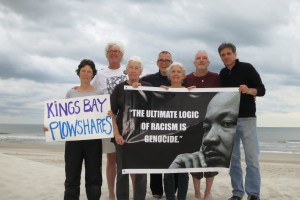
Kings BayFrom Clare Grady, a member of the Kings Bay Plowshares 7, in an interview with Amy Goodman this week on Democracy Now, explaining why they risked twenty-five years in prison for their nonviolent action on the 50th anniversary of Dr. King’s assassination:

The weapons of empire are always the threat of death and torture and incarceration and dehumanization. And so, when we undertake this, as white people of privilege, we are just adding a little tiny bit to what is ongoing of the struggle of people, where the Doomsday Clock has already hit midnight for them and their children and their grandchildren and the Earth where they live.

But I think that what we want to do…is be invitational to other people with similar privilege to say that we enjoy these privileges. But we’re not really enjoying it. There’s just tremendous cost that comes with all this. But in stepping over that line and taking that hammer and actually hammering a dent in some of these weapons system, they give you this 25-year threat, but you don’t know what the outcome is. The whole process is to encourage each other to walk in love and not fear.

Latin-X Discipleship

Josh LR2By Rev. Josh Lopez-Reyes (right), Pastor and Community Life Specialist at The Loft in Los Angeles, California

*This is the 15th installation of a year-long series of posts from contributors all over North America each answering the question, “How would you define radical discipleship?” We will be posting responses regularly on Mondays during 2019.

What is radical discipleship? As I reflect on this question, the image of deep-dirty soil comes to mind. As many contributors have reminded us via this wonderful online community of resisters, the word ‘radical’ comes from the Latin radix or radic meaning roots. Therefore, radical discipleship is the inherit, deep and primary essence of apprenticeship concerning the brown Palestine prophet and peasant. As the Rev. Dr. Miguel De La Torre reminds us in, The Politics of Jesús: A Hispanic Political Theology (Rowman & Littlefield, 2015), this is nevertheless saying “no” to Jesus.[1] That is, it is the rejection of a comfortable, gnostic, white supremacist savior. Radical discipleship is about going to the roots of our tradition, to recover the profoundly deep solidarity of Creator’s love demonstrated in the one who was crucified on Good Friday in unity with the crucified communities of our world.[2] However, it is also about going deep into the roots of who we are. It is about revealing the beloved community as the unique creation that the Creator birthed us to be. In my case, it is about being Latin-X. Continue reading “Latin-X Discipleship”

The Evidence is Clear

Rhiana GunnFrom Rhiana Gunn-Wright, policy director for the nonprofit New Consensus, one of the lead policy writers for the Green New Deal. She was interviewed on DemocracyNow.org and asked about the connections between racial wealth disparity and climate change and how the Green New Deal will address them.

There’s a couple reasons that we see [racial wealth disparity]  connected to the Green New Deal. One is, of course, a moral argument. A lot of the people who are dying from fossil fuel pollution or who are carrying the heaviest burden are people of color, and they’re poor people of color. And likely, when climate change picks up and we see more disasters, more deaths, those are the first people who are on the line. People like to say climate change will kill us all, but the truth is climate change will kill some people first. And so, there’s a moral imperative to make sure that in the green transaction the same people who bear the brunt of our reliance on fossil fuels are not the same people who the green transition is being built on their backs. So that’s one. Continue reading “The Evidence is Clear”

Responding to a Deep, Insistent Sense of Call

Chava Redonnet (1)
PC: Lisa, a guest at the Catholic Worker

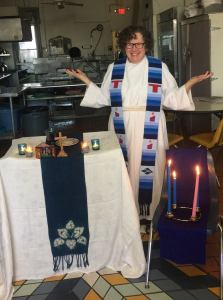
By Chava Redonnet (right), from the bulletin of Oscar Romero Inclusive Catholic Church in upstate New York (4th Sunday in Lent)

Something I really do not enjoy doing is arguing. It’s one of those character traits that can be seen as either a virtue or a fault, but whichever it is, it’s me. Live and let live is more my style. We don’t all have to agree.

So in recent years I have found myself less and less interested in trying to convince anyone why women should be priests. I figure my priesthood is my argument for women priests. If someone can look at my ministry and say it’s not valid simply because I’m female, I don’t think anything I could say would change their mind. Continue reading “Responding to a Deep, Insistent Sense of Call”

With a heavy heart

51018208_1652852181527529_5162391080217346048_nBy T. Tackett

Dear beloved family,

I write this with a heavy heart. In the last couple months we have lost a lot. The towns are flooded. The cities are on fire. The air is thick, toxic, and unbreathable. Most of the water, if there is water, is not potable.  Which leaves us thirsty and breathless.

We have lost a lot of people. All by murder in my opinion. If not by direct assassination, then by the insidious hand of the systems that be.

In these times of resistance and working towards radical transformation; grief and trauma collect in creases of our being. There is no way around it. Battle wounds become battle scars, which become evidence of our fight.

In our work, we are often reminded that grief is a call to action, yet it is difficult to move forward without fully understanding what is happening to us, to our children and to the outcome of all life on earth. It feels all to much. The pain. The burden weight on our soul, trying to sink us. We try to listen, but the sound of our hearts breaking is just to loud.

Don’t get me wrong, most of us understand death, we have had intimate relationship with it. But from this death, life often begins anew. So here in this deep grief we are met with life again. And in this new life, we bare the grief of our old life; a death which we have not yet accepted, and a death which hurts our hearts to bare.

I have always held the belief that we can change this world and we can heal ourselves in the process. But this is hard. This is painful. This is unthinkable. It has never been done before and at the same time it has been done for generations. These two truths are not opposite or contradictions. They are of the same and live within each other.

It was Charity Hicks, one of the great martyrs of the Detroit Water struggle, who called us to “Wage Love”. This idea is not a passive act, but a call to be courageous. A call to heal, but  not forget. To remember our grief. To hold it in our pursuing of justice. And to also remember one can not do this alone. That the possibility and opportunity to heal lays in the foundation of the beloved community. And that every member of the beloved community never truly leaves us. Even in death, They live in the home of our hearts and that in each step towards justice, they continue to walk with us forever.

I finish this letter to say that It is together we will continue to fight, it is to together we will grieve and it is together, we will live again.

In struggle and love

Your brother,
-T. Tackett

T.Tackett is a Community organizer, Activist ,Water Protector, and Land Defender. Born and raised in the Great Lakes region.




On The Floor

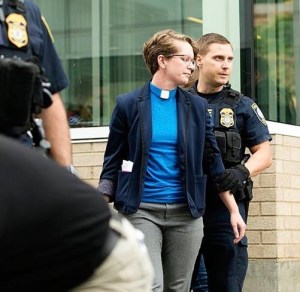
Rev Spaet (1)By Rev. Erika Spaet (right)

*This is the 14th installation of a year-long series of posts from contributors all over North America each answering the question, “How would you define radical discipleship?” We will be posting responses regularly on Mondays during 2019.

I learned to cook from the kitchen floor.

As a kid, while the evening rituals unfolded in our suburban New Jersey home–the nightly news, the coming in from traffic, the smell of onions in the skillet–I would get onto the linoleum floor and recline under the kitchen prep table that held my mother’s cookbooks. From there, I watched her rock back and forth, from stove to fridge, and make our meals. She, my unknowing teacher; me, her odd, lackadaisical student. Something about the canopy of that table made it my favorite place in the house. It’s also where our labrador, Max, used to hang out. Continue reading “On The Floor”