Interconnectedness & Intimacy

Friendly FireA message from our friends at the Friendly Fire Collective:
Another church is possible!

Global systems of domination keep us isolated.  Capitalism, white supremacy, cisheteropatriarchy, ableism, and christian hegemony violently tear our communities apart. The church has for too long perpetuated these power structures—but we will not. Continue reading “Interconnectedness & Intimacy”

KICKED & PRODDED by the SPIRIT

Descending, Front CoverBy Oscar Cole-Arnal (Oz)
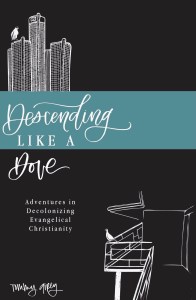
A review of Descending Like A Dove: Adventures in Decolonizing Evangelical Christianity By Tommy Airey

As of April 4, 2018 I have lived a half century pilgrim’s existence hounded, kicked and prodded by the Spirit through weird and wonderful emissaries thereof.  Of course, she had to act this way, precisely because I am of that abominable character best described as a white old fart privileged male—you know that demographic who helped give our world the gifts of Donald Trump and Doug Ford.  So I say to the Spirit and her visitations to me—bring em’ on and more of the same.  Yes, as a young Lutheran pastor well on the road to pastoral and academic success in my first pastorate near Pittsburgh, my world became upturned by martyr’s blood, not my own, but that of Martin Luther King Jr.  With his shed blood pouring from Memphis into my heart, my family and I vowed to disdain our privileges and realign our lives after his model.  So we became civil rights and antiwar activists, strong supporters of Cesar Chavez’ boycott—going to jail, facing baton-wielding cops, having anonymous life threats and ending my paid vocational career in Waterloo, Ontario teaching Church History at the Lutheran Seminary there.  Since retirement, I remain active in a local group called the Alliance Against Poverty. Continue reading “KICKED & PRODDED by the SPIRIT”

Taught By The Trees

Kim RedBy Kim Redigan, a teacher, organizer and author in Detroit, Michigan

*This is the 13th installation of a year-long series of posts from contributors all over North America each answering the question, “How would you define radical discipleship?” We will be posting responses regularly on Mondays during 2019.

There was an April day in a small West Bank town when a group of us serving on a peace team witnessed ancient olive trees ripped from the ground by a confluence of machines and the military – an act of violence that literally drove us to our knees in grief.

Years later, I danced among the olive groves in a small village in Greece with my great-aunt Demetra where ancestral trees brought me home to myself, awakening something deep down inside that speaks truth older than history. The same brilliant Mediterranean sun throbbing against a canvas of brilliant blue, the same terraced hills that undulate like patterned green blankets rolled out by Mother Earth, the same brown ground that feels solid and familiar under the feet. Continue reading “Taught By The Trees”

The Real Substantive Issue

IlhanAn excerpt from the article “How targeting Ilhan Omar instead of white supremacy furthered both anti-Semitism & Islamophobia” at BlackYouthProject.com by Su’ad Abdul Khabeer, Chanda Prescod-Weinstein, Margari Hill, Rakel Joseph, and Asha Noor:

The false charges of anti-Semitism divert public attention away from the real substantive issue at hand: human rights abuses by the Israeli government in Occupied Palestine and Israel itself. According to the UN Human Rights Council, over 6,000 unarmed Palestinian demonstrators, including children, journalists and medical personnel, were shot by military snipers during the “Great March of Return” protests in Gaza in 2018. Continue reading “The Real Substantive Issue”

Sitting Together in the Darkness

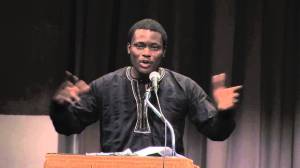
BayoFrom Bayo Akomolafe of The Emergence Network:

This time, which some call the Anthropocene, disturbs the idea that we can summarily understand everything that is going on, or that such a venture is even desirable. We can study patterns and notice dynamics, but we can also exercise care and be humble about the reach of language and rhetoric – knowing that (as the Yoruba say) “wisdom is like a baobab tree; one cannot fully embrace it.” Continue reading “Sitting Together in the Darkness”

I Am

Aireys, Early 20sBy Tommy Airey

Note: this was homework assigned by Dr. Lily Mendoza to a beloved community of ethno-autobiographical faith resisters in Detroit, Michigan

I am Southern California branded, but DNA stranded in a blue-eyed tribal scandal, maybe Goth or Vandal—or even a Saxon and Celtic quarrel from long long long ago.

I am the wandering whiteness of Cain, against-the-grain Abraham resisting an abiding city, the peregrini pilgrimage, the wonder voyage, the sign of the cross, always in process. Continue reading “I Am”

Belovedness

Will O'BrienBy Will O’Brien (right), director of the Alternative Seminary in Philly, PA

*This is the 12th installation of a year-long series of posts from contributors all over North America each answering the question, “How would you define radical discipleship?” We will be posting responses regularly on Mondays during 2019.

Many decades into a vocation of trying to faithfully engage in movements for social justice and peace, I am coming to sense more and more the powerful and radical truth in the simple phrase from the First Letter of John, “God is love” (1 John 4:8). I am utterly convinced that all systematic theologies, all ethics and morality, all spiritualities are subsumed into this daring assertion: God is love. All of the created order is a miracle of love. The human adventure over millennia is the struggle to know and live out our belovedness. The mystery of sin is ultimately the failure to love or to experience belovedness. Jesus the Anointed One embodies love and invites us to a path of love. Continue reading “Belovedness”

A Symbol of a Nation

The End of the Myth_JKT.inddFrom Greg Grandin, professor at New York University and author of The End of the Myth: From the Frontier to the Border Wall in the Mind of America (2019):

The wall might or might not be built. But even if it remains only in its phantasmagorical, budgetary stage, a perpetual negotiating chip between Congress and the White House, the promise of a two-thousand-mile-long, thirty-foot-high ribbon of concrete and steel running along the United States’ southern border serves its purpose. It’s America’s new myth, a monument to the final closing of frontier. It’s a symbol of a nation that used to believe that it had escaped history, or at least strode atop history, but now finds itself trapped by history, and of a people who used to think they were captains of the future, but now are prisoners of the past.

We’re Not in that World Yet

StevensonIn a New York Times Magazine interview, Bryan Stevenson was asked, “What would the Rev. Dr. Martin Luther King, Jr. think of America if he were alive today?” This was his answer.

When he found out that one in three black male babies born in this country is expected to go to jail and prison, when he saw the level of poverty, when he heard some of the rhetoric that we frequently hear, I think he would be heartbroken. But I also think he would be excited that if he called a meeting, thousands would come. And that’s what has to happen, even without Dr. King — that we have to be willing to make that commitment so that we can create a world where if Dr. King emerged, he would be so proud to say his dream has finally been realized. We’re not in that world yet.

Bryan Stevenson is the author of Just Mercy: A Story of Justice and Redemption (2014) and the co-founder of the National Memorial for Peace and Justice (informally known as the National Lynching Memorial).

Bending the Arch: An Interview with Rose M Berger

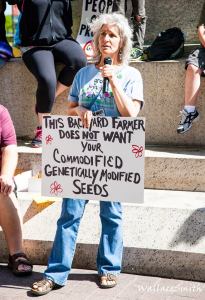
roseOnce a young woman asked Rose Berger, out of the blue, to baptize her. I watched as right then and there, Rose summoned sacramental power and beauty pouring water and speaking holy poetry. So, when Rose publishes a book of poetry, I pay attention and call upon all of you to heed her cry.          -Lydia Wylie-Kellermann

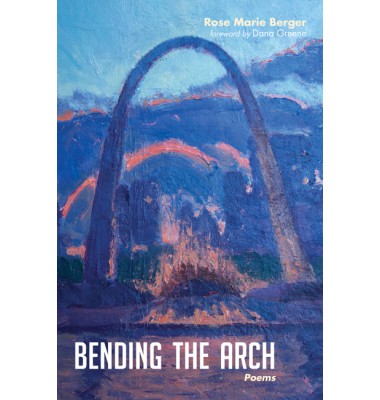
Bending the Arch, By Rose Marie Berger

RD: It is a heavily annotated poem, can you talk about the relationship between the poetry and the history and information in the back?

RMB: It’s a good question. I just finished reading Micheal O’Siadhail’s The Five Quintets, a 350-page poem examining the Modern era with no endnotes or explanations. It’s a stunning, ground-breaking work. But it requires a lot of work by the reader. Bending the Arch requires a lot from the reader also, but I wanted to lower the bar a little. Make it a little easier and more accessible. There are themes in Bending the Arch that I want readers to explore more on their own. My hope is that the endnotes will encourage readers to dig into the suppressed historical narratives in their own families and regions. Continue reading “Bending the Arch: An Interview with Rose M Berger”