We Need a Moral Breakthrough

BarberAn excerpt from Rev. William Barber’s address presented before the 74th Union for Reform Judaism Biennial convention on December 6, 2017.

We are here tonight, and 62 years ago would have been the fifth day of the Montgomery Bus Boycott. Today, when the prophetic actions of Rosa Parks like Shiphra and Puah in the Bible, chose to challenge the Pharaoh of Jim Crow. She sat down and birthed a movement on a stage that produced a prophet like Moses named Martin. She sparked a nonviolent revolution. Continue reading “We Need a Moral Breakthrough”

Nuestros Sueños

immigration
By Julia Jack-Scott

By Liza Neal

“Nuestros sueños no se detendrán incluso en la muerte.”  Our dreams will not stop even in death.

These words are painted on the Mexico side of the Border Wall.  It could have been carved on the Mayflower.  Half the Pilgrims that traveled to the “new world” died. The rest would have died if not for the mercy of the Wampanoag, who were repaid with disease, indoctrination, and their leader’s head on a spike displayed next to the Pilgrims’ crops. Continue reading “Nuestros Sueños”

Counter-Recruiting for the Politics of Nonviolence

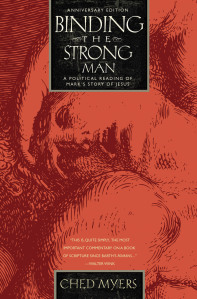
BindingComments on this week’s Gospel text (Mark 13:1-8) from Binding the Strong Man: A Political Reading of Mark’s Story of Jesus (1988), the commentary from Ched Myers, celebrating 30 years of prophetic utterance. 

The images Mark uses in 13:7f.–wars, famines, earthquakes–are all virtually generic to apocalyptic literature. One need only consult contemporaneous apocalyptic literature such as John’s Revelation, 4 Ezra, the Assumption of Moses, or the Qumran war scrolls. At the same time, these events could be correlated to contemporaneous history. “Rumors of war” aptly characterizes and describes the way in which news regarding the seesaw political events of 68-70 C.E. would have circulated around Palestine. Was the siege coming? Were the Romans withdrawing? “Kingdom rising against kingdom” might have referred to the wavering fortunes of Rome in 67, embroiled in a civil war and fearing a Parthian invasion. Major natural disasters were also part of contemporaneous history, such as the famine (which hit Palestine especially hard) of the early 50s C.E., or the earthquakes and volcanic eruptions that destroyed Laodicia and Pompei in 61-62 C.E. Both Mark and his opponents could–and did–appeal to the “plurivalent” (multi-referential) nature of apocalyptic symbolics in making their respective cases. Continue reading “Counter-Recruiting for the Politics of Nonviolence”

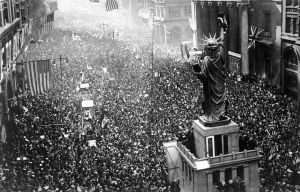
Aftermath of the Great War’s Armistice

ArmisticeBy Ken Sehested

The Resurrection is the Beloved’s own
Armistice, intimate seal on ancient covenant,
when the rain’s own bow arches in the flood’s
aftermath as divine reminder, animus receding
by act of divine contrition:

Never again. Never again.*
No longer will Heaven respond with drowning
contempt over earth’s profaning habit. Divine
remorse calls out for creaturely requite. The
soil itself destined for fertile bounty’s return. Continue reading “Aftermath of the Great War’s Armistice”

When Will We Rise?

ImageFrom the Center for Prophetic Imagination, working to live in a world where all walls of alienation are torn down and all people live justly with each other, with the land, and with the Spirit of Life. Sign up HERE to receive their weekly email updates!

Usually, we talk about the Risen Christ around Easter. But it is perhaps more fitting to explore the significance of the Resurrection on a day like today, the day after the election, when our collective imagination has been transfixed by party politics and we begin to ask “now what?”

Perhaps the juxtaposition between electoral politics and the Resurrection of Jesus seems jarring. Bear with me. Continue reading “When Will We Rise?”

Impoverished By Her Obligations

BindingComments on this week’s Gospel text (Mark 12:38-44) from Binding the Strong Man: A Political Reading of Mark’s Story of Jesus (1988), the commentary from Ched Myers, celebrating 30 years of prophetic utterance. 

The last episode in the temple is a story of a widow being impoverished by her obligations to the temple cultus (12:41-44). Long mishandled as a quaint vignette about the superior piety of the poor, Wright has shown that Jesus’ words should be seen “as a downright disapproval and not as an approbation”:

The story does not provide a pious contrast to the conduct of the scribes in the preceding section (as is the customary view); rather it provides a further illustration of the ills of official devotion. Jesus’ saying is not a penetrating insight on the measuring of gifts; it is a lament….Jesus condemns the value system that motivates her action, and he condemns the people who conditioned her to do it.

Continue reading “Impoverished By Her Obligations”

Hidden Beasts

OzBy Dr. Oz Cole-Arnal (far left in photo), former professor emeritus at Waterloo Lutheran Seminary

I was visiting my oldest son Bill and his partner Darlene when I heard the awful news of the massacre at the Tree of Life Synagogue in the Squirrel Hill neighborhood of Pittsburgh, Pennsylvania. I felt gut-punched and burst into tears. With so much hatred in the world, with the “othering” of all God’s vulnerable—Jews, blacks, women, Muslims, immigrants, LGBTQ– reaching new heights of murderous invective and hate as the wave of neo-Fascism arising throughout the western democracies, this attack in Squirrel Hill struck me exceedingly close to home. I am an ex-American from Western Pennsylvania, roughly an hour by auto to Pittsburgh, yet the emotions involve a deeper gut-wrenching connection than the thirty-mile jaunt by car to that city. Continue reading “Hidden Beasts”

Orthodoxy is not Enough

Binding30 years in and Ched Myers’ Binding the Strong Man: A Political Reading of Mark’s Story of Jesus (1988) is more relevant than ever. We’ve got four more Sundays to celebrate it! This week’s commentary homes in on Mark 12:28-34.

The man’s question concerning the “first of all the commandments” is a common topic of rabbinic discussion, but could also be interpreted as yet another attempt to get Jesus to reveal his own political commitments. Jesus’ answer at first glance seems cautious in its orthodoxy: he quotes from the Shema (Dt 6:4f), with minor changes to the LXX text. Suddenly, however, he adds a citation of Leviticus 19:18 about obligation to neighbor, and concludes that “No other command is greater than these.”  Continue reading “Orthodoxy is not Enough”

To Reduce My Crazed Fever Dream Hatred of Certain People

LamottFrom the mind and heart of Anne Lamott (Facebook 10.20.18):

Every so often, I mention a book I’ve always thought about writing, called All The People I Still Hate: A Christian Perspective. Half the people responding roar with laughter and say, “I’d read that,” and half are sort of horrified, by either the word “hate” or “Christian.”

You’re not supposed to hate, because hate is ugly and diminishes the soul of the hater. But if I were to be honest. I’d admit that I could still write the book, about some of our leaders and one really special ex-boyfriend. But I got the miracle. Continue reading “To Reduce My Crazed Fever Dream Hatred of Certain People”