Our Polarized Landscape

Hidden TribesFrom a recent piece in The Atlantic summarizing the recently released report Hidden Tribes: A Study of America’s Polarized Landscape.

If you look at what Americans have to say on issues such as immigration, the extent of white privilege, and the prevalence of sexual harassment, the authors argue, seven distinct clusters emerge: progressive activists, traditional liberals, passive liberals, the politically disengaged, moderates, traditional conservatives, and devoted conservatives.

According to the report, 25 percent of Americans are traditional or devoted conservatives, and their views are far outside the American mainstream. Some 8 percent of Americans are progressive activists, and their views are even less typical. By contrast, the two-thirds of Americans who don’t belong to either extreme constitute an “exhausted majority.” Their members “share a sense of fatigue with our polarized national conversation, a willingness to be flexible in their political viewpoints, and a lack of voice in the national conversation.”

Most members of the “exhausted majority,” and then some, dislike political correctness. Among the general population, a full 80 percent believe that “political correctness is a problem in our country.” Even young people are uncomfortable with it, including 74 percent ages 24 to 29, and 79 percent under age 24. On this particular issue, the woke are in a clear minority across all ages.

Progressive activists are the only group that strongly backs political correctness: Only 30 percent see it as a problem.

So what does this group look like? Compared with the rest of the (nationally representative) polling sample, progressive activists are much more likely to be rich, highly educated—and white. They are nearly twice as likely as the average to make more than $100,000 a year. They are nearly three times as likely to have a postgraduate degree. And while 12 percent of the overall sample in the study is African American, only 3 percent of progressive activists are. With the exception of the small tribe of devoted conservatives, progressive activists are the most racially homogeneous group in the country.

Into the Jaws of a Crocodile

Cross in desert (1)
PC: Rebecca Heskamp

By Joyce Hollyday

To our right the desert sunset was a dazzling blaze of gold with streaks of red behind towering saguaro cacti, as my partner Bill, our friend Becca, and I drove south from Phoenix to the Arizona-Mexico border. To our left a glowing, salmon-colored full moon rose and perched on a blue-gray mountain peak. We were on our way to participate with a hundred other people of faith from around the country in a week of prayer and protest, communion and confrontation, organized by the Southwest Conference of the United Church of Christ. Continue reading “Into the Jaws of a Crocodile”

Help Wanted

By Tommy Airey, co-curator of RadicalDiscipleship.net and the author of Descending Like a Dove: Adventures in Decolonizing Evangelical Christianity

Arrest (1)On that Spring day in Lansing, when Lindsay joined the band of holy rebels getting arrested for civil disobedience (right), I participated in civil discourse with a police officer hired to keep the peace at the peaceful demonstration. Despite the overtime pay, he wasn’t happy. He confessed that he was reluctant to support anyone too lazy to get off their butts to get a job. I shared with him the data—there are hundreds of jobs for hundreds of thousands of applicants. But he had a comeback: “No way. I see help wanted signs everywhere.” Continue reading “Help Wanted”

I Speak of Jesus of Nazareth

will-headshot4-225x300By Will O’Brien

While I loathe almost everything about the Trump Administration, it is fitting to applaud and be grateful for the release of Pastor Andrew Brunson after two years of detention in Turkey. Now it is time to turn our attention to another tragic case of a religious leader being unjustly imprisoned in a hostile country.

I speak of Jesus of Nazareth, who for many years has been imprisoned under harsh circumstances in the United States.  Reports suggest he has suffered brutal torture during his detention – some followers who have glimpsed him in prison say he has been beaten so badly they could hardly recognize him.  The regime insists that Jesus is not being detained and in fact has complete freedom to function in society, though in fact he has not been seen in public for many years.  Regime supporters also frequently mention him in positive terms, but his followers say the statements about him are utterly false and distorted, which they cite as further proof that Jesus himself is not in fact active in ministry.  Scattered appearances of “Jesus” are, according to human rights observers, highly staged state events, using a poorly disguised double.

The regime denies claims of Jesus’ imprisonment, labeling them “fake-Good New propaganda” by Jesus’ supporters, who it asserts are a threat to the social order.  International observers say that the Trump regime’s treatment of Jesus is a departure from similar situations under modern authoritarian rule, such as the case with Pastor Brunson:  Rather than charging the religious leader with crimes against the government as a justification for detention, the U.S. is instead denying the detention and instead promoting the notion that Jesus is free, active, and working in support of the government.  One regime spokesperson, speaking on the condition of anonymity, said, “We saw how Rome tried to handle Jesus through state-sanctioned law-and-order violence – which obviously didn’t work.  We felt that the strategy of Constantine was more appropriate to the U.S. situation, and so far it is working quite well” …

Alas, a little levity is in order, … but conscientious disciples must undertake the hard work of “liberating Jesus” if we are to have the power to be liberators.


On the Right and the Left

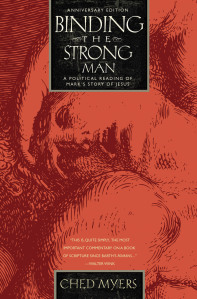
Binding30 years in and Ched Myers’ Binding the Strong Man: A Political Reading of Mark’s Story of Jesus (1988) is more relevant than ever. This week’s commentary homes in on Mark 10:35-45.

The petition by James and John shows that the disciples are still “deaf” to Jesus’ portents, continuing to understand his talk of the manifestation of the Human One’s “glory” (en te doxe sou) to mean some kind of messianic coup. Convinced their leader will prevail, they are already considering the administration of the new regime; they lobby for “first and second cabinet position.” The image of “sitting on the right and left” could be an allusion to Psalm 110:1, or to places at the messianic victory banquet, or subordinate thrones. In either case, it is an overtly political euphemism. Continue reading “On the Right and the Left”

Functioning Democracy

NoamAn excerpt from Noam Chomsky’s brilliant speech “Prospects for Survival.”

Let’s return finally to the main line of defense: functioning democracy. We can begin with the leader of the free world, the model of democracy for centuries.

In a democracy, the voice of the people is heard. Let’s ask what might happen in the United States if this principle were upheld. One consequence would be that the most popular and respected political figure in the country would have an influential role, maybe even be president. That’s Bernie Sanders, by a very large margin. Continue reading “Functioning Democracy”

A Spirituality of the Feet Moment

OzBy Dr. Oz Cole-Arnal (far left in photo), former professor emeritus at Waterloo Lutheran Seminary

As a “once upon a time” born-again fundamentalist Lutheran, nurtured and raised in a Pennsylvania steel town near Pittsburgh, Pennsylvania, who bought into that epoch’s anti-Catholicism and anti-Communism, I reflected the standard “White, Anglo-Saxon Protestant—Male” (WASP-M) privilege while being blithely unaware of the advantages this reality provided. My intense discovery of the quintessential Protestant core belief that we are made right with God, through no works of our own but solely though divine love manifested through Christ’s cross and made personal through trust in this radical God of love, combined with my academic love and success, led me to the ordained Lutheran ministry and the hope of teaching New Testament after a stint in parish ministry. Such a dream was turned on its head by a more profound conversion on the evening of April 4, 1968 when the blood of Dr. Martin Luther King Jr. poured out on the balcony of Memphis, Tennessee’s Lorraine Motel. At the very moment I heard the news of his death, I feel to my knees and through my tears, vowed never to be silent in the face of injustice. Whether or not I have been true to that pledge remains in God’s loving hands, precisely where it belongs, but I highlight here one glorious moment of a fifty-year pilgrimage that I celebrate to this very day. Continue reading “A Spirituality of the Feet Moment”

An Unbound Spirit

JESUIT FATHER DANIEL BERRIGANBy Bill Wylie-Kellermann. A review of Jim Forest’s At Play in the Lion’s Den: A Biography and Spiritual Memoir of Daniel Berrigan (Orbis books 2017). A shorter version of this was published in the November 2018 issue of Sojourners Magazine.

When Fa. Daniel Berrigan and his brother Philip, along with AJ Muste, John Howard Yoder, and a handful of budding Catholic radicals gathered in 1964 with Thomas Merton at Gethsemani Abbey for a retreat concerning the Spiritual Roots of Protest, the intercessions of that meeting, I am convinced, not only seeded a movement, but fell upon me, summoning my vocation.

Four years later when the Berrigan brothers with seven others entered the draft board in Catonsville, MD, removed the 1A files (of those eligible for sending to the Vietnam War) and burned them with homemade napalm, those ashes too would eventually anoint my life and pastoral calling. Daniel turned that action toward liturgy, toward poetry. He edited the transcript of their conviction in Federal Court into a play of international repute, refused induction into the prison system, and went notoriously underground for four months writing and speaking from the “most wanted list,” before being captured by the FBI at the Block Island home of his friend William Stringfellow. When he was released after two years in the Federal system, Berrigan came to New York City and taught a course on the Apocalypse of St. John when I was a student at Union Seminary. Full disclosure: Dan Berrigan became to me not merely teacher, but mentor and friend. Continue reading “An Unbound Spirit”

The Eye of the Needle

Binding30 years in and Ched Myers’ Binding the Strong Man: A Political Reading of Mark’s Story of Jesus (1988) is more relevant than ever. This week’s commentary homes in on Mark 10:17-31.

Mark’s wry joke about the camel and the needle in particular has received ingenious “manipulation at the hands of bourgeois conscience-tranquilizing exegetes” (Jose Miranda). The famous medieval assertion that the “eye of the needle” referred to a certain small gate in ancient Jerusalem through which camels could enter only on their knees (!) is only one of the more obvious ways devised to rob this metaphor of its class-critical power. The proposition is plainly an impossible one. Bailey points out that the Babylonian Talmud records a similar hyperbole–an elephant going through the eye of a needle–and comments that “the elephant was the largest animal in Mesopotamia and the camel the largest in Palestine.” Mark’s stinging sarcasm is perhaps more recognizable in Frederick Buechner’s contemporary paraphrase: for wealthy North Americans it is harder to enter the kingdom “than for Nelson Rockefeller to get through the night deposit slot of the First National City Bank!”  Continue reading “The Eye of the Needle”

A Known and Familiar Workplace Hazard

Bernice YeungAn excerpt from Bernice Yeung’s recent release In A Day’s Work: The Fight to End Sexual Violence Against America’s Most Vulnerable Workers (2018):

After looking at various industries that hire the most vulnerable workers, I’ve been forced to conclude that low-wage immigrants laboring in isolation are at unique risk of sexual assault and harassment. While it is not possible to know how often these abuses happen, they are not anomalies. The federal government estimates that about fifty workers are sexually assaulted each day, and in the industries that hire newcomers to the country in exchange for meager paychecks, such assault is a known and familiar workplace hazard. Continue reading “A Known and Familiar Workplace Hazard”