The Dysfunction of Denial

BillFrom Bill Wylie-Kellermann’s newest release Dying Well: The Resurrected Life of Jeanie Wylie-Kellermann:

I don’t intend to use it as a frame, but I do want to say something about denial. I understand how healthy a survival mechanism denial can be in certain circumstances, a sane way to cope in the short term. So let me affirm it up front and in passing, but add that as a long-run tactic it is dysfunctional. As already stated, I also believe it is politically endemic to the culture. On societal scale, it hides the body bags, renders the tortured or the prisoners or mistreated workers invisible, obfuscates privilege, distances us technologically from the explosion, misdirects our gaze with media, deadens us to suffering (of others), and outsources the necessary violence of empire. Among other things.
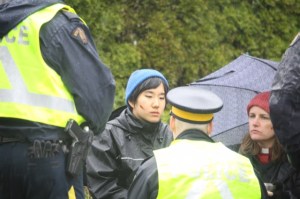
Let Justice Roll Like Rivers: A Court Statement

IMG_5916
photo by Kimiko Karpoff

By Céline Chuang

June 12, 2018

My Lord, I thank you for the opportunity to speak today. I want to acknowledge that this courtroom, this city, and all of us stand on traditional, ancestral and unceded territory, that of the Musqueam, Squamish, and Tsleil-Waututh, stewards of this land since time immemorial. I am here today as I was on the day I was arrested for participating, like others, in nonviolent civil disobedience – standing in solidarity with Indigenous people, here on these territories, and across Turtle Island. I mean no disrespect to the court in my actions. I simply wish to live in a way that honours those whose voices, stories, and wisdom predate the court system on these lands, and whose rights remain unrecognized. I hope that one day we will not only adopt the United Nations Declaration on the Rights of Indigenous People in theory, but put each of its articles into practice as a starting point for true reconciliation. Continue reading “Let Justice Roll Like Rivers: A Court Statement”

Abolition Spell (summer solstice)

015D4709-872B-4C04-8011-54999221350C-300x300.jpegBy adrienne maree brown. Re-shared from her blog.
the other small thing i can offer is an abolition spell, for siwatu, for the babies at the border, for their families, for all political prisoners, for all nonviolent offenders, for all those who have caused harm and are not being helped to find a different way.

all that is light
break bars between teeth
grind bricks down to dust
explode a sunscale life force
in each direction
until the cages shed like dead skin Continue reading “Abolition Spell (summer solstice)”

The Other Side

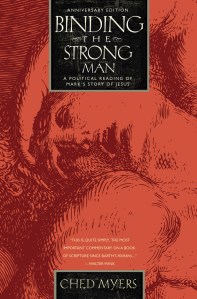
BindingWe continue our celebration of the 30th anniversary of Binding The Strong Man, Ched Myers’ political reading of Mark’s Gospel. Mark, according to Myers, represents a dissenting socio-political movement.  As the narrative continues, Jesus breaks through the social and economic barriers to the realization of human solidarity.  Today’s passage is Mark 4:35-41.

“On that day, when evening had come, he said to them, ‘Let us go across to the other side.’ And leaving the crowd behind, they took him with them in the boat…”–Mark 4:35-36

…the two sides of the Sea of Galilee symbolize Jewish and gentile territory, and the two major boat journeys represent the crossing from one side to the other.

…Throughout the Gospel, Mark is far more interested in articulating geo-social “space” in terms of narrative symbolics than actual place-names.  Indeed, it is not impossible that Mark may have intentionally dissociated the coordinate “other side” from a literal correspondence with eastern and western shores of the sea;  straining the geographical credulity of the sea narrative would have forced his first readers to focus upon the journeys as symbolic action (which is their purpose) rather than upon details of marine transit around the Sea of Galilee (which is not).  Continue reading “The Other Side”

The Major Philanthropists of Our Society

BarbaraFrom Barbara Ehrenreich’s Nickel and Dimed: On (Not) Getting By in America (2011):

When someone works for less pay than she can live on—when, for example, she goes hungry so that you can eat more cheaply and conveniently—then she has made a great sacrifice for you, she has made you a gift of some part of her abilities, her health, and her life. The “working poor,” as they are approvingly termed, are in fact the major philanthropists of our society. They neglect their own children so that the children of others will be cared for; they live in substandard housing so that other homes will be shiny and perfect; they endure privation so that inflation will be low and stock prices high. To be a member of the working poor is to be an anonymous donor, a nameless benefactor, to everyone else.

Blessed Assurance: Call to the Table in the Face of Terror

ChildrenBy Ken Sehested

One important thing that hasn’t been said this week [about the savagery of separating of children from parents at the US-Mexican border] is that this Department of Justice policy change is in fact a form of terrorism.

The point of terrorism isn’t killing people. Terrorists make strategic use of aggressive trauma to spread fear for the purpose of affecting social or political objectives. Look up the FBI’s definition.* Continue reading “Blessed Assurance: Call to the Table in the Face of Terror”

Hauling the Sanctuary on to the Street

Marian (1)By its simple public character a measure of light is directed upon an otherwise hidden and inconspicuous evil. By it an aspect of the historical crisis is expressly identified.  A kairos moment of decision for the community of faith is named and commended and acted upon.
Bill Wylie Kellermann, Seasons of Faith and Conscience: Kairos, Confession, Liturgy (1991)

More than a quarter century ago, Detroit native and ordained United Methodist Bill Wylie-Kellmann coined the phrase “liturgical direct action” to describe a brand of Christian witness that goes beyond charitable giving and moves outside the church building to expose and resist the powers that be.  Now 70 and retired from formal ministry, Bill is still hauling the sanctuary out on to the street.  Yesterday, in downtown Detroit, he joined 250+ friends and faithful in the final moral Monday of the national Poor People’s CampaignContinue reading “Hauling the Sanctuary on to the Street”

Like a Mustard Seed

BindingToday, we continue our celebration of the 30th anniversary of Binding The Strong Man, Ched Myers’ extraordinary political reading of Mark’s Gospel.  Each Sunday, we will post excerpts from Myers’ comments on the lectionary reading of the day.  Today’s passage is Mark 4:26-34.

He also said, “With what can we compare the kingdom of God, or what parable will we use for it? It is like a mustard seed, which, when sown upon the ground, is the smallest of all the seeds on earth; yet when it is sown it grows up and becomes the greatest of all shrubs, and puts forth large branches, so that the birds of the air can make nests in its shade. (Mark 4:30-32)

In the famous parable of the mustard seed Mark one last time expands upon the theme of sowing in the earth (4:30-32).  There can be no question that this similitude concerning the disproportion between the seed and the mature plant is meant to instill courage and hope in the small and fragile discipleship community for its struggle against the entrenched powers.  As in 4:29, the appended scriptural citation places the parable firmly within a political context.  Mark adopts the conclusion of Ezekiel’s cypress tree parable for his own: the “small sprig” planted by Yahweh will bear fruit, and its branches will give shelter to birds (Ezekiel 17:22f).  In late biblical literature the sheltering branch was a common metaphor for political hegemony.  Daniel explains the image to Nebuchadnezzar: Continue reading “Like a Mustard Seed”

The Violence Happening in Our Midst

Clancy Dunigan
The Poor People’s Campaign resists and rises above systems of oppression in Olympia, Washington (PC: Clancy Dunigan)

The Poor People’s Campaign keeps on rolling. This is from Jeremy Porter in Kentucky:

There is a long history of nonviolent civil disobedience in this country and around the world. The goal is not to be arrested, but to bring attention to the violence happening in our midst. If we get arrested on the road to justice, then we are willing. This violence includes: People without dignified affordable housing (where an individual in KY has to work 77 hours a week on minimum wage just to afford a two bedroom apartment), the 40% of homeless youth who are queer, 200,000 people who die in this country annually from lack of wealth, 1 in 5 KY children who don’t know where their next meal will come from…these are just the tip of the iceberg of violence happening daily.

Our goal in the Kentucky Poor People’s Campaign: A National Call for Moral Revival is to wage peace and justice against this violence, but first people must know it exists…and so we name it and make it known through nonviolent moral fusion direct action, which sometimes means risking the breaking of a law to bring attention to the unjust laws all around us.

Binding The Strong Man

BindingAs we transition into the summer months of Ordinary Time, we are celebrating the 30th anniversary of Binding The Strong Man, Ched Myers’ extraordinary political reading of Mark’s Gospel.  Each Sunday, we will post excerpts from Myers’ comments on the lectionary reading of the day.  Today’s passage is Mark 3:20-35, the episode in which the book is named after.

But no one can enter a strong man’s house and plunder his property without first tying up the strong man; then indeed the house can be plundered. (Mark 3:27)

Mark has come clean: Jesus (a.k.a. “the stronger one” heralded by John, 1:8) intends to overthrow the reign of the strong man (a.k.a. the scribal establishment represented by the demon of 1:24).  In this parable the oracle of Second Isaiah lives again: Yahweh is making good on the promise to liberate the “prey of the strong (LXX, ischuontos) and rescue the captives of the tyrants” (Is 49:24f).  Imperial hermeneutics, ever on the side of law and order, will of course find this interpretation of the strong man parable strained, offensive, shocking.  Yet Mark drew the image of breaking and entering from the most enduring of the primitive Christian eschatological traditions: the Lord’s advent as a thief in the night (Mt 24:43 par; I Thes 5:2; 2 Pt 3:10; Rev 3:3, 16:15). Continue reading “Binding The Strong Man”