

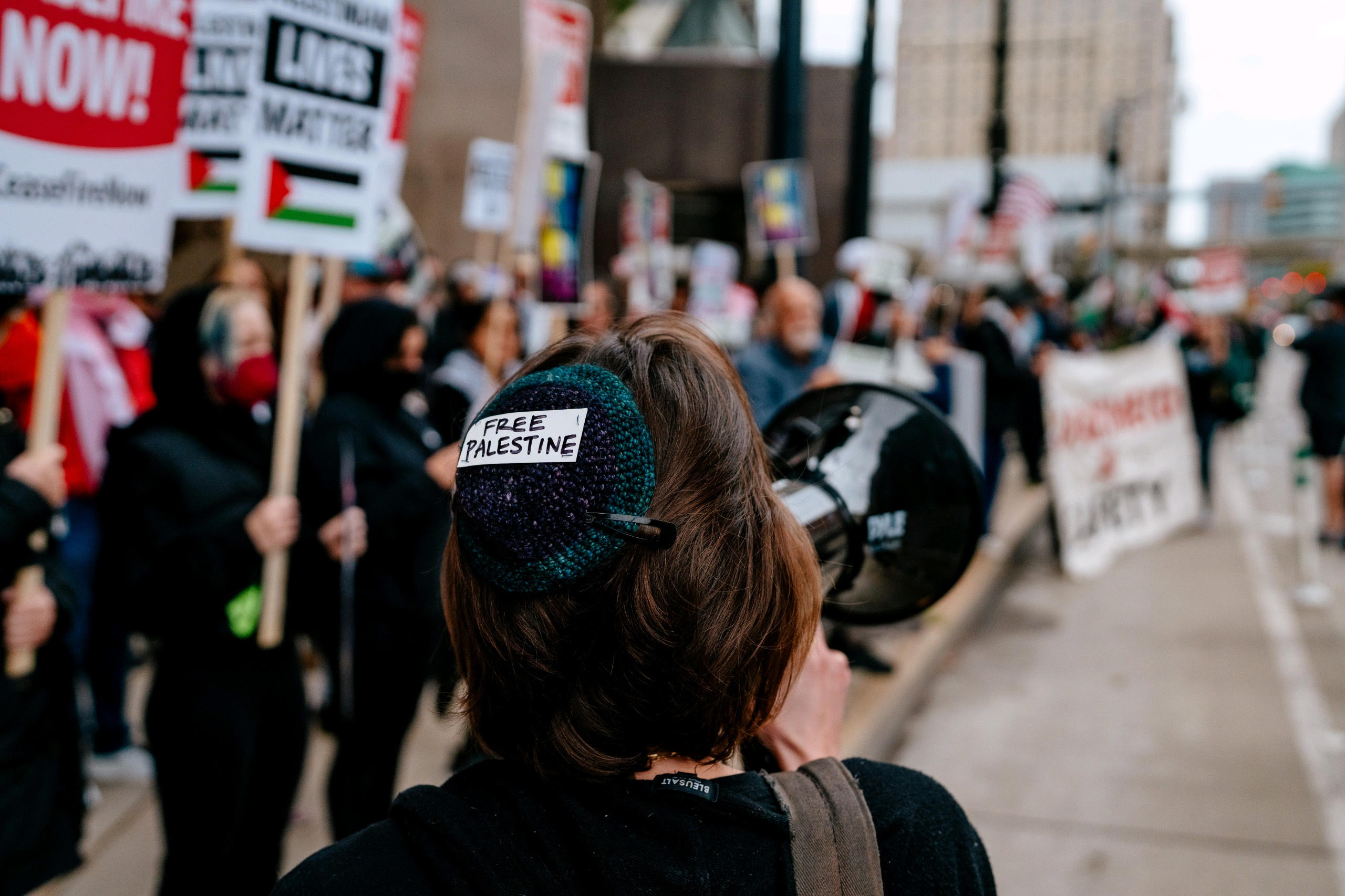
An open letter from a coalition of anti-occupation Jewish students at Brown University. Re-posted from The Brown Daily Herald (November 7, 2023)
“Solidarity is the political version of love.” – Jewish feminist activist Melanie Kaye/Kantrowitz
As of today, it has been a month since the Oct. 7 attacks that have dominated global political consciousness and discourse, not to mention our experiences as young Jewish people. Zionist institutions purport to be representative of all Jews, often using us as a rhetorical shield to support the unconscionable actions of the state of Israel. We feel a particular pain as Jews having to continuously justify our stance against genocide. We are here to make ourselves clear: We stand in solidarity with Brown Students for Justice in Palestine and the Palestine Solidarity Caucus in the pursuit of the liberation of Palestinian peoples. We know intimately that Jewish struggles are necessarily bound up in global struggles for freedom. We are a group of Jewish students who have coalesced around our shared vision of justice, anti-occupation, liberation and community. We ask you to listen to us now:
1. What do we mean when we say, “from the river to the sea”?
“From the river to the sea, Palestine will be free” is not a call for the forced removal of Jews from Palestine or, as it is commonly misconstrued, a call to “throw Jews into the sea;” instead, it is a call for the end to the oppression of all Palestinians — in Gaza, the West Bank and within the Green Line. Liberating all of Palestine requires revolutionary change: not an eradication of Jews from the land, but a total dismantlement of the apartheid regime occupying it. The assumption that this phrase is inherently genocidal falsely conflates liberation with the annihilation of each citizen of the oppressive state and ignores its liberatory intent. Within this conflation, we hear a racist assumption that Palestinians are ruthless “animals” and an intentional obscuring of the violent intent of a neo-fascist government — a characterization shared even by writers in Israel’s newspaper of record. It is not only blatantly false but obscene to frame a call for liberation and justice as genocidal while Israel is carrying out genocide in Gaza funded by billions of American tax dollars. If calling for a future in which Palestinians can live in their homeland unshackled implies an existential threat to the Zionist ideology, it is that ideology that must be called into question — not the call for liberation.
Continue reading “We are Here to Make Ourselves Clear”




 Radical Discipleship