Interrogation of Everything

D18_185_015Sheldon C. Good, executive director of The Mennonite, Inc., interviewed Ibram X. Kendi about antiracism and the church by email Sept. 3. The interview, edited for clarity, appears below. The editorial in the October issue of The Mennonite, available here, includes part of the interview.

Kendi is author of How to Be an Antiracist. He won the 2016 National Book Award for Nonfiction for his book Stamped from the Beginning. He is the founding director of the Antiracist Research and Policy Center at American University in Washington, D.C.

1. You make the case in How to Be an Antiracist that the word “racist” has been removed from its proper usage. How did that happen?

The most virulent racists define racist as anyone who uses the r-words, race or racism. They say, racist is a pejorative term, it is the equivalent of saying I don’t like you, as Richard Spencer once said. Anyone who categorizes people by race, who calls someone racist, is the real racist, they say. Obviously, they are deeply defensive, and deeply in denial. As such, they don’t want to be called racist. They shut down and close up when they do. Some racial reformers have agreed and view “racist” as an attack. So they don’t use the term either. But racist is a descriptive term, not an attack. It describes when a person is saying there is something wrong or right with a racial group. It describes when a person is supporting racist policy with their action or inaction. Continue reading “Interrogation of Everything” →
Emmaus Road Litany

Farm Church
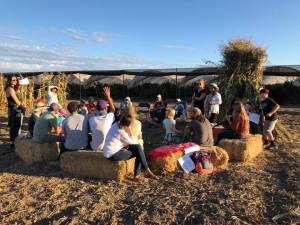
A Farm Church gathering in pre-pandemic times.

Inspired by Ched’s “Easter Faith and Empire” article, Katerina Friesen wrote the following litany for Farm Church (Ventura River Watershed in California) on Sunday, April 26 for an adapted “Bread of Life” communion time.

El Peregrino camina con nosotr@s (The Sojourner walks with us)
When we are confused, disillusioned after hopes of revolution,
Disappointed by loss after loss, Jesus opens our minds. Continue reading “Emmaus Road Litany” →

Reading History Through the Prophets

ZundAn excerpt from Ched Myers’ classic article “Easter Faith and Empire: Recovering the Prophetic Tradition on the Emmaus Road.” These comments are posted just in time for this weekend’s Gospel text Luke 24:13-35. 

Luke tells us that Jesus addresses these fit-to-be-tied disciples as “fools”
(24: 25). But the Greek term anontoi refers simply to those who don’t
quite get it, who find the truth as yet unintelligible (cf. Romans 1:14;
Galatians 3:1,3} He knows their hearts are “sluggish” (Greek, bradeis),
as indeed are ours. Because we, like Cleopas and company, forever refuse to embrace the counterintuitive wisdom of the Hebrew prophets.

The prophets tell us to defend the poor, but we lionize the rich. The prophets tell us that horses and chariots cannot save us, but we are transfixed by the apparent omnipotence of modern military technology. The prophets tell us to forgo idolatry, but we compulsively fetishize the work of our own hands, Above all, the prophets warn us that the way to liberation in a world locked down by the spiral of violence, the way to redemption in a world of enslaving addictions, the way to true transformation in a world of deadened conscience and numbing conformity is the way of nonviolent, sacrificial, creative love. But we who are slow of heart–a euphemism for not having courage–instead remain fiercely loyal to ever more fabulous myths of redemptive violence, practices of narcissism, and delusions of our own nobility.

the wind from the tomb

JPerk
Dr. Jim Perkinson offering a spoken word at the Heidelberg Project in Detroit, MI

by jim perkinson, 04.19.2020, St. Peter’s Episcopal Church (Detroit, MI)

we worry now
about breath
where it has been
whose kiss it carries and whose
nostril-curl in zephyr-spins
of night or day or twirling
door-gush rushing to the street
and we now see how primal
is the air of earth, the river
whence we cruise and where
we move, like fish-in-flow or
a swallow on the wing at dusk—we,
feet on dust, head up-thrust and strolling Continue reading “the wind from the tomb” →

Never Forget

Deschutes National ForestBy Ric Hudgens, Quarantine Essay #22, originally posted to Facebook on April 18, 2020. Ric is posted all his essays to Medium. 

Every day for the past month, something has stunned me. I’ve been unable to respond. I’m astonished by the news stories I’m hearing. I see and hear horrifying things.

The world has never been an entirely pleasant place. Horrifying things happen all the time. But now perhaps I’ve slowed down enough to feel and see the full weight of them.

I’m not surprised by the inequalities revealed in this crisis. They have been there for anyone to see who wanted to look. The callous disregard for human life by those who claim to be “pro-life” doesn’t surprise me. Their understanding of “life” has always been very narrow, partisan, and racist. Continue reading “Never Forget” →

the second coming of easter

Water Shift
A pre-pandemic water shift in Detroit, MI.

By Jim Perkinson

empty churches preaching empty tombs
to empty pews, a vision of gloom,
the doom of the poor now creeping
close in corona-spoor knocking even
at the door of the rich and who would
have thought it all could upend
in a single dash of air-splash, invisible,
carrying not quite living code from animal
to our abode everywhere, leading all
but rash, bible-brash evangelical hubris
to hunker in shelter, or fear-trembled,
in hovels or dense-packed streets of
homeless retreats or refugee tents
a world of babel towers
and fake news showers and glowering, bulge-veined purveyors of cover
for the bankers and oil exec wankers to push profit-margins to the edge of the cliff . . . Continue reading “the second coming of easter” →

Good Friday’s Warning

chedBy Ched Myers. For Good Friday.

“From noon on, darkness came over the whole land until three in the afternoon.” (Matthew 27:45)

In this greatest of cosmic “signs” in the gospel narrative–the darkening of the world for three hours—our attention is pointed back to the old Exodus story.  There Yahweh, in the war of myths with Pharaoh to free the Hebrew slaves, blots out the sun in Egypt for three days–a repudiation of the imperial order legitimized by the sun god Ra. The rhetoric describing this penultimate plague is evocative: “People could not see one another, and for three days they could not move from where they were” (Ex 10:23). What a trope for collective blindness, denial and paralysis, so fitting to the culture of empire still today! (For more on this, see my piece here.)

This Good Friday falls at or near the peak of the Covid-19 plague in the U.S. At the “apocalyptic moment” of Jesus’ crucifixion, we are supposed to pay attention to the lesson of plagues: they are the dramatic expression of the great struggle between Creation and Empire–and of the God who takes sides.

Maybe at 3 pm today we should be out on our porches banging pots for that…

Ched Myers, an ecumenical activist theologian, is a popular educator, writer, teacher and organizer, committed to animating and nurturing church renewal and radical discipleship, and supporting faith-based movements for peace and justice. Find his blog, many articles, webinars and a few audio recordings at chedmyers.org. You can also find out more about his Life & Activism there. Ched’s books are available for purchase on this site.

A Wonderfully Complex Set of Illusions

anti-capitalist-protestFor Good Friday: Rev. Lynice Pinkard.
From her legendary 2014 interview with The Sun Magazine.

There is a seductive beauty in the idea that everyone has equal economic opportunity under capitalism. First, it allows the wealthy and powerful, the owning class, to feel justified in their position. They can believe their privilege is based on their own hard work, or the hard work of their ancestors. Second, just enough of the poorest are desperate enough to think that, despite all evidence, they can become rich. Most poor people don’t believe this, but they also don’t have enough resources or popular support to bring about real change, or else they are convinced that they are indeed unworthy and sometimes even work toward their own destruction. Third, the so-called middle class is led to dream of becoming rich and to fear the encroachment of the poor. Continue reading “A Wonderfully Complex Set of Illusions” →

AS THE WORLD SQUIRMS (Quarantine Essay #9)

mlkBy Ric Hudgens (originally posted to Facebook March 31, 2020). Ric is posting all of his quarantine essays to Medium.

In his 1963 Letter from a Birmingham Jail, Dr. King wrote: “In a real sense all life is inter-related. All men are caught in an inescapable network of mutuality, tied in a single garment of destiny. Whatever affects one directly, affects all indirectly. I can never be what I ought to be until you are what you ought to be, and you can never be what you ought to be until I am what I ought to be…This is the interrelated structure of reality.”

The coronavirus/COVID-19 pandemic is putting this perspective to the test and vindicating it once again.

If we attend to the virology of this moment our unity is dramatically highlighted. Within just a few weeks, this disease has traveled the globe, infecting thousands, regardless of race, color, or national origin. All are vulnerable, and it is a universal threat. Continue reading “AS THE WORLD SQUIRMS (Quarantine Essay #9)” →

Praying Like Jesus in the Garden

gethsemaneA timely post and prayer practice from Rev. Solveig Nilsen-Goodin

Throughout Jesus’ ministry, when crowds were pressing in on him, when thousands were needing to be fed, when he was discerning his next steps, he prayed. When the disciples asked him how to pray, he taught them. And when the death squads were coming, and even his closest friends were too exhausted to keep watch for him, he prayed. There, in the Garden of Gethsemane, alone, when death loomed near and his friends were close at hand but far away, Jesus prayed.

But how? How did he pray? How did he pray in the Garden?

He wasn’t reciting the rote version of what we know as the Lord’s Prayer, though perhaps that prayer brought him comfort and connection even in his isolation.

He wasn’t doing a breathing practice, though no doubt Jesus drew on his skills of meditation and contemplation to ground and strengthen him even to the end. Continue reading “Praying Like Jesus in the Garden” →