Congestion

The Hole (1)By Tommy Airey

Advent is almost here. As always, she sends us signs from the sun, the moon, the rising seas and the leafless fig tree. This season, she is speaking to me through a cough that won’t give up. The sinus pressure adds insult to injury. I am now convinced that these chronic symptoms stem from my inability to just say “no.” As it turns out, I have long been addicted to “becoming all things to all people, so that I might by any means save some” (I Cor 9:22). I share the codependent affliction of the apostle who confessed that his life was unmanageable too:

I do not understand my own actions. For I do not do what I want, but I do the very thing I hate (Romans 7:15).

Continue reading “Congestion”

Wild Lectionary: Advent’s Procreative Urgency

IMG_1895
Deer tracks in the snow

The First Sunday of Advent, Year C
December 2, 2018

By The Rev. Marilyn Zehr

Luke 21: 25-36

So also, when you see these things taking place, you know that the kingdom of God is near.  Luke 21:31

The Kin-dom of God is near.  It visits in the night like the spirit presence of the white-tailed deer.  I go out early to search for fresh prints in the previous night’s early snows.  Like the kin-dom of God, the deer are on the move.  It’s rutting season.  Their tracks tell me that the does and last year’s fawns move in groups.  The lone tracks that cross these are the bucks seeking mates.  I am not yet skilled or scent sensitive enough to notice the signs the bucks leave on branches to attract the does but I know it is so.  When they mate the doe and buck “enact a ritual of motion, touch, sound and scent before coming together.”  (p. 14, All Creation Waits, by Gail Boss and illust. by David G. Klein, 2016)  All is now pregnant possibility unfolding just beyond my vision in the night.  All I see of their restless urgency are the tracks in the morning snow.

Continue reading “Wild Lectionary: Advent’s Procreative Urgency”

Jesus Was Non-Binary

ChristA re-post from our comrades at Friendly Fire Collective (11/27/18):

“So God created human beings, making them to be like himself. He created them male and female, himself.”

All people are made in god’s image. The vast variety of human souls are all a little reflection of rich, deep, complicated god.

In his piece “Is God Transgender?” Mark Sameth writes about the “highly elastic” language used to describe gender in the Hebrew bible. As an example, he describes how Adam is referred to as “them” and Eve is referred to as “he” in Genesis 3:12.

The first people, made in god’s image, switching between pronouns from sentence to sentence. Continue reading “Jesus Was Non-Binary”

Truth Sunday

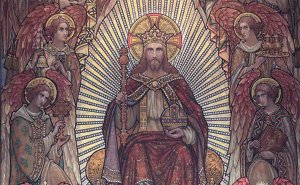
ChristtheKing-1-1500x926Sermon B Proper 29
“Christ the King”
Preached at the Church of the Incarnation, Ann Arbor, MI,
November 25, 2018
By Bill Wylie-Kellermann

Psalm 93
Daniel 7:9-10, 13-14
Revelation 1:4b-8
John 18:33-37

I do love the church’s liturgical year, setting the rhythms of our prayer, our community life – and, on occasion, our public witness and action. Even when it’s is appropriated by the culture – inverted, inflated, commodified, corrupted – it still stands primarily as a counter rhythm, a different drummer to which we move. Continue reading “Truth Sunday”

Rooted in Story and Struggle

BindingFor our final Sunday installment celebrating 30 years of Ched Myers’ Binding the Strong Man: A Political Reading of Mark’s Story of Jesus, radical disciples weigh in on both Ched and his book. 

From Jennifer Henry, the executive director of Kairos Canada, reflecting on the viral image from Ossie Michelin’s cell phone in 2013 (left), portraying resistance to fracking led primarily by indigenous women:

OssieWhat I have learned from the witness of Ched Myers is that we can bring kairos moments like these into conversation with biblical moments, in ways that deepen understanding of the present day struggle and inspire prophetic action. His life’s work does not just demonstrate that we can build this bridge, but that we must, for the integrity of our faith and its call to justice. It is an intersection that enriches both our grasp of the historic texts and our commitment to current struggle. In Ched’s hands this process is never theoretical, but embodied, wading deep into the bible, but just as deeply into social change movements so that we’re grounded in, both rooted in story and struggle.


Continue reading “Rooted in Story and Struggle”

Brave Space

Screen Shot 2018-11-13 at 4.31.09 PM
PC: Michael Raymond Smith

By Micky ScottBey Jones, re-posted from her website here   

Together we will create brave space

Because there is no such thing as a “safe space”

We exist in the real world

We all carry scars and we have all caused wounds.

In this space

We seek to turn down the volume of the outside world,

We amplify voices that fight to be heard elsewhere, Continue reading “Brave Space”

Wild Lectionary: Apocalypse

fireReign of Christ
Proper 29 (34) B

Daniel 7:9-10, 13-14
Revelation 1:4b-8

By: Ron Berezan

I used to avoid apocalyptic scriptures like the plague.  I’m beginning to rethink that.

For many years, I found the violent imagery, intense dualism and gnostic sounding anti-earth passages too hard to stomach. So I chose to ignore them – mostly. I’ll admit, there was always a tinge of guilty fascination, a bit like staring at an accident scene, even though I knew I really shouldn’t.

Continue reading “Wild Lectionary: Apocalypse”

We Need a Moral Breakthrough

BarberAn excerpt from Rev. William Barber’s address presented before the 74th Union for Reform Judaism Biennial convention on December 6, 2017.

We are here tonight, and 62 years ago would have been the fifth day of the Montgomery Bus Boycott. Today, when the prophetic actions of Rosa Parks like Shiphra and Puah in the Bible, chose to challenge the Pharaoh of Jim Crow. She sat down and birthed a movement on a stage that produced a prophet like Moses named Martin. She sparked a nonviolent revolution. Continue reading “We Need a Moral Breakthrough”

Come, you whose lamps are blazing

index.jpgBy Kat Friesen

Gathering

Come, you whose lamps are blazing,
and come, you whose lamps are dim.
Come, salty ones, and come,
you whose lives are feeling bland.
Come worship the One who was, and is, and is to come,
our God who restores our lamps with oil,
our God who renews our saltiness,
so that together we may be a city alight with praise,
a city that makes known the Glory of the Lord!

Confessing/reconciling

God who sees the needs of the oppressed,
We confess that our piety, our prayers and our habits are empty without justice.
God who hears the cries of the workers, of the homeless, of the hungry,
We confess our fear of risk, our fear of being made vulnerable
in the face of so much need.
Assure us again of Your healing in our weakness,
of Your abundance in our sharing and in our receiving.

Counter-Recruiting for the Politics of Nonviolence

BindingComments on this week’s Gospel text (Mark 13:1-8) from Binding the Strong Man: A Political Reading of Mark’s Story of Jesus (1988), the commentary from Ched Myers, celebrating 30 years of prophetic utterance. 

The images Mark uses in 13:7f.–wars, famines, earthquakes–are all virtually generic to apocalyptic literature. One need only consult contemporaneous apocalyptic literature such as John’s Revelation, 4 Ezra, the Assumption of Moses, or the Qumran war scrolls. At the same time, these events could be correlated to contemporaneous history. “Rumors of war” aptly characterizes and describes the way in which news regarding the seesaw political events of 68-70 C.E. would have circulated around Palestine. Was the siege coming? Were the Romans withdrawing? “Kingdom rising against kingdom” might have referred to the wavering fortunes of Rome in 67, embroiled in a civil war and fearing a Parthian invasion. Major natural disasters were also part of contemporaneous history, such as the famine (which hit Palestine especially hard) of the early 50s C.E., or the earthquakes and volcanic eruptions that destroyed Laodicia and Pompei in 61-62 C.E. Both Mark and his opponents could–and did–appeal to the “plurivalent” (multi-referential) nature of apocalyptic symbolics in making their respective cases. Continue reading “Counter-Recruiting for the Politics of Nonviolence”