We Need a Moral Breakthrough

BarberAn excerpt from Rev. William Barber’s address presented before the 74th Union for Reform Judaism Biennial convention on December 6, 2017.

We are here tonight, and 62 years ago would have been the fifth day of the Montgomery Bus Boycott. Today, when the prophetic actions of Rosa Parks like Shiphra and Puah in the Bible, chose to challenge the Pharaoh of Jim Crow. She sat down and birthed a movement on a stage that produced a prophet like Moses named Martin. She sparked a nonviolent revolution. Continue reading “We Need a Moral Breakthrough”

Come, you whose lamps are blazing

index.jpgBy Kat Friesen

Gathering

Come, you whose lamps are blazing,
and come, you whose lamps are dim.
Come, salty ones, and come,
you whose lives are feeling bland.
Come worship the One who was, and is, and is to come,
our God who restores our lamps with oil,
our God who renews our saltiness,
so that together we may be a city alight with praise,
a city that makes known the Glory of the Lord!

Confessing/reconciling

God who sees the needs of the oppressed,
We confess that our piety, our prayers and our habits are empty without justice.
God who hears the cries of the workers, of the homeless, of the hungry,
We confess our fear of risk, our fear of being made vulnerable
in the face of so much need.
Assure us again of Your healing in our weakness,
of Your abundance in our sharing and in our receiving.

Counter-Recruiting for the Politics of Nonviolence

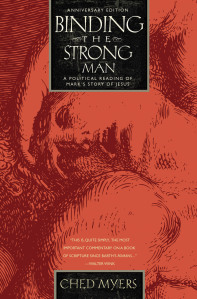
BindingComments on this week’s Gospel text (Mark 13:1-8) from Binding the Strong Man: A Political Reading of Mark’s Story of Jesus (1988), the commentary from Ched Myers, celebrating 30 years of prophetic utterance. 

The images Mark uses in 13:7f.–wars, famines, earthquakes–are all virtually generic to apocalyptic literature. One need only consult contemporaneous apocalyptic literature such as John’s Revelation, 4 Ezra, the Assumption of Moses, or the Qumran war scrolls. At the same time, these events could be correlated to contemporaneous history. “Rumors of war” aptly characterizes and describes the way in which news regarding the seesaw political events of 68-70 C.E. would have circulated around Palestine. Was the siege coming? Were the Romans withdrawing? “Kingdom rising against kingdom” might have referred to the wavering fortunes of Rome in 67, embroiled in a civil war and fearing a Parthian invasion. Major natural disasters were also part of contemporaneous history, such as the famine (which hit Palestine especially hard) of the early 50s C.E., or the earthquakes and volcanic eruptions that destroyed Laodicia and Pompei in 61-62 C.E. Both Mark and his opponents could–and did–appeal to the “plurivalent” (multi-referential) nature of apocalyptic symbolics in making their respective cases. Continue reading “Counter-Recruiting for the Politics of Nonviolence”

Wild Lectionary: Hope in Difficult Times

2018-11-18-Clipped-Photo-by-Larry_Howell.jpgProper 28(33)
26th Sunday after Pentecost

Daniel 12:1-3
Hebrews 10:11-14, (15-18), 19-25
Mark 13:1-8

By Rev. Dr. Victoria Marie

Today’s homily, like most of my homilies, is not merely to preach to you but to call myself to account. It is part of my ongoing aim to preach a message of hope in these times, when the life of our planet and peace in our world are under threat.

Continue reading “Wild Lectionary: Hope in Difficult Times”

When Will We Rise?

ImageFrom the Center for Prophetic Imagination, working to live in a world where all walls of alienation are torn down and all people live justly with each other, with the land, and with the Spirit of Life. Sign up HERE to receive their weekly email updates!

Usually, we talk about the Risen Christ around Easter. But it is perhaps more fitting to explore the significance of the Resurrection on a day like today, the day after the election, when our collective imagination has been transfixed by party politics and we begin to ask “now what?”

Perhaps the juxtaposition between electoral politics and the Resurrection of Jesus seems jarring. Bear with me. Continue reading “When Will We Rise?”

the gold loses its lustre

talithaBy Talitha Fraser

the gold loses its lustre
candlelight yields
a warm reflection
but these are
sacred and ordinary things
fabric, candleholders, cross
they aren’t imbued with any
special strength of their own
how then shall I love You?
the dust motes suspended
in light from the window
they are golden too
and the fine
sunlit hairs of my arms
they are golden too
let me love You on
the ordinary and extraordinary days
let me love You in
ordinary and extraordinary ways
let me love You

Impoverished By Her Obligations

BindingComments on this week’s Gospel text (Mark 12:38-44) from Binding the Strong Man: A Political Reading of Mark’s Story of Jesus (1988), the commentary from Ched Myers, celebrating 30 years of prophetic utterance. 

The last episode in the temple is a story of a widow being impoverished by her obligations to the temple cultus (12:41-44). Long mishandled as a quaint vignette about the superior piety of the poor, Wright has shown that Jesus’ words should be seen “as a downright disapproval and not as an approbation”:

The story does not provide a pious contrast to the conduct of the scribes in the preceding section (as is the customary view); rather it provides a further illustration of the ills of official devotion. Jesus’ saying is not a penetrating insight on the measuring of gifts; it is a lament….Jesus condemns the value system that motivates her action, and he condemns the people who conditioned her to do it.

Continue reading “Impoverished By Her Obligations”

Every Goodbye Ain’t Gone

Aireys, Early 20s.jpeg (1)By Tommy Airey, a homily for Day House, a four-decade Catholic Worker experiment wedged between casinos and stadiums a stone’s throw from downtown Detroit

I am new to the traditions of Celtic Samhain and Christian All Saints. I grew up in the world of white suburban Evangelical Christianity. I attended a private Christian school that was part of the movement sparked a decade earlier as a response to the Civil Rights Movement and the racial integration instituted by the Supreme Court (and resisted by Governors who were enabled by Presidents). My pastors and teachers taught me that Catholics were going to hell and that Halloween was the devil’s holiday. Continue reading “Every Goodbye Ain’t Gone”

Wild Lectionary: Snow and Sunshine

IMG_2188.jpgProper 27(32) B
25th Sunday after Pentecost

Hebrews 9:24-28
By Jamie Johnstad
The darkness of winter seemed to come early this year, where my family lives along the Catfish Creek Watershed, about two miles upstream from where the creek connects with the Mississippi River in Dubuque, Iowa.  The days many people here describe as their favorite time of the year — those sunny, crisp, fall days — were few and far between, as the rain fell heavy and often.  The fall leaves seemed to move from green to brown quickly, with too few of the stunning colors in between, then to fall to the ground as compost.  Our frequent hikes down the trails are muddy under cloud-covered skies, making the early dusk of November seem especially dark.  The only things that seemed to hold onto their leaves are the invasive shrubs that permeate our woods.  Last year at this time, the beauty of fall made me forget about the invasive species removal we need to do, the prairie we need to restore, the buckthorn growing under and hiding the beautiful oaks in a field of ours.

Continue reading “Wild Lectionary: Snow and Sunshine”

Hidden Beasts

OzBy Dr. Oz Cole-Arnal (far left in photo), former professor emeritus at Waterloo Lutheran Seminary

I was visiting my oldest son Bill and his partner Darlene when I heard the awful news of the massacre at the Tree of Life Synagogue in the Squirrel Hill neighborhood of Pittsburgh, Pennsylvania. I felt gut-punched and burst into tears. With so much hatred in the world, with the “othering” of all God’s vulnerable—Jews, blacks, women, Muslims, immigrants, LGBTQ– reaching new heights of murderous invective and hate as the wave of neo-Fascism arising throughout the western democracies, this attack in Squirrel Hill struck me exceedingly close to home. I am an ex-American from Western Pennsylvania, roughly an hour by auto to Pittsburgh, yet the emotions involve a deeper gut-wrenching connection than the thirty-mile jaunt by car to that city. Continue reading “Hidden Beasts”