21 Running, Working, Experiential Definitions of Mysticism

meditationFrom Matthew Fox’s The Coming of the Cosmic Christ (1988):
By exposure to each of these “definitions” the reader will begin to feel and make connections with his or her own mysticism, for the purpose of defining mysticism here is to elicit the mystic within each person…

  1. Experience: a trust of the universe, a trust of what is and what occurs to us, yes, a trust of oneself
  2. Non dualism: the end of alienation and the beginning of communion, the end of either/or relationships and the beginning of unity
  3. Compassion: “the keen awareness of the interdependence of all living things which are all part of one another and involved in one another” (Thomas Merton)
  4. Connection Making:  by symbols, stories, myths, music and colors, form and ritual–we connect with one another’s deep and often unspoken experiences of life’s mysteries
  5. Radical Amazement: awe is the opposite of taking life for granted
  6. Affirmation of the World as a Whole:  neither neutral nor bitter or cynical
  7. Right-Brain: synthesis over analysis and verbalization

Continue reading “21 Running, Working, Experiential Definitions of Mysticism”

Sermon: Born to Be a Light

homrich-9
Trial for the Homrich 9. Activists blocked trucks from turning off Detroiters’ water.

By Bill Wylie-Kellermann, Saint Peter’s Episcopal Detroit, Epiphany 2, January 15, 2017

Isaiah 49:1-7
Psalm 40:1-11
1 Corinthians 1:1-9
John 1:29-42

Our readings for today echo those of last week. Again we have reference to John, to the baptism of Jesus, the dove alighting upon him, AND again beside it a Servant song from Isaiah.

There is a striking commonality of Second Isaiah and John: both have central figures whose identity is hard to pin down. In the gospel of John it is the “beloved disciple,” identified only by that name. Is this a cipher for John himself, for his beloved community? Is there an historical referent? Even another character in the story? Or is this a narrative figure with which we, as readers, may identify, a call to discipleship by another name? Continue reading “Sermon: Born to Be a Light”

Sermon: Epiphany under Empire: Remembering Resistance

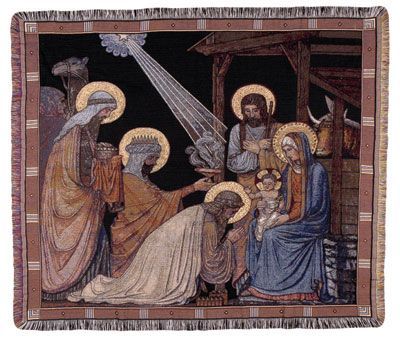
3-kingsBy Ched Myers

Caspar, Melchior, Balthasar, behütet uns auch für dieses Jahr, vor Feuer und vor Wassergefahr. (“…protect us again this year from the dangers of fire and water.”)

— prayer uttered during the traditional German feast of the Three Kings

The origins of the Feast of the Epiphany are historically complicated and ecclesially disputed.  We might think of it as a kind of peace offering from the Western to the Eastern Church, given the latter’s (surely older) January 6th date for the Feast of the Nativity.  The Twelve Days of Christmas, in turn, represent a bridge between the two traditions, straddling exactly our celebration of the New Year.  Continue reading “Sermon: Epiphany under Empire: Remembering Resistance”

EPIPHANY: Light to the Powers

seasonsExcerpt and reflection from Bill Wylie-Kellermann’s Seasons of Faith and Conscience: Explorations in Liturgical Direct Action

Among the liturgical ironies of Epiphany is that the date of this ancient feast should be rooted in a heresy and then subjected to the interests of Roman imperial manipulation.

There were many gnostic approaches to Jesus, all tending to assault the integrity of his person. He wasn’t human,he only ‘appeared’ to be. He floated through life, his feet barely touching ground. Or,as some had it, the divine spirit swooped down on him at a certain point, occupying his body and slipping away just before the agony of the crucifixion. In short, he never died. Nor was he ever born. Against such the creeds,indeed the scriptures themselves, avail. Continue reading “EPIPHANY: Light to the Powers”

Wild Lectionary: Water is Life

image-11-3-16-at-1-30-pm
Photo caption: water protectors in the Cannonball River Photo credit: resistmedia

Baptism of the Lord
January 8, 2017

Laurel Dykstra, priest in charge of Salal + Cedar, a watershed discipleship community in Coast Salish Territory near Vancouver BC, and Steve Blackmer, priest at Church of the Woods in Canterbury, NH discuss the readings for January 8.

Steve: There’s so much here but what stands out to me is water, living, real water.
Laurel: What do you mean by “real water”?
S: Real water as opposed to tame water that is contained in the font, sometimes even covered up with a lid, the water itself is tamed and the act of baptism is tamed. But this is actual flowing water. You can imagine Jesus—not a casual surfacing but a splashing, bursting forth! In the psalm the voice of the LORD over mighty waters, powerful and present there’s a sense of divine power. It makes oak trees writhe, that is not a tame God but something wild and untamable.
L: Let’s look at the readings verse by verse. Continue reading “Wild Lectionary: Water is Life”

Mary, Our Theologian of Hospitality

isaac-villegasBy Isaac Villegas, Chapel Hill Mennonite Fellowship

Mary treasured all these words and pondered them in her heart (Luke 2:19).

Her heart. We glimpse Mary’s heart in our Bible passage today. A glimmer of her inner life, of what she thinks about, of what will flash through her thoughts over the years, the thirty-three years, as her child grows from infant in the manger to man on the cross.

It’s worth taking our time here, with this verse, with Mary and her heart, because this is a surprising moment in the ancient world—a world dominated by men, where men do all the writing and thinking. So it’s surprising for a piece of literature to tell us that women have thoughts. I know that sounds strange to say—so crazy to think back to a time when men didn’t think it worthwhile to consider the possibility that a woman could have thoughts, thoughts worth pondering, thoughts worth sharing. The ancient world, the Western tradition, is notorious for considering women as more bodily than brainy, more suited for earthly concerns than to have time for thinking, for knowledge, for contemplation and speculation—for theoria, as the ancient philosophers would call it. Continue reading “Mary, Our Theologian of Hospitality”

Sermon: Thirst

waterA Sermon by Joyce Hollyday. Given at Circle of Mercy: February 28, 2016

My friend Jeanie Wylie-Kellermann died on New Year’s Eve of 2005 of brain cancer. In the aftermath, her daughter Lydia claimed me as one of her two honorary mothers. One of the ways I’ve taken that beautiful tribute seriously was to be present to help catch her son Isaac when he was born three years ago.

Last month Isaac’s brother, Cedar, came into the world. I wasn’t present for his birth, but I had the delight of meeting him when he was ten days old and staying with him, Isaac, and their mothers for a few days. My main task was entertaining Isaac. I read a lot of books, put together countless puzzles, and played endless rounds of the game “Goodnight Moon.” Continue reading “Sermon: Thirst”

Wild Lectionary

IMG_9021.JPGcurated by Laurel Dykstra

Martin Luther wrote, “God writes the gospel not in the Bible alone, but on trees and flowers and clouds and stars.” Watershed discipleship communities, forest churches, and farm-to-table faith projects attend in different ways to this Word in creation. But many of us falsely imagine that scripture is focused on divine-human relations and unconcerned with “trees and flowers and clouds and stars.”

The Psalm assigned for January 1 both assumes and demands that all creatures—celestial bodies, spiritual beings, plants, animals, and forces of weather—praise their creator. And the diversity of humankind is just one small part of this glorious chorus of praise. Continue reading “Wild Lectionary”

Christmas: O Holy Nightmare: Incarnation and Apocalypse

seasonsExcerpt and reflection from Bill Wylie-Kellermann’s Seasons of Faith and Conscience: Explorations in Liturgical Direct Action

A great sign appeared in heaven, a woman clothed with the sun, with the moon under her feet, and on her head a crown of twelve stars. Because she was with child, she wailed aloud in pain as she labored to give birth. Then another sign appeared in the heaven: it was a huge dragon, flaming red, with seven heads and ten horns; on his heads were seven diadems. His tail swept a third of the stars from heaven and hurled them down to the earth. Then the dragon stood before the woman about to give birth, ready to devour her child when it should be born.She gave birth to a son–a boy destined to shepherd all the nations with an iron rod. Her child was caught up to God and to his throne. The woman herself fled into the desert, where a special place had been prepared for her by God; there she was taken care of for twelve hundred and sixty days.Then war broke out in heaven; Michael and his angels battled against the dragon. Although the dragon and his angels fought back, they were overpowered and lost their place in heaven. The huge dragon, the ancient serpent known as the devil or Satan, the seducer of the whole world, was driven out; he was hurled down to earth and his minions with him….When the dragon saw that he had been cast down to the earth, he pursued the woman who had given birth to the boy. But the woman was given wings of a gigantic eagle so that she could fly off to her place in the desert, where, far from the serpent, she could be taken care of for a time, and times, and half a time.The serpent, however, spewed a torrent of water out of his mouth to search out the woman and sweep her away. The earth then came to the woman’s rescue by opening its mouth and swallowing the flood which the dragon spewed out of his mouth.Enraged at her escape, the dragon went off to make war on the rest of her offspring, on those who keep God’s commandments and give witness to Jesus. He took up his position by the shore of the sea. (Revelation 12:1_9, 13_17) Continue reading “Christmas: O Holy Nightmare: Incarnation and Apocalypse”