Wild Lectionary: The Very Edges of Your Field

wheat.jpgSeventh Sunday After the Epiphany

“When you reap the harvest of your land, you shall not reap to the very edges of your field, or gather the gleanings of your harvest. You shall not strip your vineyard bare, or gather the fallen grapes of your vineyard; you shall leave them for the poor and the stranger: I am YHWH, your God.” (Lev 19.9-10)

By Wes Howard-Brook and Sue Ferguson Johnson

More than any other biblical text, the book of Leviticus claims to express the direct voice of YHWH. Of the 160 uses of the phrase, “I am YHWH” in the Hebrew Bible, 49 uses are in Leviticus. And yet, the book may be among the least respected or understood scriptural texts. It is to this very chapter in Leviticus that Jesus turns when asked about the greatest commandments. Just a few verses down from the quote above we find: “You shall not take vengeance or bear a grudge against any of your people, but you shall love your neighbor as yourself: I am the LORD” (Lev 19.18; cf. Mk 12.31). Indeed, not only Jesus, but also Paul and James—made into opponents of each other in the post-Reformation culture wars—cite Lev 19.9 as central to discipleship (Rom 13.9; Gal 5.14; James 2.8). Continue reading “Wild Lectionary: The Very Edges of Your Field”

Prophetic Moral Challenge

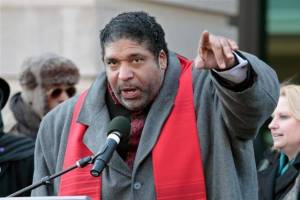
barberFrom the Intro to Rev. William Barber’s recent Op-Ed:

President Trump’s first appearance at the National Prayer Breakfast met awkward silence on Thursday (Feb 2) as he began his comments by touting ratings when he was on “The Apprentice.” Unpracticed in the public performance of piety, the candidate who was praised for “telling it like it is” made even his white evangelical base momentarily uneasy as he demonstrated the impotence of their religion to overcome his narcissism. Excused as a “baby Christian” during his campaign, the teen-like Trump continues to expose the hypocrisy of white evangelicalism.  Continue reading “Prophetic Moral Challenge”

Radical Friendship

radical-friendshipAn exclusive RadicalDiscipleship.Net interview with Ryan Newson, professor of religion, philosophy and ethics at Campbell University.  He is the author of Radical Friendship: The Politics of Communal Discernment, coming out on April 1.

RD: Describe how this project started.

RN: This project began during my doctoral studies when I was immersed in Anabaptist theology and political theology, respectively. As I read Anabaptist theologians in depth, I was drawn to a communal form of reasoning about spiritual and moral questions that seemed to haunt that tradition—always lurking even if it was not always perfectly implemented. This picture of radical disciples drawing near one another in order to figure out what God would have them do, or who God would have them be, was magnetic. It reminded me of the form of Christianity that had always appealed to me, and that I had seen practiced by house churches in Camden, NJ, and New Monastic communities in Durham, NC, and Catholic Worker communities in Silk Hope, NC. In particular, I was attracted to the way in which this practice had the potential to guide communities into new waters without fear, acquiescence, or retreat. It certainly carried much more power, it seemed to me, than the way many of my fellow Christians approached questions of discernment: through a wooden, legalistic application of scripture. Continue reading “Radical Friendship”

Sermon: Stories of Salt and Light

Anneke_jans.jpg
Anna Jansz

By Katerina Friesen, February 5th, 2017, Fellowship of Hope Mennonite Church

Matthew 5:13-20

In recent sermons and reflections here at Fellowship of Hope, we’ve pondered how Jesus’ wisdom teachings and the way of the cross are foolishness to the world. Foolishness, to love our enemies. Foolishness, to be persecuted and blessed. Foolishness, that those who hunger and thirst are the highly favored ones. Yet this foolishness is the wisdom of God that we are given to chew on, the bread of life. Today, we draw our attention to a crucial ingredient in bread baking, the seasoning of our dough: salt. Continue reading “Sermon: Stories of Salt and Light”

The Anti-Trump

rileyBy Tommy Airey, a letter to his nephews who call him “Uncle Coo-Coo”

Riley and Mason,

I want so badly for you to grow up with a deep awareness of what it means to be “a real man.” You have a big advantage because you have parents and a Nawny who are committed to recovery: fearless and thorough in their commitments to mutual and rigorous honesty, to establishing boundaries and assertiveness and to pursuing gentleness with themselves and others in the process.  They have been important models in my own journey of re-claiming open-heartedness and emotional expressiveness.

Unfortunately, the man who gets the most attention, who you will see over and over on TV and the internet, whose name you will hear about more than any other man on the planet is a President who lives off a steady diet of name-calling and fear-mongering, who paints those from south of the border as “criminals” and “rapists” and says if refugees from Muslim-majority countries “are allowed in, it’s death and destruction!,” who magnifies deeply ingrained racial stereotypes of inner-cities as “in horrible shape and falling apart (not to mention crime infested),” whose whole ethos is shaped by bullying and “locker room talk” and whose policies favor the securing of enormous profits for a few over relieving the suffering of everyday people. Continue reading “The Anti-Trump”

Sermon: Grounded in the Bedrock of Faith

beatitutudesBy Joyce Hollyday. January 29, 2017,
Circle of Mercy, Asheville, NC

Micah 6:8; Matthew 5:1-12

On the night of January 19th, the eve of the inauguration, several of us from Circle of Mercy’s immigration mission group gathered at the home that Bill and I share. We kept a vigil in the tradition of the Watch Night Service.

Watch Night is typically traced back to New Year’s Eve of 1862, when enslaved communities stayed up all night waiting for the Emancipation Proclamation to take effect on January 1st. When I was collecting oral histories among African-American UCC churches during my time as an associate conference minister, I was told that the custom is actually much older—that enslaved families stayed up every New Year’s Eve, because January 1st was when masters decided whom they would sell off. Families facing the imminent threat of separation spent all night singing and praying and hoping that they would be together for another year. Continue reading “Sermon: Grounded in the Bedrock of Faith”

I Was A Stranger

martinFrom the Facebook page of Fr. James Martin:
President Trump has announced that he will order the construction of a Mexican border wall, the first in a series of actions to crack down on immigrants, which will include slashing the number of refugees who can resettle in the United States, and blocking Syrians and others from what are called “terror-prone nations” from entering, at least temporarily.

These measures, which mean the rejection of the stranger, the rejection of the person in need, the rejection of those who suffer, are manifestly unchristian and utterly contrary to the Gospel. Indeed, last year, Pope Francis said, “A person who thinks only about building walls, wherever they may be, and not building bridges, is not Christian. This is not the Gospel.”  

Continue reading “I Was A Stranger”

Sojourners in Our Midst

undocumented
Art by Julio Salgado

From the introduction to Ched Myers’ “A House For All Peoples?  A Bible Study on Welcoming the Outsider” (2006):

There have always been two Americas: that of rich and poor, of inclusion and exclusion. The America of inclusion found expression in the ideal of “liberty and justice for all,” and has been embodied whenever Indian treaties were honored, and in the embrace of civil rights, women’s suffrage, or child labor laws. The America of exclusion, on the other hand, was articulated in a Constitution that originally enfranchised only white landed males and has been realized in land grabs, Jim Crow segregation, Gilded Age economic stratification, and restrictive housing covenants.

These two visions of America continually compete for our hearts and minds, not least in our churches. On one side are the voices of Emma Lazarus in her poem “The New Colossus” (“Give me your tired, your poor…”), and Martin Luther King Jr. when he preached “I Have a Dream.” On the other side are those of George W. Bush’s imperial politics and James Dobson’s “Focus on the Family.” Click HERE to read the whole article.


Wild Lectionary: Holy Fools

holyfoolimagewquote32.jpg4th Sunday after Epiphany

1 Corinthians 1:18-31

by Tevyn East and Jay Beck, excerpted from Watershed Discipleship: Reinhabiting Bioregional Faith and Practice

The Catholic Feast of Fools was a day for liturgical dramas that dissolved church hierarchy, celebrated becoming a “Fool for Christ” (1 Cor) and enacted the Magnificat’s call to turn society upside down (Luke 1:52–53). This feast day was later suppressed by authorities lived on for centuries within medieval folk culture. Europeans eventually brought many such religious festivities to the New World under the common label “carnival.” Continue reading “Wild Lectionary: Holy Fools”

Wild Lectionary: Under the Cover of His Tent

dsc02678-768x576
Great American Backyard Campout photo credit: Chattahoochee Nature Center

3rd Sunday after Epiphany

One thing I asked of the Lord, that I will seek after: to live in the house of the Lord all the days of my life, to behold the beauty of the Lord, and to inquire in his temple.
For he will hide me in his shelter in the day of trouble; he will conceal me under the cover of his tent: he will set me high on a rock.
Now my head is lifted up above my enemies all around me, and I will offer in his tent sacrifices with shouts of joy; I will sing and make melody to the Lord.  -Psalm 27:4-6

By Sarah Thompson and Na’Taki Osborne Jelks, excerpted from Watershed Discipleship: Reinhabiting Bioregional Faith and Practice

Sarah: Connecting people to land connects us with one another, enabling us to re-knit kinship ties that were broken by enslavement. In the Diaspora, Black folks have had a primarily extractive relationship with the land, and later in industrial factories. We were seen as people whose worth was in our productive capacity, but beyond that, as disposable. It is easy to understand, therefore, why we have had an extractive relationship with one another, and use a lot of disposable things. But this cycle is spiritually devastating. Continue reading “Wild Lectionary: Under the Cover of His Tent”