Lifting Up Our Gaze to Gaza

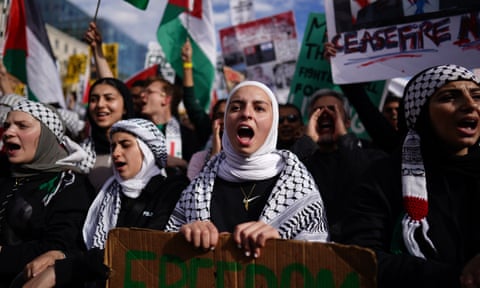
Young woman in keffiyeh among may others holds sign and appears to chant. Lots of red and green.

By Tommy Airey

Over the next three weeks, the Christian season of Lent will overlap with the Muslim holy month of Ramadan, which started yesterday at sundown. Yesterday. When a billion Christians read the Gospel text where the radical rabbi Jesus tells the wealthy and powerful Nicodemus that Jesus himself must be lifted up on a cross – just like Moses lifted up the serpent in the wilderness.

Jesus was giving a little sermon on the story in the Hebrew bible about the post-exodus Israelites getting bit by poisonous snakes. God tells Moses to make a bronze snake, put it on a pole and raise it up whenever someone gets bit – so they can look up at the snake and be healed. Jesus says that he is now playing the role of the bronze snake.

In the Gospel story, Jesus will inevitably be lifted up on a cross. Because he paved a path that threatened those who clung to their privilege, power and wealth. Radical Christian spirituality roots salvation in gazing at Jesus up on that imperial cross.

Continue reading “Lifting Up Our Gaze to Gaza”

Whose Liturgy Is It Anyway?

Another compelling offering from Alternative Seminary.

Whose Liturgy Is It Anyway? Reclaiming Christian Liturgy as the People’s Work

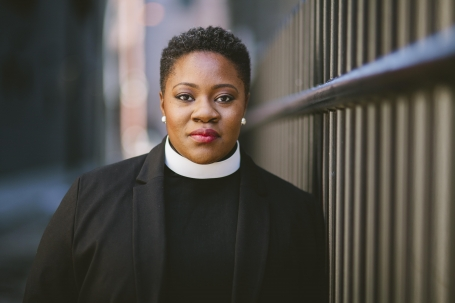
A Three-Part Series Led by Rev. Naomi Washington-Leapheart (above)

Saturdays, March 9, 16, 23. 10:00 am- 12:00 noon EST. $100

Familiar and traditional liturgy in Christian worship can be a source of comfort. But liturgies left unexamined can do harm. In this series, we’ll explore various liturgical forms and ask – whose liturgy is this and what “work” is this liturgy doing? 

Continue reading “Whose Liturgy Is It Anyway?”

Jesus’ “Second Call” to Discipleship

JesusPeter2By Ched Myers, For the Second Sunday in Lent (Mk 8:31-38), re-posted from Lent 2015

Note: An ongoing series of Ched’s brief comments on the Markan gospel readings from the Revised Common Lectionary.
————–
The midpoint of Mark’s narrative poses two questions, aimed both at the disciples in, and the readers of, the story:

“Do you not yet understand?” (Mk 8:21).

“Who do you say that I am?” (8:29a).

The latter provokes what I call the “confessional crisis” (8:30-33), which this Sunday’s reading inexplicably jumps into the middle of (we get the whole text on the 16th Sunday after Pentecost, Sept 13th). This is followed by Jesus’ second call to discipleship (8:34ff), deepening the journey begun in 1:16-20. Continue reading “Jesus’ “Second Call” to Discipleship”

Learning from Laughter and the Trees: Sometimes I Feel like it’s the End of the World

By Lydia Wylie-Kellermann

Sometimes the most miraculous moments of parenting happen in those late night hours when you wish your kids were asleep, but you are snuggled up beside them and they begin to speak.

A few months ago, as the leaves were just beginning to fall, I was lying with Isaac rubbing his back. The lights were off, but the moonlight was streaming through his window. Isaac is now ten years old. I don’t know if you remember fifth grade social studies, but this is the year when the curriculum teaches about “the founding of America.” And Isaac has been struggling. He is learning it in a very different context from our beloved Detroit to our new home in the mountains of eastern Pennsylvania.

We had been quiet for quite some time and I wondered if he had fallen asleep, when suddenly he said, “I miss Detroit.”

Continue reading “Learning from Laughter and the Trees: Sometimes I Feel like it’s the End of the World”

Having Nothing and Yet Possessing Everything

It’s Ash Wednesday. A day for personal recommitment to collective liberation. A day marked by scrutiny, accountability, confession. A day to rediscover our identity and worth in the well-being of others. A day to remind ourselves of our baptism into the struggle for Something Else, from the ghetto to the Gaza Strip. A day to double-down on rebuilding what supremacy has burned down. A day to start giving up what weighs us down and holds us back. A day to embrace the beautiful, ancient tension of what the sacred text says in 2 Corinthians 6:4-10:

…but as servants of God we have commended ourselves in every way: through great endurance, in afflictions, hardships, calamities, beatings, imprisonments, riots, labors, sleepless nights, hunger; by purity, knowledge, patience, kindness, holiness of spirit, genuine love, truthful speech, and the power of God; with the weapons of righteousness for the right hand and for the left; in honor and dishonor, in ill repute and good repute. We are treated as impostors, and yet are true; as unknown, and yet are well known; as dying, and see—we are alive; as punished, and yet not killed; as sorrowful, yet always rejoicing; as poor, yet making many rich; as having nothing, and yet possessing everything.

Hope is a Deeper Current

From Ken Sehested’s newsletter Prayer & Politiks (Jan 30, 2024).

My friend Richard sent me strong words of encouragement regarding something I’d written, particularly this line: “”Despair is often a disguised form of narcissism. Get over yourself.” He then recounted a recent conversation, saying “I told a friend the other day: “When I think about 2024, I am not as hopeful as you are. But I wish I were. Does that count?”

It is a pertinent question requiring a thoughtful response. I responded:

Thanks for your words of encouragement. I certainly resonate with the sentiment you spoke to your friend; though I would use the word “optimistic” instead of hopeful. When it comes to public policy, I am as pessimistic as I’ve ever been.

Continue reading “Hope is a Deeper Current”

Three Dominating, Antidemocratic Dogmas

An excerpt from Cornel West’s Democracy Matters (2013).

The problems plaguing our democracy are not only ones of disaffection and disillusionment. The greatest threats come in the form of the rise of three dominating, antidemocratic dogmas. These three dogmas, promoted by the most powerful forces in our world, are rendering American democracy vacuous. The first dogma of free-market fundamentalism posits the unregulated and unfettered market as idol and fetish. This glorification of the market has led to a callous corporate-dominated political economy in which business leaders (their wealth and power) are to be worshipped—even despite the recent scandals—and the most powerful corporations are delegated magical powers of salvation rather than relegated to democratic scrutiny concerning both the ethics of their business practices and their treatment of workers. This largely unexamined and unquestioned dogma that supports the policies of both Democrats and Republicans in the United States—and those of most political parties in other parts of the world—is a major threat to the quality of democratic life and the well-being of most peoples across the globe. It yields an obscene level of wealth inequality, along with its corollary of intensified class hostility and hatred. It also redefines the terms of what we should be striving for in life, glamorizing materialistic gain, narcissistic pleasure, and the pursuit of narrow individualistic preoccupations—especially for young people here and abroad.

Continue reading “Three Dominating, Antidemocratic Dogmas”

Where are God’s People?

By Jonathan Kuttab, executive director of Friends of SABEEL North America (FOSNA), a theological reflection of 100 days of genocide

As we have now passed 100 days of ongoing genocide and the number of named victims exceeds 25,000 (not counting those still buried under the rubble), the scale human suffering has long reached unbearable dimensions. Over ten thousand children have been killed and continue to be killed at the rate of about 100 per day; over 1,000 children suffered  amputations, many without anesthesia. 50,000 pregnant women struggle to survive and give birth, sometimes by cesarean section, without enough milk, food, or water, much less sanitary conditions. An entire population is being starved, 90% of them are homeless, within just a few miles of a full convoy of trucks filled with supplies not being allowed in to provide food and water. Entire neighborhoods are razed to the ground. The continuous bombardment has exceeded within three months the entire tonnage of bombs used by the US in Iraq over six years. Meanwhile, the people of Gaza have no air defenses, bomb shelters, or escape. For people of faith, this agonizing reality forces  us to confront serious theological challenges. 

The Holocaust in Germany generated a crisis of faith for many Jewish individuals and theologians. Recurring questions include:

  • Where was God during the holocaust?
  • Why did God allow these atrocities to occur? 
  • How could a just God allow such evil to persist? 
  • How can God abandon innocents facing genocide? 

Many individuals lost their faith in God altogether. Similar questions are being raised by people of faith these days in response to the ongoing genocide in Gaza.

Continue reading “Where are God’s People?”

A Compelling Line-Up for the 1st Half of 2024

Do you know about Kirkridge Retreat and Study Center?

With a long, storied activist history (Dan and Phillip Berrigan had a favorite room and frequently led retreats and organized actions there) and an 80-year history of supporting LGBTQI Christians, it’s the kind of place radical disciples should know about. We have a number of retreats coming up that your communities might be interested in attending:

Birthing and Earthing Love: A Lenten Journey with the Gospel of John with Sue Ferguson Johnson & Wes Howard-Brook
Tuesday, February 20 – Thursday, February 22
In this Lenten retreat rooted in the gospel of John, we’ll hear the gospel call to be born anew as “inspired earth” with our identities rooted in God rather than…something else. Join us as we remember what it means when “Love becomes flesh.”

Òrìshà: The Gift of Failure, the Promise of the Monstrous with Báyò Akómoláfé

Friday, March 8 – Sunday, March 10

Drawing on Yoruba indigenous insights, Dr. Báyò Akómoláfé imagines emancipation through the topography of failure. By treating failure, disability, and the destabilizing syncopations visited upon white stability as a form of generative incapacitation, Dr. Akómoláfé invites us to convene at the sites of our greatest vulnerabilities – for it is there that we might take on new shapes. 

Continue reading “A Compelling Line-Up for the 1st Half of 2024”