Discipleship as Defection from the Mammon System: Jesus’ Parable about a “Manager of Injustice”

luke16By Ched Myers, on Luke 16:1-13

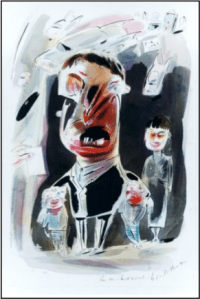
Note: This post is part of a series of weekly comments on the Lukan gospel readings from the Revised Common Lectionary during Year C, 2016. This week Ched offers a longer study because of his conviction that this is a crucial text for middle class Christians. A more detailed version of the reflections below can be found here; a webinar exploring these themes can be found here. [Right: “The Wicked Servant,” Ian Pollock, 1972.]

Summary: This Sunday’s gospel can be read as a poignant fable for all who realize that they have been disenfranchised by the dominant economic system, and who would try to “monkeywrench” whatever status they have in it to provide a modicum of Jubilee justice for themselves and others.  This parable illustrates the contemporary strategy of navigating what Wendell Berry calls the “Two Economies” by using capital to build social relations, rather than sacrificing social relations to build capital.  Continue reading “Discipleship as Defection from the Mammon System: Jesus’ Parable about a “Manager of Injustice””

Empire Baptized

wesDuring our current lectionary cycle, we’ve been downright spoiled with the scholarship that Ched Myers, Wes Howard-Brook (right) and Sue Ferguson Johnson bring every Thursday with their weekly comments on the Gospel passage.  When Wes is not busy teaching at Seattle University, serving at the local soup kitchen, leading the weekly Bible Study in his home, participating in liturgical direct action, hiking up Tiger Mountain or making Sue a latte, he spends his free time researching church history for his next publication.  Last week, his Empire Baptized: How The Church Embraced What Jesus Rejected (Orbis) was released for public consumption.  We sat down for a long-distance dialogue about what to expect next.

RD.net: What were the circumstances in your own life that led to writing Empire Baptized?

WHB: Two major realities led to this book. First, in doing Come Out, My People!, the contrast between the New Testament’s clear message of embodied resistance to empire and historical Christianity’s embrace of empire jumped out at me. Second, in teaching undergrads who are often deeply and rightly suspicious of “Christianity” as well as older and often lifelong church people, I regularly experienced the shock people express when they discover that, for instance, Jesus not only wasn’t concerned with “how does my soul go to heaven,” but wouldn’t even have understood the question!

I had inherited the Yoderian narrative [Mennonite theologian John Howard Yoder] of “it was great for three centuries, but then along came Constantine,” but several things led me to question that story. For instance, that Constantine embraced “Christianity” did not explain such things as many churches’ obsessive focus on right “doctrine,” sexual ethics, and lack of regard for social injustice. I wanted to find out, at least for myself, what “really happened.”

Continue reading “Empire Baptized”

Sinners & Lost Sheep

sheepBy Wes Howard-Brook and Sue Ferguson Johnson
This Sunday’s passage from Luke (15.1-10) seems straightforward: like a man seeking a lost sheep and a woman a lost coin, Jesus seeks and finds people who are “lost.” But like so much of the Bible in general and Luke in particular, a close reading reveals there is more than what meets the eye at first glance.

Our first task is to show how Luke subtly but clearly suggests that the Pharisees’ resistance to Jesus’ message is the primary topic of our passage. Next, we’ll look at the passage itself, and how the first two parts of the parable (sheep/coin) are parallel to the two sons in the final section (15.11-32). Finally, we’ll consider how this speaks to our call to discipleship today. Continue reading “Sinners & Lost Sheep”

Too Big—and Failing! Jesus’ Cure for Affluenza

DropsyBy Ched Myers, 15th Sunday after Pentecost, Aug 28, 2016 (Luke 14:1-14)

Note: This is part of a series of weekly comments on the Lukan gospel readings from the Revised Common Lectionary during year C, 2016. This week’s gospel text is related to last week’s; see the background comments for last week here. Much of the post below is adapted from a sermon given at Downers Grove (IL) First United Methodist Church on 10/10/10.

Luke 14:2-6 is unaccountably skipped over in the lectionary. Yet it is profoundly germane to last week’s reading, and moreover introduces the theme of the whole sequence through 14:24: namely, the issue of how social power and privilege is mirrored in meals, and what to do about it. So I strongly advocate re-instating this beginning episode as part of this Sunday’s gospel. Continue reading “Too Big—and Failing! Jesus’ Cure for Affluenza”

The Silent Cry

DSFrom Dorothee Soelle in her book The Silent Cry: Mysticism and Resistance (2001):

At best, what Protestant theology and preaching articulate in what they designate as “gospel” can be summed up as follows: God loves, protects, renews, and saves us. One rarely hears that this process can be truly experienced only when such love, like every genuine love, is mutual. That humans love, protect, renew, and save God sounds to most people like megalomania or even madness. But the madness of this love is exactly what mystics live on.

What drew me to mysticism was the dream of finding a form of spirituality that I was missing in German Protestantism. What I was seeking had to be less dogmatic, less cerebral and encased in words, and less centered on men…

The title of this book [The Silent Cry] is an address to God that is taken from an anonymous letter from the late Middle Ages, presumably from a pastor to a penitent in difficulties and distress. “My child, be patient and leave off because God will not be torn from the ground of your heart. O deep treasure, how whilt thou be unearthed?” This is followed by a series of addresses to God that, as often happens in the language of German mysticism, do not use the traditional personal metaphors like Father, King, Most High, but new, nonpersonal ones like treasure, fountain, radiance, or “security that is hidden” in order to name the deity. In that sequence of metaphors is found the paradoxical expression “the silent cry” that has fixed itself in my mind for years now. It is a mystical name for God, whose divine power is not grounded in domination and commandment. It is a name that everyone can use, everyone who misses the “silent cry” that has often become inaudible among us. May the one who also cries in us help us all to learn to hear the cry in the foundations of the world.

Healing as Liberation from Crippling Debt

DebtBy Ched Myers, on Luke 13:10-17, for the 14th Sunday after Pentecost

Note: This is part of a series of weekly comments on the Lukan gospel readings from the Revised Common Lectionary during year C, 2016.

This part of Luke’s gospel offers two symbolic stories about the healing of “political bodies” that signify pathology in the body politic: the “bent over” woman (13:10-17) and the “too big” man (14:1-6). Sadly, the second of these is (literally) skipped over by the lectionary. These intimately related healings bracket a series of Jesus’ sayings concerning the Kingdom as surprise and mystery (13:18-21), the “narrow Way” (13:22-30) and the cost of prophetic discipleship (13:31-35). Continue reading “Healing as Liberation from Crippling Debt”

The Inevitable

KingBy Tommy Airey, a homily on Luke 12:49-56 (St. Peter’s Episcopal, Detroit, MI)

For all intents and purposes, in the Gospel this morning Jesus is sounding a whole lot like my high school basketball coach, unrelentingly lighting a fire under our asses, telling us that it’s not his job for us to like him, a rant filled with name calling and rhetorical questions. But this is more than a game: “You hypocrites!” Jesus scolds, “You know how to interpret the appearance of earth and sky, but why do you not know how to interpret the present time?” We know when the Perseids are going to light up the night in Michigan, but we struggle to respond to the signs chronicled by Dr. King: “when machines and computers, profit motives and property rights, are considered more important than people.” Continue reading “The Inevitable”

The Ferguson Declaration: A Black Lives Matter Creed

BlmFrom Rodney Thomas, Pierre Keys, and Friends–originally posted at The Christian Century

We, the heirs of Black Churches and their traditions, in the Spirit of the Prophets, the Apostles, and the Early Church

1.1 We believe in God Our Creator and the Father, the Maker of Heaven and Earth, the Source and Fountain of Love (1st John 4: 8) who loves all people from every tribe and nation and who is the same God who appoints seasons of justice and peacemaking (Ecclesiastes 3:1-8). Continue reading “The Ferguson Declaration: A Black Lives Matter Creed”

Jesus of Nazareth, Arsonist

FireBy Wes Howard-Brook and Sue Ferguson Johnson

Jesus, erstwhile proclaimer of peace and love, hopes for fire and anticipates division within households. Was the Lord having a bad day on the Way to Jerusalem in this Sunday’s Gospel? How can we reconcile his word in this week’s lectionary text (Luke 12.49-56) with what we hear in the rest of Luke’s Gospel? Continue reading “Jesus of Nazareth, Arsonist”