A Liturgy for Removing the Flag from your Sanctuary

Konrad Summers CC, “Countries of the Cross,” Santa Clarita, California, 2008.

By Kerr Mesner, Lydia Wylie-Kellermann, and Kateri Boucher. First published in Geez 62: Dismantling White Theology.

May this symbolic action catalyze us into ever-deeper action to remove the nationalism and white supremacy still living in our communities and our world.

We hope that this liturgy can be used in both Canada and the United States (and indeed anywhere else), but we know that the histories and symbols are unique. Let this be an offering that can be edited, amended, altered, and made stronger in your own beloved community.

OPENING PRAYER
We gather in this sacred place,
declaring that symbols matter.
They reflect our dreams, our joy,
our courage, and our work.

We have come here today to remove
the flag from our worship space.
It is time. It is past time
to say that nationalism has
no place in our church.
Our allegiance belongs to God.

Continue reading “A Liturgy for Removing the Flag from your Sanctuary”

Bound

By Tommy Airey

“The possessive investment in whiteness can’t be rectified by learning ‘how to be more antiracist.’ It requires a radical divestment in the project of whiteness and a redistribution of wealth and resources. It requires abolition, the abolition of the carceral world, the abolition of capitalism. What is required is a remaking of the social order, and nothing short of that is going to make a difference.”—Saidiya Hartmann

Fifty years before George Floyd moved to Minneapolis, Rev. Dr. Martin Luther King, Jr. got arrested in Birmingham. Dr. King, whose national holiday we now celebrate every January, was one of the greatest Americans who ever lived. However, like love itself, Dr. King has been sanitized. White folks and middle-class people have molded him into a meek and mild Black man devoted to a watered-down dream of politeness and patriotism. The real MLK took his cues from a bold biblical brand of love that beckoned him to break rank from a cozy and counterfeit middle-class life built on injustice and oppression.

During his short life, Dr. King was arrested 19 times—the same number of trips that Harriet Tubman made back to the South after she escaped to freedom. While King was in that Birmingham jail cell, he wrote a long letter to white pastors on the margins of a newspaper and smuggled it out to get it published. It is one of the greatest documents ever produced in American history. In it, Dr. King articulated a profound spiritual conviction that serves as the basis for a biblical conspiracy—a life built on belovedness and belongingness.

Continue reading “Bound”

We Need the Funk

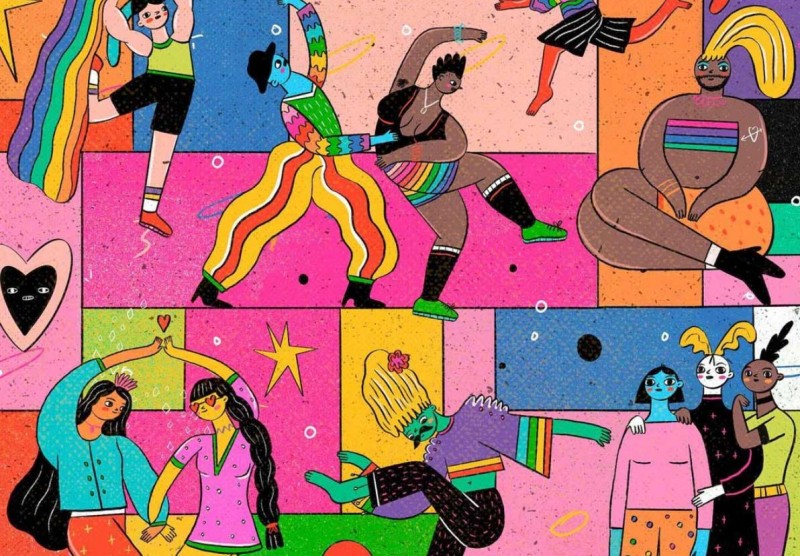
Catalina Vásquez, “Celebrating LGTBIQ+ Pride by Dejusticia,” 2020.

By Lynice Pinkard and Nichola Torbett. This article first appeared in Geez 62: Dismantling White Theology.

The two of us have kicked off countless antiracism and anti-oppression trainings by asserting, not half in jest, that “diversity trainings ruin well-meaning white people.”

But it’s not the trainings, really. It’s the whole moralistic ethos that focuses on getting everything right and avoiding what is wrong: Never use this word. Always use that word. Say “BIPOC,” not “people of colour.” Never cry in a mixed group. Intervene in instances of oppression, but remember that you are not a saviour. Speak up and stand up, but also, step back and yield the mic. These injunctures yield stiff, stilted white people who may successfully “perform” antiracism for limited periods of time but have little capacity for joy or genuine relationship across lines of difference.

Continue reading “We Need the Funk”

All the time in the world

A sermon by Bill Wylie-Kellermann
Given at the Homecoming Service at North Central College, Naperville, IL commemorating 50 years since graduating in 1971.

“To a Young Activist” A Reading from the Letter of Thomas Merton to Jim Forest:

Do not depend on the hope of results. When you are doing the sort of work you have taken on, essentially an apostolic work, you may have to face the fact that your work will be apparently worthless and even achieve no result at all, if not perhaps results opposite to what you expect. As you get used to this idea, you start more and more to concentrate not on the results but on the value, the righteousness, the truth of the work itself. And there too a great deal has to be gone through, as gradually you struggle less and less for an idea and more and more for specific people. The range tends to narrow down, but it gets much more real. In the end, it is the reality of personal relationships that saves everything.

Gospel Reading: Luke 4: 16-21

When he came to Nazareth, where he had been brought up, he went to the synagogue on the sabbath day, as was his custom. He stood up to read, and the scroll of the prophet Isaiah was given to him. He unrolled the scroll and found the place where it was written:

‘The Spirit of the Lord is upon me,    
to bring good news to the poor,
Sent me to proclaim release to the captives  
and recovery of sight to the blind,
to let the oppressed go free,
to proclaim the year of the Lord’s favor.’

And he rolled up the scroll, gave it back to the attendant, and sat down. The eyes of all in the synagogue were fixed on him. Then he began to say to them, ‘Today this scripture has been fulfilled in your hearing.’

In the Name of the One who was, who is, and is to come, Let all of this be…

All of us, to one extent or another can identify with the Homecoming of Jesus to Nazareth – returning to where he began. He’s back to the shul where he learned Hebrew and its texts, back to his synagogue, from which, first as an infant, then as a young person, he made the pilgrimages to Jerusalem. On one occasion to sit with the rabbis and learn from them; or if Luke has it right to astound and teach them.

I’ll wager another pilgrimage in his student days: to the ruins of

Continue reading “All the time in the world”

Reading Jesus and the Rich Man on Indigenous Peoples’ Day: Redistributive Justice and a Discipleship of Decolonization

Saskatoon Catholic cathedral doors, where Indigenous activists have planted red handprints to remind us of the children whose graves are now being discovered at Indian Residential Schools.

In preparation for Indigenous People’s Day on October 11, we share this edited excerpt from Elaine Enns & Ched Myers, Healing Haunted Histories: A Settler Discipleship of Decolonization(Cascade, 2021), pp 275, 281f.

Christians are too often responsible for injecting what Bonhoeffer called “cheap grace” into public conversations that seek to reckon with historical violations through reparations. Our sentimentality would presume to resolve centuries of oppression with ritual apologies. But healing historical injustices and violence requires systemic transformation, not rhetorical contrition. The problem is, the culture of capitalism in North America has few ethical resources that consider seriously wealth or power redistribution of any kind, much less as reparation. Indeed, redistributive justice as a concept is roundly condemned as heretical here.

But the biblical imaginary can reinvigorate our political imagination. As an example, let us reread the infamous gospel story of Jesus and the rich man—the Revised Common Lectionary’s gospel reading for 10/10/21—with our eye on Indigenous Peoples’ Day (10/11/21). 

Continue reading “Reading Jesus and the Rich Man on Indigenous Peoples’ Day: Redistributive Justice and a Discipleship of Decolonization”

Family, Gender & Power

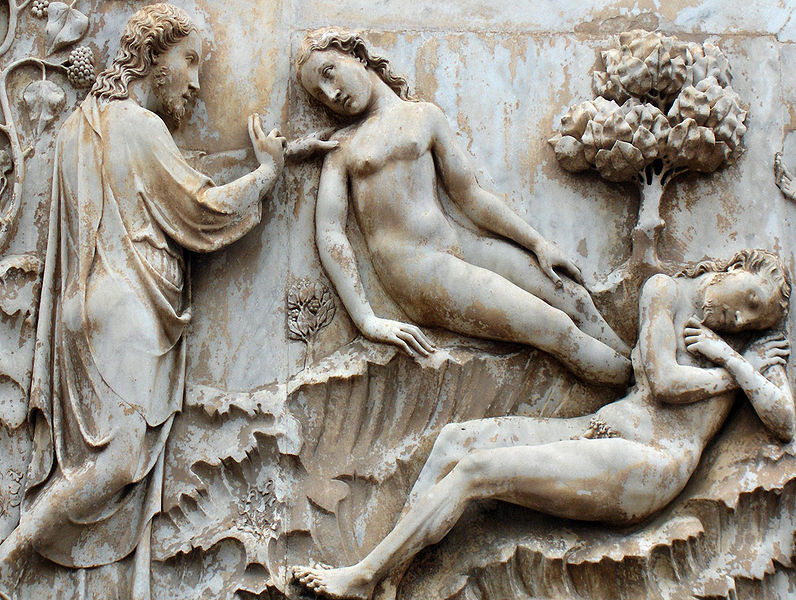
Adam, EveBy Ched Myers, for the 19th Sunday of Pentecost (Mark 10:1-16), originally posted on October 1, 2015

Note: This is an ongoing series of Ched’s brief comments on the Markan gospel readings from the Revised Common Lectionary during year B, 2015.

This Sunday is the Feast of St. Francis. There is much to celebrate about the recent U.S. visit of the Bishop of Rome who took this saint’s name, even for Protestants (after all, October 4 is also World Communion Sunday). In particular, Pope Francis’ encyclical Laudato Si’ is an important statement of public theology addressing the implications of our interlocking ecological crises for our civilization. So we would do well to focus preaching on these themes, perhaps through the lens of the gospel’s concern for children (i.e. future generations). Continue reading “Family, Gender & Power”

Fed

Image credit: “Food,” @berkshirecat, March 3, 2006.

By Shannon Evans. Originally published in Geez 61: Seeds are Sacred.

We hungered to imagine a world where people could just eat together without anyone trying to rescue the other, without anyone more powerful or anyone more shamed.

I raised my sweater and put the baby to my breast, the still-thick rolls of my middle cushioning his tiny body as he slurped hungrily for his dinner. Around us, people milled about, flicking cigarettes into the grass to free their fingers for a plate and fork.

Continue reading “Fed”

Sisters of the Same Seed

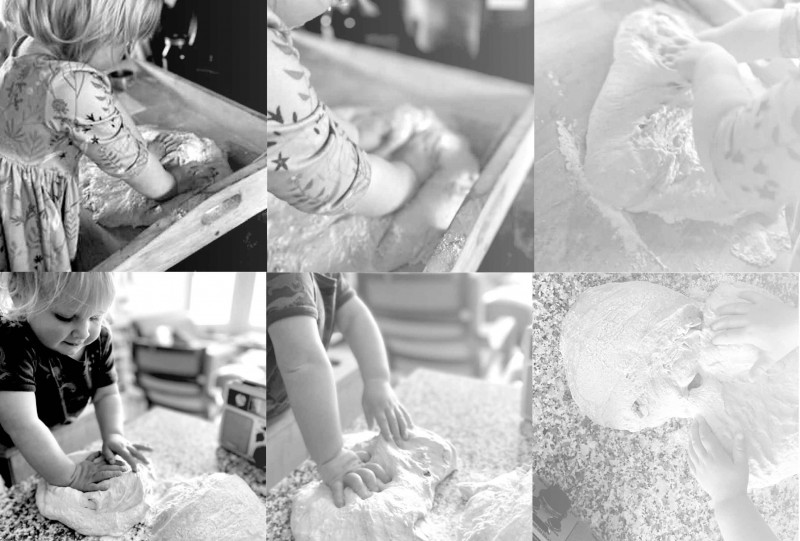
Image credit: Kris’ daughter Flora, 3 (top), and Em’s daughter Lorena, 2.5 (bottom) kneed dough from the same family sourdough starter 1,400 kilometres apart, Em and Kris Jacoby, April 2021, Castleton, Vermont and Chicago, Illinois.

By Em Jacoby. Originally published in Geez 61: Seeds are Sacred.

I am repeatedly called back, like a ministry, to the growing, tending, gathering, transforming, and sharing of food.

The seed was planted during one of my teenage summers spent living on my sister’s small homestead in rural Vermont. I heard my sister say: Why not centre your life around something that is essential for it? I looked down at the dough I was kneading as I heard the coos of my infant nephew.

Two decades later, though Kris remains on that rural homestead and I live in a dense urban neighbourhood 1,400 kilometres (880 miles) away, we share a calling to food as though we share a kitchen. I can still taste that dough we were kneading, rich with ricotta and basil. Only now, my ricotta comes from boiling cast-off gallons of food-bank-donated milk from a Nicaraguan neighbour; Kris’ comes from Tulip, the brown cow born and raised in view of the kitchen window, milked a few hours earlier. While my basil grows in hand-built boxes that hang over my porch railing two stories up, Kris’ comes from the rows of vibrant green herbs in her fields ready to cut for farmers markets.

I easily spend 40 hours a week in my kitchen. I find my vocation in the grinding of grains mounding into a peak in the shiny metal bowl beneath, the dripping of whey from fermenting cream cheese, the snap of a sealed jar of canned tomato sauce speckled with basil and peppercorn. Because of my sister’s words – their grounding in sustainability and history – I am repeatedly called back, like a ministry, to the growing, tending, gathering, transforming, and sharing of food. Even sitting here to write these words, my mind wanders to the seedlings sprouting up from dirt-packed milk cartons resting on my bathroom tiles, and to the pumpkin roasted last fall now thawing to bake into spice bread as edible gratitude for a neighbour.

Continue reading “Sisters of the Same Seed”

On the Wild Goose Festival

Re-posted with permission from the social media account of Alicia Crosby, a writer, speaker and justice educator from Chicago (August 18, 2021).

When I resigned from my leadership position at the Wild Goose Festival in 2016 I asked the board a question.

Do you want to be a prophetic place for transformation or a playground for white progressives?

When <10 sessions out of 400+ focus on racial equity, the answer is clear.

I should note that most of those <10 sessions are not explicitly named as racial justice spaces but I can trust @lennyaduncan, @JoLuehmann, @irobyn, @RevDrBarber, & my beloved Dr. Forbes to prioritize what is just because I know their public theology & preaching pushes for this.

Aside from the impudence of still hosting an multi-day, in-person event in which masks are not required during a COVID surge across the South, it’s clear to me that safety is still not being prioritized in myriad ways.

Continue reading “On the Wild Goose Festival”