Wild Lectionary: Look to the Acorns

IMG_2956.JPG
Dark-eyed Junco
Photo Credit: Laurel Dykstra

Proper 28(33) A
Pentecost + 24

Matthew 25:14-30

By Ragan Sutterfield

I have been spending my mornings in the woods lately, a short hike before I begin to work on the tasks of the day. As fall finally arrives here in Arkansas the juncos have returned, twittering as they flash the white of their tails, and the long metallic notes of white-throated sparrows echo in the understory. Each step along the trails comes with a crunch, not only of the newly fallen leaves, but also of the acorns, cracking orange against the gray shale of the hillsides. Continue reading “Wild Lectionary: Look to the Acorns”
Wild Lectionary: Letting it flow down the creek

IMG_4361Proper 27(32)A
Pentecost + 23

I Thessalonians 4:13-18
Matthew 25: 1-13

Keep awake therefore, for you do not know the day or the hour. (Mt 25:13)

…so that you may not grieve as others do who have no hope. (1 Th 4:13)

By Andrew Hudson

I’m an empty-nester, twice over. I sent my son off to college a couple years ago, and I’m still not through adjusting. And just recently, I had a similar experience, sending off a good, small Mennonite congregation to a new location at the end of my being their interim pastor.  Continue reading “Wild Lectionary: Letting it flow down the creek”

Wild Lectionary: Parting the Water or Crossing Over, The Trouble Remains

IMG_2162.JPGBy Edward Sloane
Proper 26 (31)
Joshua 3: 7-17

The movement of crossing-over offers a theologically rich metaphor, but one that is not without troubles. The Israelites crossed-over the Red Sea and the Jordan River to establish a Promised Land; Jesus crossed over from death in the resurrection; the colonization of indigenous communities and the exploitation of more-than-human communities are the result of crossing oceans and bioregions; enslaved black bodies in the United States travelled the Underground Railroad to cross over into free territories; migrants cross borders seeking refuge from political, economic, and climate instability. Crossing over suggests a happy ending—we have arrived. Leaving behind a troubling, or unsatisfying, past, we are on our way to something better, perhaps even salvation. Depending on who tells the story and how, it is easy to read such crossings in multiple ways.   Continue reading “Wild Lectionary: Parting the Water or Crossing Over, The Trouble Remains”

Wild Lectionary: Who Is My Neighbor?

P1260327(1)
Sacred Earth Camp youth catalogue species at Coleman Creek Credit: Devin Gillan

Proper 25 (30)
Twenty-First Sunday after Pentecost

Matthew 22:34-46

By Laurel Dykstra

In today’s Gospel when asked about the greatest of all the commandments, Jesus’ reply is simple, “love God, love your neighbor.” In Luke, this same exchange is followed by the question, “who is my neighbor?” which Jesus answers with the parable of the Good Samaritan. The story of upstanding citizens who fail to respond to suffering after an assault has obvious parallels for first world Christians confronted by climate crisis, species extinctions, and environmental racism. Continue reading “Wild Lectionary: Who Is My Neighbor?”

Wild Lectionary: Judgment and Joy

IMG_9963.JPG
Photo credit: Laurel Dykstra

Proper 24(29)
20th Sunday after Pentecost
Psalm 96

by Calvin Redekop

I love to return again to the Scriptures, to those visions seen by the prophets and apostles and singers of Israel about the “peaceful reign of God.” There is a strange concatenation of judgment and celebration in some of the Psalms, especially Psalms 96 to 99 and 104. Psalm 99 beings, “The Lord is king; let the people tremble!” In many Christian circles it is today politically incorrect to speak about God as king, as reigning, as judging, and instead God is portrayed as a morally nondiscrimination, indulgent Santa. Such and attitude represents the deliberate denial of a theme that runs through the Bible from beginning to end. “The Lord is king,” and one of the functions of a king was to be a judge, to dispense justice.

Continue reading “Wild Lectionary: Judgment and Joy”

Wild Lectionary: We Despised the Pleasant Land

6863477149_86ff790b32_b
Fort McMurray Alberta Tar Sands, Kris Krüg CC BY-NC-ND 2.0

Proper 23(28)
19th Sunday after Pentecost
Psalm 106

By Wes Howard-Brook and Sue Ferguson Johnson

When you tell the story of your, your family’s, or your community’s journey, what role does the land and its nonhuman creatures play?

Central to God’s promise to ancient Israel was a land to call their own, both as a people and as local families. In this week’s reading, Psalm 106 presents one of several biblical summaries of Israel’s relationship with YHWH, the land and its peoples. It is framed by “praise YHWH,” although the core of the psalm laments the people’s constant disobedience and forgetfulness. Throughout the psalm, the land is close at hand, beginning with deliverance from Egypt via the Red Sea, and continuing into the wilderness struggles. Continue reading “Wild Lectionary: We Despised the Pleasant Land”

Wild Lectionary: Until there is room for no one but you

kContinued from yesterday’s reflections on the lectionary for the 18th Sunday after Pentecost

Isaiah 5:8-23

By Ched Myers

Isaiah articulates the contemptible socio-economic disparity in Israel. A series of prophetic “woes” (howy) commences in verse 5:8 that extend through 5:23, and the first one summarizes starkly and succinctly all that will follow. The image of  “joining house to house and field to field” specifically refers to the phenomenon of “latifundialization,” the economic process by which large landowners increase their holdings by foreclosing on indebted small farmers. Theologians Urich Duchrow and Franz Hinkelammert point out that the 8th century BCE saw history’s first wave of “privatization” spread throughout the Mediterranean world, including Israel: Continue reading “Wild Lectionary: Until there is room for no one but you”

Wild Lectionary: Ecological Theology of the Vineyard

kj
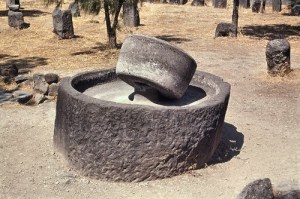
Old millstone, Palestine

Proper 22 (27)
18th Sunday after Pentecost

Isaiah 5:1-7
Matthew 21:33-46

By Ched Myers

The 18th Sunday after Pentecost this year comes on the heels of the “Season of Creation,” a contemporary liturgical and lectionary movement celebrated during the four Sundays in September prior to St Francis of Assisi Day (4 October). Today’s haftorah—Isaiah’s famous “Song of the Vineyard”—continues this vein of ecological theology. Continue reading “Wild Lectionary: Ecological Theology of the Vineyard”

Irma and La Tuna, Charlottesville and North Korea: The Voice Under the Voice, Still Unheard

KidRockTrump
Detroit, Michigan: Six sold-out shows to open up the new $800 million Little Caesar’s Arena

Dr. James Perkinson, Ecumenical Theological Seminary (Detroit, MI)

The signs of our time shout! Harvey hammers Houston and the entire Gulf Coast camps out in a boat or a grave. Then comes Irma with Jose and Katya in Her wake, raking an entire peninsula with rebuke. While fire ungraced with gendered traces of naming, blisters the west. All on top of Charlottesville, itself evoking Trump, chopping restraints militant and policing, channeling a large chunk of the dominant demographic of the country! As I write, Kid Rock readies his concert of hate in downtown Detroit, as front for the Ilitch family take of Motown turf, faking concern, raking in tax dollar support, celebrating white vituperation in the gala opening of a new ice hockey stadium at the core of an 82 % black city. Little Caesar indeed! But what do all of these events have to do with each other? How might a community aspiring to some measure of humanity and morality “hear” what these events sound out? I do not yet even dare to say, “Respond.” Continue reading “Irma and La Tuna, Charlottesville and North Korea: The Voice Under the Voice, Still Unheard”

Join Us Into Your Movement

CircleBy Joshua Grace, a report from Circle of Hope

Philadelphia, PA

At Circle of Hope, we have the advantage of being small (over 50 cells – circles of 10), medium (5 congregations of 100-200 people), and large (we get together several times per year). Some of our expressions happen when people form Compassion Teams (we have 20 right now) that lead the church in an effort according to the passions, gifts, and limits of the folks who lead. Our most recent Love Feast, where people from all cells and congregations gather, was an expression of the Holy Spirit breathing life into all levels of the body. Continue reading “Join Us Into Your Movement”