A God Who is Very Different from the Almighty

AugsburgerFrom the conclusion of David Augsburger’s recent piece “Lent: Is God Like Jesus?” originally posted on The Mennonite blog. Read the entire Lenten reflection here.

“Christ is not only God-like, but God is Christ-like,” Martin Luther King Jr. wrote in Strength to Love (1963). The Christian gospel proclaims a God who is very different from “the Almighty,” the historic God among all the gods who is, by trusted definition, an omnipotent paragon of ultimate invincible irresistible power. The God of Jesus Christ, in Leonardo Boff’s phrase, is “weak in power but strong in love” (Cry of the Earth; Cry of the Poor, 1978).

God is like this gentle good gracious guest at Mary, Martha and Lazarus’ home, at Zacheus’ table, at Simon’s banquet, at Cleophas and spouse’s supper. Continue reading “A God Who is Very Different from the Almighty”

To Combat Deportation: A Day of Prayer

Christians for SocialismThis Monday, April 15,  Christians For Socialism is proposing a day of prayer for all those in the States facing deportation (see below for more specifics). Consider joining them.  

On Tuesday, April 2, a court ruled that hundreds of Assyrian/Chaldean people in the Detroit area detained by ICE could be deported to Iraq after a legal battle carried out by the ACLU. The Assyrians/Chaldeans are a regional minority who have been targeted and brutalized in Iraq. The deportation would be especially dangerous for Assyrian/Chaldean Christians. Continue reading “To Combat Deportation: A Day of Prayer”

To Walk in Love and Not Fear

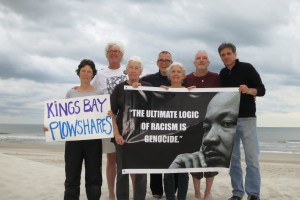
Kings BayFrom Clare Grady, a member of the Kings Bay Plowshares 7, in an interview with Amy Goodman this week on Democracy Now, explaining why they risked twenty-five years in prison for their nonviolent action on the 50th anniversary of Dr. King’s assassination:

The weapons of empire are always the threat of death and torture and incarceration and dehumanization. And so, when we undertake this, as white people of privilege, we are just adding a little tiny bit to what is ongoing of the struggle of people, where the Doomsday Clock has already hit midnight for them and their children and their grandchildren and the Earth where they live.

But I think that what we want to do…is be invitational to other people with similar privilege to say that we enjoy these privileges. But we’re not really enjoying it. There’s just tremendous cost that comes with all this. But in stepping over that line and taking that hammer and actually hammering a dent in some of these weapons system, they give you this 25-year threat, but you don’t know what the outcome is. The whole process is to encourage each other to walk in love and not fear.

Fourth Helpings

talitha4By Talitha Fraser

We live in times where the focus is on those things that divide rather than connect us but as Chappo (Peter Chapman) says “You should share communion together, it has a unique power to unite beyond words.

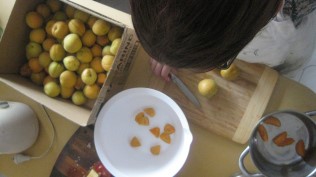
For many years I was a co-ordinator for a local community project called Sharing Abundance, the idea behind the project was food sustainability through food rescue and food redistribution.  If we noticed a home in our neighbourhood had produce growing, especially if they didn’t seem to be using it, we’d knock and ask if we could pick it and donate it on to people in need: through our local church foodbank and outreach projects offering a community meal. Mostly people were happy to get rid of it seeing the produce as something that attracted lots of birds and bats or made a mess on the lawn below. Continue reading “Fourth Helpings”

Latin-X Discipleship

Josh LR2By Rev. Josh Lopez-Reyes (right), Pastor and Community Life Specialist at The Loft in Los Angeles, California

*This is the 15th installation of a year-long series of posts from contributors all over North America each answering the question, “How would you define radical discipleship?” We will be posting responses regularly on Mondays during 2019.

What is radical discipleship? As I reflect on this question, the image of deep-dirty soil comes to mind. As many contributors have reminded us via this wonderful online community of resisters, the word ‘radical’ comes from the Latin radix or radic meaning roots. Therefore, radical discipleship is the inherit, deep and primary essence of apprenticeship concerning the brown Palestine prophet and peasant. As the Rev. Dr. Miguel De La Torre reminds us in, The Politics of Jesús: A Hispanic Political Theology (Rowman & Littlefield, 2015), this is nevertheless saying “no” to Jesus.[1] That is, it is the rejection of a comfortable, gnostic, white supremacist savior. Radical discipleship is about going to the roots of our tradition, to recover the profoundly deep solidarity of Creator’s love demonstrated in the one who was crucified on Good Friday in unity with the crucified communities of our world.[2] However, it is also about going deep into the roots of who we are. It is about revealing the beloved community as the unique creation that the Creator birthed us to be. In my case, it is about being Latin-X. Continue reading “Latin-X Discipleship”

Journey Into Restorative Justice

ElaineBy Elaine Enns

* This article appeared in Rock! Paper! Scissors! Tools for Anarchist + Christian Thought and Action (Vol I, No. 3). Check out the entire issue for more passionate and in depth writing like this. 

Exactly one hundred years ago as I write, during Christmas 1918, in the community of Osterwick, Ukraine, my maternal grandmother Margreta survived a two-week home invasion—one episode in what one historian called “a continuous climate of violence, plundering, rape, mass killing and extensive bloodbaths” endured by Mennonites (and others) during the Russian Civil War from 1917-1921. The men of the house had fled into the forest while thirteen-year-old Margreta and her older sister and girl cousins had been hidden in the attic. My great-grandmother Anna fed and bandaged the wounds of rough, demanding peasant soldiers in the rooms below, trying to respond to violence with courage and hospitality. It is difficult to believe that she escaped sexual violation, as claimed by family stories passed down; my studies with descendants of other Mennonite women who experienced similar depredations suggests their stories were lost, silenced, or suppressed. Still, Anna’s non-violent actions may have warded off the worst. Some months later, for example, her sister and three relatives were brutally murdered in their basement, and Margreta would lose more family members and friends in the following years. So my grandmother experienced severe trauma yet also witnessed her mother’s profound trust in God and in her religious tradition of nonresistance.

Click HERE to read the rest of Elaine’s piece at Rock! Paper! Scissors!

Elaine Enns, DMin, a Canadian Mennonite, is an educator, writer, facilitator and trainer in conflict transformation. She focuses on how restorative justice applies to historical violations, including issues of intergenerational trauma and healing. ​Elaine has been working in the field of restorative justice since 1989.  For the first 15 years of her career, she was part of the pioneering generation of contemporary restorative justice practitioners whose focus was on the Criminal Justice System. Elaine facilitated victim-offender dialogues, provided training and worked to apply restorative justice principles and theory to conflict issues in schools, communities and churches.  Born and raised in Saskatoon, Saskatchewan, she lives in Oak View, CA, where she is co-director of Bartimaeus Cooperative Ministries (www.bcm-net.org).

The Evidence is Clear

Rhiana GunnFrom Rhiana Gunn-Wright, policy director for the nonprofit New Consensus, one of the lead policy writers for the Green New Deal. She was interviewed on DemocracyNow.org and asked about the connections between racial wealth disparity and climate change and how the Green New Deal will address them.
There’s a couple reasons that we see [racial wealth disparity]  connected to the Green New Deal. One is, of course, a moral argument. A lot of the people who are dying from fossil fuel pollution or who are carrying the heaviest burden are people of color, and they’re poor people of color. And likely, when climate change picks up and we see more disasters, more deaths, those are the first people who are on the line. People like to say climate change will kill us all, but the truth is climate change will kill some people first. And so, there’s a moral imperative to make sure that in the green transaction the same people who bear the brunt of our reliance on fossil fuels are not the same people who the green transition is being built on their backs. So that’s one. Continue reading “The Evidence is Clear”

Responding to a Deep, Insistent Sense of Call

Chava Redonnet (1)
PC: Lisa, a guest at the Catholic Worker

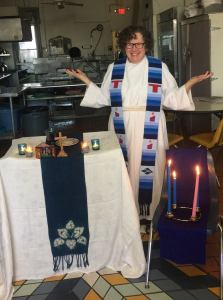
By Chava Redonnet (right), from the bulletin of Oscar Romero Inclusive Catholic Church in upstate New York (4th Sunday in Lent)

Something I really do not enjoy doing is arguing. It’s one of those character traits that can be seen as either a virtue or a fault, but whichever it is, it’s me. Live and let live is more my style. We don’t all have to agree.

So in recent years I have found myself less and less interested in trying to convince anyone why women should be priests. I figure my priesthood is my argument for women priests. If someone can look at my ministry and say it’s not valid simply because I’m female, I don’t think anything I could say would change their mind. Continue reading “Responding to a Deep, Insistent Sense of Call”

Wild Lectionary: Affection vs. Effectiveness

DSC00116
A tree that the author’s family visits weekly.

Lent 5C
John 12:1-8

By Ragan Sutterfield

The current level of atmospheric carbon is just above 411 parts per million–a level that is catastrophic and rising. While little has been done, the efforts of most institutions both governmental and non-governmental have treated the problem like a math equation. Cut fossil fuels by X amount. Increase forest carbon sinks by Y. Problem solved. But the problem has not been solved any better than the problem of a person who counts calories but does not trust in the goodness and value of their own body. We have failed to recognize that carbon is not the problem; that it is only the symptom of an underlying disease of our habits and hearts, a matter of our affections more than arithmetic.

Continue reading “Wild Lectionary: Affection vs. Effectiveness”