Suffering the Gift: Decolonizing the Holidays

winslowBy Luke Winslow, a re-post from The Seattle School blog

Which story? Whose thanks?

In the days surrounding Thanksgiving, I was practicing mindful listening to Native and indigenous activists whom I follow on social media. As a kind of bookend to the emotional harm Native American communities re-experience every fall when the dominant culture still acknowledges days like Columbus Day (rather than its increasing replacement, Indigenous Peoples’ Day), followed by the colonial version of Thanksgiving, I find myself searching for language weeks later for how to translate what I’m hearing back to my own communities.

Although each holiday focuses on different themes (one could say, American and Christian identity formation, respectively), perhaps Thanksgiving and Christmas need to be viewed together, not separately, that with a retrospective, deconstructive view we can look at the ways these holidays mutually inform how and what we celebrate at the end of the year. In short, what does giving thanks and giving gifts mean in the specific context of—for we white and settler communities—being guests on stolen land? Continue reading “Suffering the Gift: Decolonizing the Holidays”

Helpings

talitha
Illustrator – Chris Booth, Ordinary Time

By Talitha Fraser

We live in times where the focus is on those things that divide rather than connect us but as Chappo (Peter Chapman) says “You should share communion together, it has a unique power to unite beyond words.

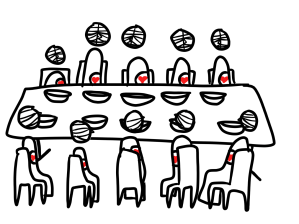
Our practices of radical hospitality and community have something to offer we know the world is hungry for and to that end we are going to share some recipes over the coming weeks that are for community meals. Don’t think: How can I reduce the scale of this to feed my family? Instead think: Who shall I invite to share food at my table? Continue reading “Helpings”

Presence

heartBy Melissa Shaw-Smith. Re-posted from her blog.

The year has rocked this world to its roots.
What if for one day each being put down
their burdens, their words of hate, their inhumanity
and breathed in the presence?
Stopped fighting for history, for fears, hopes, dreams
and stood facing the morning sun
letting the warmth of the moment
and the next, the next, accumulate like dust at their feet
Listened instead of spoke, acknowledged truth,
embraced silence.

What if for one day each being acknowledged the fear
and let it go? Suspended beliefs
opened their arms, drew strength
through earth, grass, rock, sand
Found the sparrow singing from a lone bush
the small heart-shaped cloud
Felt the currents of air wash over them, mingle
with the breath, and let the seams unravel
borders blend, walls dissolve
and be
one.

Radical Discipleship in a Time of Extinction

Puck JPerkBy James W. Perkinson 

*This is the first of a year-long series of posts from contributors all over North America each answering the question, “How would you define radical discipleship?” We will be posting responses regularly on Mondays during 2019.

“Radical discipleship” is one way of stating the call of the gospel. At face value, it means something like “following the root” (“radical” comes from the Latin “radix,” meaning “root”). But Christianity since Constantine has become so much the creature of urban imperial regimes that we typically approach the language of roots and plants as metaphor—nice “conceits” from earlier times that we have more literally “left behind” in our collaboration with a high-tech takeover of the planet. Indeed, in evangelical circles the great hope of the age in books going by the “Left Behind” nomenclature is to be “raptured” out of the mess of history and the barbarity of nature. The vision of salvation is one of exiting everything to do with earthly living—such as plant bodies growing, root-systems exchanging with soil, or animals eating and reproducing. Indeed, if heaven offers any “food” delights (like pizza or beer, in my paradise)—they will surely not issue in bacterial-driven metabolic processing and defecation or entail beheading of wheat or fermenting yeast or fungi handing off nitrogen to roots! (Not to mention anything as scandalous as sexual intercourse!) Continue reading “Radical Discipleship in a Time of Extinction”

Learning the Word in the Shell of the World

michaelraymondsmith_41632004_183400802554740_4175147947804037989_n
PC: Michael Raymond Smith

By Bill Wylie-Kellermann

For Danielle and Matt, 4/28/12

it is
new as an egg nested high in the cleft of a rock
teeming precariously, with life,
and ancient, even as the rock itself

fresh as manna glistening the ground
of a wilderness camp
convened in the company of ungulates, angels, and wild beasts.
we travel light, learning this day
our daily bread – and nothing more Continue reading “Learning the Word in the Shell of the World”

Truth, Trust, and Power

Jesus RadA CALL FOR CONTENT from our co-conspirators at Jesus Radicals for their third issue of Rock! Paper! Scissors!

Tools for anarchist + Christian thought

Issue 3: Truth, Trust, and Power

Guest Editor: Ted Lewis

In the field of restorative justice, which seeks to address and repair harm in relationships, two elements have been central to people’s experience: truth-telling and trust-building. In this way, truth and trust (which share word origins in a number of languages) work together to bring about healing and restoration between people and even communities. In this third issue of Rock! Paper! Scissors! Tools for anarchist + Christian thought, we seek to wrestle with the tensions of speaking truth and building trust in the midst of power-imbalances in relationships and in movements for justice. Continue reading “Truth, Trust, and Power”