Wild Lectionary: Dry Seed and Soil

Screen Shot 2018-10-29 at 9.39.02 AM
Dawn, Yukon, 2001 by Tia McLennan

Proper 26(31) B
24th Sunday after Pentecost

Happy are those whose help is the God of Jacob, whose hope is in the LORD their God, who made heaven and earth, the sea, and all that is in them;

Psalm 146:5-6

By Juleta Severson-Baker

Psalm 146

Everyone who turns around to look for God is dancing

Every word spoken of God’s love is a poem

Every name pinned on the mystery of God is a metaphor

I will not put my trust in the parts of the whole
I will praise the whole Continue reading “Wild Lectionary: Dry Seed and Soil” →

Like a Roadmap of Resistance

4.2.7By Chava Redonnet, Oscar Romero Inclusive Catholic Church (Rochester, NY)

When I first visited El Salvador in 2005 with a class from Divinity School, we went to the Divina Providencia cancer hospital where Monseñor Romero lived (because he refused to live in the bishop’s palace when the people were living in such terrible conditions). We were there again, on Thursday, October 11, just a few days before his canonization. A Carmelite nun showed us around, and I told her the story of how on my first visit there, I looked at all of his things – daily objects, so lovingly preserved – all so male and old-fashioned and foreign – and they felt strange and distant. But then I saw a pair of clip-on sunglasses that had been his. They were identical to a pair of my own! I could have bought them at Wegmans. And it hit me: this struggle is not some strange, distant, foreign thing. It’s here and it’s now, and the work continues. I am also a part of the struggle; the work is mine, as well. Continue reading “Like a Roadmap of Resistance” →

Wild Lectionary: Turtle Island Renewed

10927865_10152919819936146_8083265901206285762_oAll Saints Day –Year B

Revelation 21:1-6a

By Dan Epp-Tiessen

Then I saw a renewed heaven and a renewed earth, for the old order of things had passed away. And the sea was no more—the sea that brought colonizers’ ships, soldiers, guns and diseases, and their slaves, and their dreams of wealth, plunder and domination. The sea which was used to strip Turtle Island of its riches—its furs, lumber, fish, agricultural goods, silver and gold—will no longer be available as a highway of exploitation.

Continue reading “Wild Lectionary: Turtle Island Renewed” →

In Winter

winter.jpgBy Kate Foran
With an invitation to Word and World’s Heart and Hearth: A Writing Retreat for Women.

The nights are getting chillier and the ground is covered in frost by morning.

On days like this, even getting out of from under the warm covers to start the day requires deliberate intention. There’s a choice to be made. You have to ready yourself. Same with stepping outside in the cold—you have to attend to the transition between the cozy heat inside and the bite of cold on the other side of the door. One by one, the layers pile on. Continue reading “In Winter” →

Seeking True Vision


Binding30 years in and Ched Myers’ Binding the Strong Man: A Political Reading of Mark’s Story of Jesus (1988) is more relevant than ever. We’ve got five more Sundays to celebrate it! This week’s commentary homes in on Mark 10:46-52.

The community now approaches the suburbs of Jerusalem. Mark opens this second story of a blind man as he did the first: “And they came into” (kai erchontai; see 8:22) Jericho. Mark sets a scene for this episode, which was no doubt familiar to anyone who had gone to Jerusalem on pilgrimage. Jericho was the last stop en route to the city of David; the road out of town, representing the final, fifteen-mile leg of the pilgrim’s journey, would have been the standard beat for much of that city’s beggar population. The odds were good that pilgrims would have the mood and means to give alms. There Jesus, the disciples, and a great crowd meet Bartimaeus, the destitute blind man. Continue reading “Seeking True Vision” →

Our Polarized Landscape

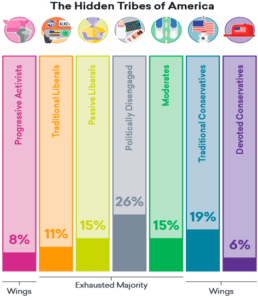
Hidden TribesFrom a recent piece in The Atlantic summarizing the recently released report Hidden Tribes: A Study of America’s Polarized Landscape.

If you look at what Americans have to say on issues such as immigration, the extent of white privilege, and the prevalence of sexual harassment, the authors argue, seven distinct clusters emerge: progressive activists, traditional liberals, passive liberals, the politically disengaged, moderates, traditional conservatives, and devoted conservatives.

According to the report, 25 percent of Americans are traditional or devoted conservatives, and their views are far outside the American mainstream. Some 8 percent of Americans are progressive activists, and their views are even less typical. By contrast, the two-thirds of Americans who don’t belong to either extreme constitute an “exhausted majority.” Their members “share a sense of fatigue with our polarized national conversation, a willingness to be flexible in their political viewpoints, and a lack of voice in the national conversation.”

Most members of the “exhausted majority,” and then some, dislike political correctness. Among the general population, a full 80 percent believe that “political correctness is a problem in our country.” Even young people are uncomfortable with it, including 74 percent ages 24 to 29, and 79 percent under age 24. On this particular issue, the woke are in a clear minority across all ages.

…

Progressive activists are the only group that strongly backs political correctness: Only 30 percent see it as a problem.

So what does this group look like? Compared with the rest of the (nationally representative) polling sample, progressive activists are much more likely to be rich, highly educated—and white. They are nearly twice as likely as the average to make more than $100,000 a year. They are nearly three times as likely to have a postgraduate degree. And while 12 percent of the overall sample in the study is African American, only 3 percent of progressive activists are. With the exception of the small tribe of devoted conservatives, progressive activists are the most racially homogeneous group in the country.

Into the Jaws of a Crocodile

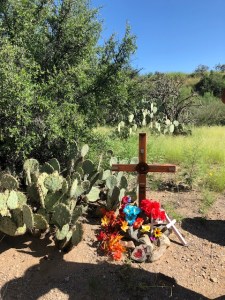
Cross in desert (1)
PC: Rebecca Heskamp

By Joyce Hollyday

To our right the desert sunset was a dazzling blaze of gold with streaks of red behind towering saguaro cacti, as my partner Bill, our friend Becca, and I drove south from Phoenix to the Arizona-Mexico border. To our left a glowing, salmon-colored full moon rose and perched on a blue-gray mountain peak. We were on our way to participate with a hundred other people of faith from around the country in a week of prayer and protest, communion and confrontation, organized by the Southwest Conference of the United Church of Christ. Continue reading “Into the Jaws of a Crocodile” →

Wild Lectionary: Persistent Truth-Telling and Way-Making Disciples

this
Found on https://ecoamerica.org

Proper 25(30) B
23rd Sunday after Pentecost

Mark 10:46-52

By Rev. Miriam Spies

As a woman who lives with a disability (Cerebral Palsy), I have a complicated relationship with healing stories in our scriptures. I tend to read physical healing stories as restoring people into life in community, and restoring community to live as a whole. That being said, the story of Bartimaeus is a call story, as well as a healing story, demonstrating it requires truth-telling even and especially in our vulnerability to be a disciple of Jesus Christ. Colleen Grant writes,

“There is also another type of healing story found in the Gospels, a type that shifts the focus from Jesus to the individual being healed.  Its aim is to communicate something about the nature of discipleship and the necessity of having faith in Jesus.  Thus, upon healing blind Bartimaeus, Jesus tells him, ‘Go, your faith has made you well’.  At these words, Bartimaeus regains his sight and he assumes the quality of a disciple, that is, he follows Jesus on the way.” (74) Continue reading “Wild Lectionary: Persistent Truth-Telling and Way-Making Disciples” →

Help Wanted

By Tommy Airey, co-curator of RadicalDiscipleship.net and the author of Descending Like a Dove: Adventures in Decolonizing Evangelical Christianity

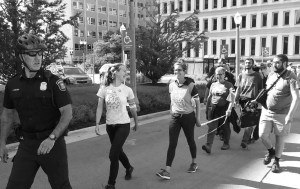
Arrest (1)On that Spring day in Lansing, when Lindsay joined the band of holy rebels getting arrested for civil disobedience (right), I participated in civil discourse with a police officer hired to keep the peace at the peaceful demonstration. Despite the overtime pay, he wasn’t happy. He confessed that he was reluctant to support anyone too lazy to get off their butts to get a job. I shared with him the data—there are hundreds of jobs for hundreds of thousands of applicants. But he had a comeback: “No way. I see help wanted signs everywhere.” Continue reading “Help Wanted” →