Disobedience Here Below

35280298_10214519220947802_2199522416651141120_o
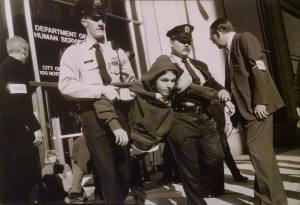
Alana Alpert, Bill Wylie-Kellermann, and others shut down the Department of Environmental Quality on June 4 as part of the Poor People’s Campaign.

Re-shared from Tikkun.

Ordained from Hebrew College of Boston in 2014, Rabbi Alana Alpert serves a dual position as rabbi of Congregation T’chiyah and as a community organizer with Detroit Jews for Justice. Because they have been working closely together on the Michigan Poor Peoples Campaign, she invited Rev. Bill Wylie-Kellermann to share the teaching for Rosh Hashanah. A graduate of Union Theological Seminary in NYC, Bill is a non-violent activist, author, and United Methodist pastor recently retired from St Peter’s Episcopal, Detroit. What follows are their remarks for the day.

Rabbi Alana Alpert: Shanah tovah!!!

I suppose you are used to most of my heresies by now, but I’ll admit a new one: vegan coneys. There is a new place in Brush Park. Just a few weeks ago, I sat around a long table of Detroit Jews for Justice leaders discussing the implications of our recent arrests as part of the Poor People’s Campaign, a national campaign uniting tens of thousands to challenge the evils of systemic racism, poverty, the war economy, ecological devastation & the nation’s distorted morality. Continue reading “Disobedience Here Below”

On the Eve of Hurricane Florence

index
Hurricane Florence from BBC

By Kateri Boucher

It’s so easy for me to still think of climate change as some kind of amorphous, future-tense crisis. Something I’ll have to deal with, for sure, just not right now. But what’s happening to our planet is not a future crisis; it is a living, breathing, current reality. Millions of people around the world have already come face to face with their personal nightmares of “climate dystopia,” and many of them haven’t made it out alive. Monsoons in South Asia; drought in East Africa; heat waves in India and Pakistan; hurricanes on the US Atlantic coasts. And here is the thing that we must keep reminding ourselves: those who are ALREADY most marginalized, oppressed, and exploited by global systems of power are those who will continue to suffer the most.

Right now, as I type, South Carolina’s MacDougall Correctional Institution (a privately owned corporation) is holding hundreds of inmates in their cells, despite a mandatory evacuation order from the Governor. For those prisoners, this current moment is a living “dystopia” in ways that many of us can’t even begin to imagine. The Campaign to Fight Toxic Prisons has organized an informal phone zap (link in comments) to pressure SC officials to evacuate all prisons in the flood zone. I’m not sure of its status right now, but if anyone else knows of other ways to support the prisoners please share more info in the comments.

In the coming days and weeks (and months and years and decades), many many others will need support as well. And looking ahead, here are the questions I’m holding in my heart: How will we find ways to support those most affected by this storm? Can we see this storm as a symptom of a much larger sickness — and what will we do to address the root causes of illness? How would it feel to actually sit with the heaviness of this collective global moment? Who are my neighbors? Who are your neighbors? What would it actually mean to love our neighbors as ourselves? Like, actually actually? What would we have to give up if we do? What would we have to give up if we don’t?

***

It’s okay to let yourself mourn.

Inevitability

Binding30 years in and Ched Myers’ Binding the Strong Man: A Political Reading of Mark’s Story of Jesus (1988) is more relevant than ever. This week’s commentary homes in on Mark 8:27-38.

Mark will tell us that it was “necessary” for John/Elijah (Mk 9:12:f) to challenge the highest powers and be executed by them; so too with Jesus, for that is the “script” Yahweh has given to the servant/prophets, as Mark will make clear through his parable of the tenants. Continue reading “Inevitability”

The Norm

DiAngeloFrom Robin DiAngelo’s White Fragility: Why It’s So Hard For White People To Talk About Racism (2018):

Racism is the norm rather than an aberration. Feedback is key to our ability to recognize and repair our inevitable and often unaware collusion. In recognition of this, I try to follow these guidelines:

1.   How, where, and when you give me feedback is irrelevant—it is the feedback I want and need. Understanding that it is hard to give, I will take it any way I can get it. From my position of social, cultural, and institutional white power and privilege, I am perfectly safe and I can handle it. If I cannot handle it, it’s on me to build my racial stamina.

2. Thank you.

The above guidelines rest on the understanding that there is no face to save and the game is up; I know that I have blind spots and unconscious investments in racism. My investments are reinforced every day in mainstream society. I did not set this system up, but it does unfairly benefit me. I do use it to my advantage, and I am responsible for interrupting it. I need to work hard to change my role in this system, but I can’t do it alone. This understanding leads me to gratitude when others help me.

It’s Not Part of Our Vision

RamseyThanks to Detroit-based law student Cait De Mott Grady for passing along this profound interview Derrick Jensen did with former U.S. Attorney General Ramsey Clark way back in 2000. His reflections are more relevant than ever. This is an excerpt, but the entire interview deserves a read.

Jensen: So how do we maintain our national self-image as God’s gift to the world, the great bastion of democracy?

Clark: But we’re not a democracy. It’s a terrible misunderstanding and a slander to the idea of democracy to call us that. In reality, we’re a plutocracy: a government by the wealthy. Wealth has its way. The concentration of wealth and the division between rich and poor in the U.S. are unequaled anywhere. And think of whom we admire most: the Rockefellers and Morgans, the Bill Gateses and Donald Trumps. Would any moral person accumulate a billion dollars when there are 10 million infants dying of starvation every year? Is that the best thing you can find to do with your time? Continue reading “It’s Not Part of Our Vision”

Wild Lectionary: Who do we say…

dear-tree-combo17th Sunday After Pentecost
Proper 19 (24)B
Mark 8:27-38

By Rev. Dr. Victoria Marie

The concrete and asphalt jungle of the Brooklyn Heights and Cobble Hill sections of Brooklyn are where I thought my heart and emotions were nourished. I thought my city dweller life and lifestyle defined me. It wasn’t until in I was in art therapy grieving the loss of several family members that I discovered the longing in my heart for nature’s spaces and places. Buildings, streets and other signs of city life were nowhere in my art works. Rather, they were of the sea, rocks, flora and fauna. It was self-discovery—a deeper look into who I am. Continue reading “Wild Lectionary: Who do we say…”

All The Work

SerenaA timely word from Brittney Cooper, Rutgers professor of women’s and gender studies, from her Eloquent Rage: A Black Feminist Discovers Her Superpower (2018):

Watching Serena play is like watching eloquent rage personified. Her shots are clear and expressive. Her wins are exultant. Her victories belong to all of us, even though she’s the one who does all the work …That’s kind of how it feels to be a Black woman. Like our victories belong to everyone, even though we do all the work.

Visit from a Prophet

By Joyce HollydayPraying mantis 2

I slept late yesterday morning. By the time I had emerged from the trees on my walk, the pasture was already blanketed in a sultry haze. My mind was preoccupied with an upcoming trip and the pile of tasks I need to accomplish before I can leave for a week. I plodded along, barely noticing what was around me.

I felt a tiny prick above my right ankle and reached down reflexively to brush away a mosquito. This was some mosquito—huge and bright green, with a triangular face. When I tried to pry the odd creature away from my sock, it dug in the sharp spines on its forelegs and clung more fiercely. I was afraid it would leave behind a leg or two if I persisted, so I sat down in the grass and stared for a while at its curious face. Continue reading “Visit from a Prophet”

Sit

talithaBy Talitha Fraser

Sit
empty cupped hands
outreached in supplication
for the daily bread
that feeds and sustains you.
Everyday you must
acknowledge your own hunger,
acknowledge your own emptiness,
acknowledge your own longing…
in this weakness
lies your strength.
Freed from all you cannot do
you are released to do what you can
and it begins when you sit
empty cupped hands
outreached in supplication.

The Cornerstone to the New Social Order

BindingWe continue our every-Sunday-celebration of the 30th anniversary of Binding The Strong Man, Ched Myers’ political reading of Mark’s Gospel. 

The story of the Syrophoenician woman bears certain affinities with its counterparts in the Jewish cycle. She, like the hemorrhaging woman, demonstrates inappropriately assertive female behavior that is vindicated. The parallel with the Jairus story goes beyond the common petition on behalf of ailing daughters at home. Both these episodes articulate feeding-symbolics that are carefully correlated to Jesus’ feedings of the masses in the wilderness. Jesus’ somewhat anticlimactic instructions in the aftermath of his dramatic raising of Jairus’s daughter were for those present to “give her something to eat” (Mk 5:43). In like fashion, Jesus instructs his disciples in the first feeding to “give the crowd something to eat” (Mk 6:37). Similarly, Jesus tell the gentile woman that “the children must first be satisfied” (Mk 7:27 chortastenai)–which satisfaction has indeed already been reported in Mk 6:42 (“they all ate and were satisfied,” ephagon pantes kai echortastesan)! This is how Mark prepares the way for the fulfillment of the Syrophoenician woman’s request–the feeding and satisfaction of the gentiles–which will indeed shortly take place (same verb, Mk 8:4,8). Continue reading “The Cornerstone to the New Social Order”