Sister Anna: A litany for worship inspired by the Prophetess Anna

index
Rembrandt, “The Prophetess Anna”, 1639

By Ken Sehested

Sister Anna. Last-named prophet in Holy Writ, more
likely listed among household property and livestock.

When did your Temple-dwelling vocation begin?
What sustained your twenty-four-seven vigil
for all those years? Continue reading “Sister Anna: A litany for worship inspired by the Prophetess Anna”

Attacking Their Ideological Foundations

BindingWe continue our every-Sunday-celebration of the 30th anniversary of Binding The Strong Man, Ched Myers’ political reading of Mark’s Gospel. This week, the lectionary gifts us with an episode from Mark’s Gospel where Jesus deals with obstacles to an integrated community.
This episode resumes Mark’s polemic against the Pharisaic movement, begun in Mark 2:15, over the issue of the purity code as it defines the propriety of table fellowship…The issue at hand is maintenance of strict group boundaries, represented here by practices of ritual purity and dietary restriction. The Pharisees defend the purity code as fundamental to the ethnic and national identity of the people; Jesus repudiates these exclusivist definitions by attacking their ideological foundations… Continue reading “Attacking Their Ideological Foundations”

The Humanity That is Being Caged Inside

BorderThis week Rev. Traci Blackmon offered this prayer on the Mexico side of the U.S. border wall with a group of about 80 sojourning with the United Church of Christ’s Faithful Witness at the Border.

We come to this Border Patrol station, not as an enemy but as friend, because we are all connected by God. As you go about your jobs of border enforcement, as you go about guarding the border, I pray that you guard your hearts, so that you don’t lose touch with the humanity that is being caged inside; so you remember to treat those who are being detained with the same care and dignity that you would treat your own family. You must guard your souls, just as we must guard the soul of this nation.

Wild Lectionary: No Fence Can Hold

IMG_4900
Photo credit: Dylan van Dyke Brown

15th Sunday after Pentecost
Proper 17(22)B

Song of Solomon

By Cheryl Bear

he said, oh lovely one
follow my deep, ancient footprints
you will find me
you will track me until i catch you
i will always stand up for you
you remind me of a spirited young appaloosa
no fence can hold you
you’re blinding, dazzling
like trying to look at a river
flashing with sunlight Continue reading “Wild Lectionary: No Fence Can Hold”

The Catch

BoatBy Tommy Airey, a meditation on Luke 5:1-11
Once while Jesus was standing beside the lake of Gennesaret, and the crowd was pressing in on him to hear the word of God…

We grope for what is spiritual-but-not-religious. Beyond the rusted institutions. These have utterly failed to meet human need. Too often, the church is a performance, a club, an obligation. So we go beyond the four walls, where Steadfast Love cannot be contained or confined. We come to the shore. Water and trees and birds bring life and hope and wonder. Jesus meets us there. He is the anti-institutional inspiration. He speaks truth and beauty. The word of God.

…he saw two boats there at the shore of the lake; the fishermen had gone out of them and were washing their nets.

At the shore, Jesus beckons us to the simple life. Everything we need is right in front of us. Manna. Boats. Fill-in-the-Blank. Cultivating awareness becomes crucial to the spiritual life. Jesus points to the nets. Like our souls, and everything else that carries heavy burdens, they need washing. Continue reading “The Catch”

Liberating the Bible from the Hands of the Colonizers

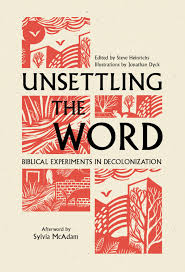
index.jpgA Review of Unsettling the Word: Biblical Experiments in Decolonization

(Edited by Steve Heinrichs)

By Jen Galicinski

A timely, poetic, and prophetic new anthology titled Unsettling the Word: Biblical Experiments in Decolonization has recently been published by the Mennonite Church of Canada and will be re-published by Orbis Books in February 2019. It was edited by Steve Heinrichs, the Director of Indigenous-Settler Relations for the Mennonite Church of Canada and one of the several faith leaders who was recently arrested and spent time in prison for protesting the Trans-Mountain pipeline in Burnaby, B.C. in solidarity with the Musqueam, Squamish, and Tsleil-Waututh peoples.

For Heinrichs, it was working on the book that deepened his profound belief that we must truly listen to the voices of Indigenous peoples, who have been suffering, alongside their wounded land, since contact with European Christian settlers.  He is committed to following The Crucified One by acting in solidarity with crucified peoples, following their leadership towards self-governance and sovereignty over their own lands. Continue reading “Liberating the Bible from the Hands of the Colonizers”

Bread of Heaven

indexBy Katerina Friesen

Lord of the harvest, Grain-sower, Bread-giver, Life-sustainer:

We are astounded by your bounteous love, filled to the brim

with good things. You give us enough, and then some!

Bread of Life, we love You. Though You were pounded down,

You rose up again, broken so all may be fed.

Breath of Heaven, Spirit of All-Things-New,

with You, we are carried through the fire and we rise up,

we rise up again! So we praise Your name, Holy Trinity of Love.

Our Script

BindingWe continue our every-Sunday-celebration of the 30th anniversary of Binding The Strong Man, Ched Myers’ political reading of Mark’s Gospel. This portion is excerpted from the book’s “Aftermath” entitled On Continuing the Narrative of Biblical Radicalism.

The empty tomb at the end of Mark’s Gospel symbolizes that his story, like its subject Jesus, has not ended but lives on. Just as Mark reached back across the centuries to bring the “old story” of Hebrew prophetic radicalism to life again in a new story about Jesus of Nazareth, so does he reach forward across the ages to us, challenging us to continue the story by “returning to Galilee” (Mark 16:7). But how is it that an invitation to “reread” this story is politically subversive? Does not the circle of narrative actually lead the reader away from practice, shutting out the real world and seducing us with one that exists only in our imagination? This is certainly what those who dismiss the fictions of apocalyptic narrative as the wish-dreams of the alienated would have us believe. Continue reading “Our Script”

Instead of Calling the Police

Vigil2From “What To Do Instead of Calling the Police,” a living document (last updated July 15, 2018) compiled by Aaron Rose.

We’ve all been there. Your neighbor is setting off fireworks at 3am. Or there’s a couple fighting outside your window and it’s getting physical. Or you see someone hit their child in public. What do you do? Your first instinct might be: call 911. That’s what many people are trained to do in the United States when we see something dangerous or threatening happening.

At this point, most of us understand that, in the U.S., the police often reinforce a system of racialized violence and white supremacy, in which black people are at least three times more likely to be killed by the police. For years now, we’ve heard the nearly daily news of another unarmed person of color being shot by the police. When the police get involved, black people, Latinx people, Native Americans, people of color, LGBTQ people, sex workers, women, undocumented immigrants, and people living with disabilities and mental health diagnoses are usually in more danger, even if they are the victims of the crime being reported. Police frequently violently escalate peaceful interactions, often without repercussions. In 2017, the police killed over 1,100 people in the U.S. Continue reading “Instead of Calling the Police”