Blessing of the Bicycles

_1080626
Photo credit: Bayne Stanley

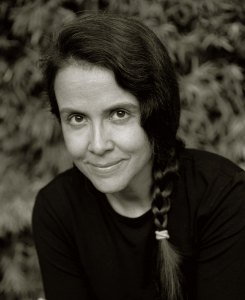
By Laurel Dykstra, Salal and Cedar

On May 29, Salal and Cedar and Fossil Free Faith organized “bike to worship week” and a blessing of the bicycles. Below is an article written by Laurel Dykstra for the Diocese of Westminster. Following the article is the order of service and intercessions.

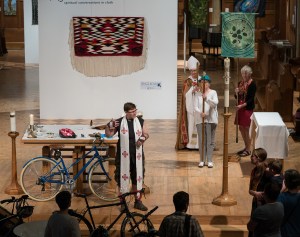
Vancouver’s Christ Church Cathedral has a new bell tower but the bells ringing in the 120 year old church on May 29th were attached to the handle-bars of bicycles. With sacramental chrism oil, bicycle chain oil, holy water and prayers, Anglican Bishop Melissa Skelton, two priests, and a United Church Minister blessed bicycles, transit passes, and a host of people who are making an effort to reduce the environmental impact of their commute to worship.

While light from the stained glass windows colored their faces, a congregation of about twenty-five listened to a passage from Ezekiel about the prophet’s vision of a wheel within a wheel and they prayed for the safety of cyclists, fossil fuel divestment and the victims of climate disasters and wars for oil.   Led by a cross and banners and the bishop with miter, crozier and cope, cyclists and pedestrians processed out of the church to a hospitality station on the street where they offered coffee, snacks, bike maps and “ride-by blessings” to commuters on the bike route outside. Continue reading “Blessing of the Bicycles” →

Jesus as Pedagogue of the Oppressed

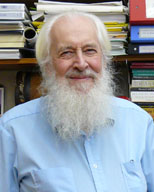
Vern RAnother short and sweet book review-summary from legendary pastor Vern Ratzlaff, posting up on the Canadian prairies, pouring his heart and mind into anti-imperial theology and soul-tending.  Vern turns 80 this week.  As Ched Myers noted a few days ago: “in his long ministry he has opened so many new ways of being Anabaptist in a pluralistic world, ways that many of us try to walk with him.” We honor this elder for his service and way-of-Being in the world–a model of radical discipleship.

Parables as Subversive Speech: Jesus as Pedagogue of the Oppressed. William Herzog, Westminster, 1994.

Herzog focuses on the parables from the social/cultural analysis of Freire, Brazilian educator, whose work with the poor brought new attention to what could help people accept a perspective that would move beyond the immediate poverty and loss of hope. Herzog traces carefully the shifting interpretation systems of Jesus ‘the Parabaler’ and presents an interpretational approach that compares it with Freire’s methodology. Continue reading “Jesus as Pedagogue of the Oppressed” →

The Mushroom Hunters

mushroom.jpgBy Neil Gaiman
Listen hear read by Amanda Palmer

Science, as you know, my little one, is the study
of the nature and behaviour of the universe.
It’s based on observation, on experiment, and measurement,
and the formulation of laws to describe the facts revealed.

In the old times, they say, the men came already fitted with brains
designed to follow flesh-beasts at a run,
to hurdle blindly into the unknown,
and then to find their way back home when lost
with a slain antelope to carry between them.
Or, on bad hunting days, nothing. Continue reading “The Mushroom Hunters” →

Book Announcement: Where the Water Goes Around: Beloved Detroit

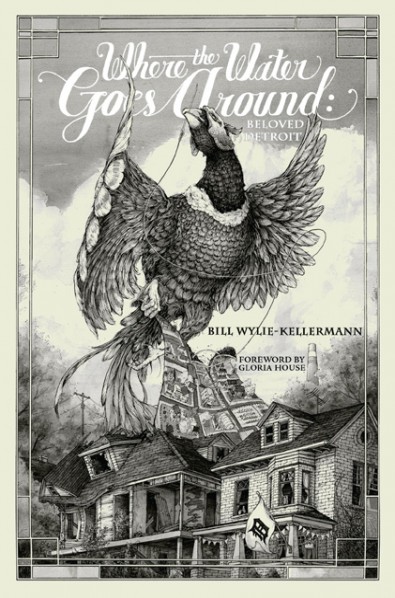
dads bookNew book by Bill Wylie-Kellermann. Where the Water Goes Around: Beloved Detroit is a biblical and political reading of Detroit over the course of three decades by an activist pastor.

Detroit is a place where one can take the temperature of the world. Think on the rise of Fordism and auto-love, the Arsenal of Democracy, the practice of the sit-down strike, or the invention of the expressway and suburban mall. Consider more recently the rebellion of 1967, the deindustrialization of a union town, the assault on democracy in this Black-majority city, the structural adjustments of municipal bankruptcy, and now a struggle for water as a human right. Continue reading “Book Announcement: Where the Water Goes Around: Beloved Detroit” →

From a Black Mother to Her Son

Wild Lectionary: Beware the Cataclysm!

19024614_10154383615946567_367044656_o
Photo by Helen H. Richardson, The Denver Post

By Wes Howard-Brook and Sue Ferguson Johnson, Abide in Me

For readers of Wild Lectionary, there is hardly a Scripture passage more fitting than Genesis’ account of the Flood. The powerful, terrifying narrative is often reduced to a kids’ story, replete as it is with “cute” animals in the Ark. But, of course, beneath the surface is a story of divine near-omnicide, revealing a deep rift between the Creator’s vision and humanity’s response to God’s gift of the earth. In combination with the conclusion of the Sermon on the Mount (Matt 7.21-28), this week’s texts offer a sobering reminder of the cost of human violence to the earth and its creatures, including sapiens. Continue reading “Wild Lectionary: Beware the Cataclysm!” →

Tables Turned: A Reflection

Susie Martin
Photo: Sally Martin. Hummocks Trail, Winter 2015.

By Seth Martin, a folksinger, writer and activist from the Pacific Northwest, now living with his partner Lee Nan Young in Korea. He recently released a collaborative album, “This Mountain” (“이산”), celebrating grass-roots, land-based resistance to militarism and the machinery of US colonial politics and religion–in Korea and North America. You can listen to it here.

Teacher, is the earth alive?

“Sweet is the lore which nature brings.
Our meddling intellect
Misshapes the beauteous forms of things
We murder to dissect.”
-Wordsworth

It was May 18th in Korea. I was teaching English to elementary schoolers. The pre-assigned lesson was about “living” and “non-living” things.

According to the textbook, things that need air, food, water, and shelter are “living”, and they always “change and grow.” Continue reading “Tables Turned: A Reflection” →

An Act of Love

PCFrom Patrisse Cullors, a co-founder of Black Lives Matter and the founder of Dignity and Power Now, in a recent interview with Krista Tippett:

It’s both rage and love at the center of our work, I think. From the beginning, Alicia Garza’s “Love Note” to black people that ended with, “Our lives matter, black lives matter,” it was from a place of rage, but also from a place of deep love for black people. And I think that — when we show up on the freeway, when we chain ourselves to each other, that’s an act of love. That act of resistance is an act of love, that we will put our bodies on the line for our community and really for this country. In changing black lives, we change all lives. And I think that’s the conversation that needs to be penetrated into folks, right? This conversation about black lives mattering is a conversation about all lives mattering, and I think that our work shows as such.

When we have actions of people — have they ever been a part of a Black Lives Matter action — it’s deeply spiritual. It’s often led by opening prayer. Folks are usually sage-ing. We use a lot of indigenous practices. People build altars to people who have passed. And so it’s this moment to both stand face-to-face with law enforcement, but it’s also this moment to be deeply reflective on the people who’ve been killed by the state and give them our honor. It’s an honor to protest for them. So many of our people, names have been lost, and so we’ve said, “We will not forget you. This protest will keep you remembered.” And Sandra Bland was a perfect example. When she was arguably killed inside a jail cell, we said, we will not forget your name, because so often the names are forgotten.