A Society Gone Mad on War

billDay 4 of our Lenten Journey with Dr. King’s “Beyond Vietnam” Speech

Since I am a preacher by calling, I suppose it is not surprising that I have seven major reasons for bringing Vietnam into the field of my moral vision. There is at the outset a very obvious and almost facile connection between the war in Vietnam and the struggle I and others have been waging in America. A few years ago there was a shining moment in that struggle. It seemed as if there was a real promise of hope for the poor, both black and white, through the poverty program. There were experiments, hopes, new beginnings. Then came the buildup in Vietnam, and I watched this program broken and eviscerated as if it were some idle political plaything on a society gone mad on war. And I knew that America would never invest the necessary funds or energies in rehabilitation of its poor so long as adventures like Vietnam continued to draw men and skills and money like some demonic, destructive suction tube. So I was increasingly compelled to see the war as an enemy of the poor and to attack it as such.
—————–
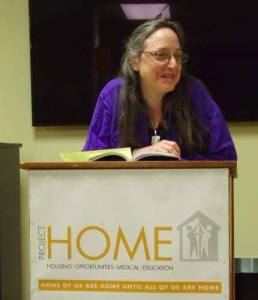
“A Lent Beyond Despair” By Rev. Bill Wylie-Kellermann (photo above) of St. Peter’s Episcopal Church in Detroit

As we begin the contemplative foray into Dr. King’s seven words on the war, it is well worth considering the overall structure of those reasons for resistance. The first three view the war through the lens of the reigning principalities of the U.S. domination system: materialism, white racism, and militarism: 1) that the war is an attack on the poor, dismantling programs of support in order to fund it, 2) that it is a racist war, sending young men in brutal solidarity to burn huts in Vietnamese villages, who wouldn’t be able to live next door in Detroit, and 3) that he couldn’t preach nonviolence to young people on the street without also opposing the “greatest purveyor of violence in the world today – my own government.” He will subsequently name these the “giant triplets,” the ruling powers of domination. Continue reading “A Society Gone Mad on War”

The Necessary Condition of Trust

nick-p-2Day 3 of our Lenten Journey with Dr. King’s “Beyond Vietnam.”

I come to this platform tonight to make a passionate plea to my beloved nation. This speech is not addressed to Hanoi or to the National Liberation Front. It is not addressed to China or to Russia. Nor is it an attempt to overlook the ambiguity of the total situation and the need for a collective solution to the tragedy of Vietnam. Neither is it an attempt to make North Vietnam or the National Liberation Front paragons of virtue, nor to overlook the role they must play in the successful resolution of the problem. While they both may have justifiable reasons to be suspicious of the good faith of the United States, life and history give eloquent testimony to the fact that conflicts are never resolved without trustful give and take on both sides. Tonight, however, I wish not to speak with Hanoi and the National Liberation Front, but rather to my fellow Americans.
——————-
By Rev. Nick Peterson (above right, with spouse NaKisha), a pastor and prophet pursuing a PhD in liturgics and ethics at Emory University in Atlanta

Fixed in the intellectual heritage of American pragmatism is the notion that every problem has a solution. From the earliest stages of our formal education we are presented with problems that can be solved if we take the time to understand them and apply the methods and rules we learned. Modern medicine and technology are all furthered by a desire to solve our problems and in so doing make our lives better. Continue reading “The Necessary Condition of Trust”

Beyond the Prophesying of Smooth Patriotism

michelleDay 2 of our Lenten Journey with Dr. King’s “Beyond Vietnam” speech.

Some of us who have already begun to break the silence of the night have found that the calling to speak is often a vocation of agony, but we must speak. We must speak with all the humility that is appropriate to our limited vision, but we must speak. And we must rejoice as well, for surely this is the first time in our nation’s history that a significant number of its religious leaders have chosen to move beyond the prophesying of smooth patriotism to the high grounds of a firm dissent based upon the mandates of conscience and the reading of history. Perhaps a new spirit is rising among us. If it is, let us trace its movement, and pray that our inner being may be sensitive to its guidance. For we are deeply in need of a new way beyond the darkness that seems so close around us.

Over the past two years, as I have moved to break the betrayal of my own silences and to speak from the burnings of my own heart, as I have called for radical departures from the destruction of Vietnam, many persons have questioned me about the wisdom of my path. At the heart of their concerns, this query has often loomed large and loud: “Why are you speaking about the war, Dr. King? Why are you joining the voices of dissent?” “Peace and civil rights don’t mix,” they say. “Aren’t you hurting the cause of your people?” they ask. And when I hear them, though I often understand the source of their concern, I am nevertheless greatly saddened, for such questions mean that the inquirers have not really known me, my commitment, or my calling. Indeed, their questions suggest that they do not know the world in which they live. In the light of such tragic misunderstanding, I deem it of signal importance to state clearly, and I trust concisely, why I believe that the path from Dexter Avenue Baptist Church—the church in Montgomery, Alabama, where I began my pastorate—leads clearly to this sanctuary tonight.

——————–
From Michelle Alexander (photo above), the author of The New Jim Crow and professor at Union Theological Seminary, posted a week after the 2016 election:

Like millions of people, I am still struggling to wrap my mind around what the election means for our collective future. I won’t try to sort it out here, in a Facebook post.

What I will say is that what happened can’t be explained simply as a failure of the political establishment — though it has failed spectacularly. Nor is it simply a problem of racism or sexism — though both are alive and well and flourishing in this moment. Nor is this election simply a matter of economics, though global capitalism and neoliberalism have created a world in which people of all colors are suffering greatly as factories close, work disappears, wages stagnate, and human beings are treated as disposable — like plastic bottles tossed in a landfill — as political and media elites (not just Trump) spew propaganda that encourages us to view “the others” as the enemy. Continue reading “Beyond the Prophesying of Smooth Patriotism”

Wild Lectionary: When the Spirit Sends You Into the Wilderness

IMG_0057.jpg(During Lent, we are journeying daily with King’s Beyond Vietnam. However, we will also continue to post the Wild Lectionary series on Thursdays)

First Sunday in Lent

Then Jesus was led up by the Spirit into the wilderness to be tempted by the devil.  He fasted forty days and forty nights, and afterwards he was famished.  -Matthew 4:1-2

By Victoria Loorz

You don’t need to read the surveys to know that most people experience a sense of connection with the earth when they spend time in wilderness, but data does confirm it. A recent(ish) survey by Pew showed that six-in-ten adults in the general public (58%) say they often feel a “deep connection with nature and the earth,” with unaffiliated persons about as likely as Christians to agree (58% and 59%, respectively).  Pew Research Center survey, June 28-July 9 2012. Continue reading “Wild Lectionary: When the Spirit Sends You Into the Wilderness”

Always on the Verge of Being Mesmerized by Uncertainty

rose-and-vincentToday, we begin our Lenten journey together, daily meditating on the words of Dr. King’s “Beyond Vietnam” speech at Riverside Church in New York City on April 4, 1967.  

Mr. Chairman, ladies and gentlemen, I need not pause to say how very delighted I am to be here tonight, and how very delighted I am to see you expressing your concern about the issues that will be discussed tonight by turning out in such large numbers. I also want to say that I consider it a great honor to share this program with Dr. Bennett, Dr. Commager, and Rabbi Heschel, some of the most distinguished leaders and personalities of our nation. And of course it’s always good to come back to Riverside Church. Over the last eight years, I have had the privilege of preaching here almost every year in that period, and it’s always a rich and rewarding experience to come to this great church and this great pulpit.

 I come to this great magnificent house of worship tonight because my conscience leaves me no other choice. I join you in this meeting because I am in deepest agreement with the aims and work of the organization that brought us together, Clergy and Laymen Concerned About Vietnam. The recent statements of your executive committee are the sentiments of my own heart, and I found myself in full accord when I read its opening lines: “A time comes when silence is betrayal.” That time has come for us in relation to Vietnam.

The truth of these words is beyond doubt, but the mission to which they call us is a most difficult one. Even when pressed by the demands of inner truth, men do not easily assume the task of opposing their government’s policy, especially in time of war. Nor does the human spirit move without great difficulty against all the apathy of conformist thought within one’s own bosom and in the surrounding world. Moreover, when the issues at hand seem as perplexing as they often do in the case of this dreadful conflict, we are always on the verge of being mesmerized by uncertainty. But we must move on.
—————————
Highlights from Rose Berger’s April 2007 Sojourners Magazine interview with Vincent Harding (photo above: Rose with “Uncle Vincent”), the author of Dr. King’s “Beyond Vietnam” speech:

The Riverside speech (variously called “Beyond Vietnam” or “Breaking the Silence”) named the sickness eating the American soul as “the giant triplets of racism, extreme materialism, and militarism.” It was a watershed moment. Continue reading “Always on the Verge of Being Mesmerized by Uncertainty”

Sermon: On Not Taking Up Crosses

transfigurationRev. Rebecca Stelle, Church of the Covenant, Lynchburg, VA
Sunday February 26, 2017
Matthew 17:1-9

I adored Gordon, my spiritual teacher and mentor, and I would have willingly followed him up a mountain. But if instead of saying, “Becca, we are going to be developing new forms of church life through which the Spirit can end poverty,” Gordon had said, “Becca, I will be arrested, suffer torture, die at the hands of church leadership and then rise again on the third day,” I can’t imagine what my reaction would have been. Without a context for that kind of comment, my adoration would not have translated to comprehension, and certainly not to collaboration.  I’m glad he didn’t say it. Continue reading “Sermon: On Not Taking Up Crosses”

Sanctuary: To Stand and Suffer With

alexiaAn excerpt from the recent Christian Century interview with Alexia Salvatierra:

We sense that there are a lot of churches that can’t participate in the sanctuary movement because it is more radical than they are willing to be, including immigrant churches. We are creating something called the Matthew 25 Movement. It consists of individuals and congregations that pledge to protect and defend the vulnerable in the name of Jesus. This can mean a variety of things. There are churches that will pray and educate and give money. Others will participate in the creation of safe zones… Continue reading “Sanctuary: To Stand and Suffer With”

A Mass Movement

keeangaAn excerpt from Keeanga-Yamahtta Taylor’s “How to Build a Mass Movement,” originally posted at SocialistWorker.org.  Dr. Taylor is an assistant professor in Princeton University’s Center for African American Studies and the author of From #BlackLivesMatter to Black Liberation.

The issue for the Left is how we get from where we are today to where we want to be in terms of making our marches blacker, browner, and more working class. Simply complaining about it changes nothing.

There will no effective movement against Trump that doesn’t directly confront the issue of racism. It has to be front and center, and it seemed to me that the march organizers took that question seriously and made genuine efforts to shift shortcomings in their original approach. Continue reading “A Mass Movement”

Small Acts of Resistance

IMG_2726.jpgBy Vickie Machado

Resistance seems to be at the forefront of political action these days. Marches and protests manifest feelings that have been rising for some time now. As a former organizer, I appreciate this energy, passion and drive. However, often times I have been asked (usually by those opposed to such forms of nonviolent resistance): “Why? What good does this do? What is the outcome?”

Again, thinking like an organizer, I want to say: I understand your perspective. Some of these larger protests lack an “ask” or a particular direction. Normally representatives would be called, letters written, and petitions delivered. From a media standpoint, not every protest will make the news—especially peaceful gatherings and vigils— again displaying a sense of failure. They are a whisper in wind. Without a tangible outcome, where does this leave us? Continue reading “Small Acts of Resistance”

Wild Lectionary: A Way Without Fear

IMG_2492.JPG
Victoria Marie (blue) at the Break Free from Fossil Fuels action at the Burnaby Mountain, Kinder Morgan tank facility.

Eighth Sunday in Ordinary Time
(many churches observe the Transfiguration this Sunday)

Isaiah 49:8-16
1 Corinthians 4:1-5
Matthew 6: 24-34

By Reverend Dr. Victoria Marie

Today I’m just going to touch on a few points in the Gospel reading in the hopes that they stimulate more thoughts and questions for all of us. To set the stage, look at the unrestrained resource extraction, our addiction to fossil fuels, and the consumerism that threatens to consume us and the earth. Yet, we all have to earn a living and unfortunately, some people have no other choice but to work for industries and systems that are killing us. We have been drafted into a system where we are trying to serve God but are enslaved by wealth; quite a dilemma! Upton Sinclair wrote, “It is difficult to get a man to understand something, when his salary depends on his not understanding it.” Continue reading “Wild Lectionary: A Way Without Fear”