
 Send us your reflections, poetry, songs, photographs, paintings, ramblings, desires, questions. This is a communal space to share the work of radical discipleship communities. Be welcomed! We want your voice and stories. Send to Lydia at lydiaiwk@gmail.com.
Reflection on arrest at DC Air Show
 By Steve Williams-Baggarly, Norfolk Catholic Worker
The annual Air Show at Oceana Naval Air Station in Virginia Beach is the Navy’s largest open house in North America. Some quarter of a million people attend it over three days, and this year it hosted some very special guests—all 6500 fifth graders in Virginia Beach Public Schools. All were students in the school system’s STEM program (Science, Technology, Engineering, and Mathematics) and were invited to the base on the first day, otherwise closed to the public, for interactive science displays along with their own private Air Show. Continue reading “Reflection on arrest at DC Air Show”
Beyond Christian Duty Into the Way of Jesus
 By Wes Howard-Brook and Sue Ferguson Johnson
Many vivid images are squeezed into this week’s Gospel passage from Luke (17.5-10), including one of the oddest in all the gospels: a tree being “planted” in the sea. Understanding this puzzling passage is even more challenging because the lectionary cuts it out of context. We need to start by taking a step back to listen to what’s going on at this point in Jesus’ journey to Jerusalem. Continue reading “Beyond Christian Duty Into the Way of Jesus”
When The Carnival Came to the Twin Cities
 By Tommy Airey (all photos from Tim Nafziger)
Everything being a constant carnival, there is no carnival left.
Victor Hugo
Minneapolis, Minnesota
The past two weekends, Redeemer Lutheran Church in North Minneapolis showcased the Carnival de Resistance, a traveling arts carnival and ceremonial theater company performing at the intersection of ecological justice and radical theology. These performers converged upon the Twin Cities during the month of September, migrating from the four corners of North America to reclaim and reframe the biblical prophetic tradition. They combined their standard four productions into two: “Rooted Wind” and “Burning River” (playing on Friday and Saturday on consecutive weekends). But the bulk of their month-long residency was devoted to uplifting projects and voices that are indigenous to this watershed, the mostly white crew consistently passing the baton to Native American leaders, people of color and women, those well-acquainted with the kind of grief and passionate resistance that it will take to create and construct Something sustainable in a culture well-adept at fooling itself into thinking America ever was great. Continue reading “When The Carnival Came to the Twin Cities”
Sacred Earth Camp – growing young leaders

By Sui-Taa-Kii, Danielle Black. Re-posted from http://www.vancouver.anglican.ca.
Oki, my name is Sui-Taa-Kii, or “Rain Woman” from Treaty 7, or more respectfully, Blackfoot Territory, where we refer to ourselves as Niitsitapi, or “Original people.” I am an advocate for Missing and Murdered Indigenous Women and Girls, and have spent the last year traveling across Turtle Island talking about intergenerational trauma and the power of creative resilience. In July, I was commissioned onto the Primate’s Youth and Elder Council, dedicated to making sure the Anglican Church of Canada abides by the United Nations Declaration on the Rights of Indigenous Peoples. My heart and my ancestors guide me on this journey to decolonization. Continue reading “Sacred Earth Camp – growing young leaders”
Let’s Talk
 By Jyarland Daniels, CEO/Founder of Harriet Speaks: Strategies and Communications for Racial Equity, an open letter to Bookies co-owner Marko Jerant, originally posted at Michigan Chronicle:
When I first heard there had been a shooting of yet another unarmed Black man, this time in Tulsa, Oklahoma I did something that I normally don’t do: I watched the video being shared in my Facebook newsfeed. Nothing prepared me for what I saw; a stranded motorist, walking slowly away from an officer and toward his car, with his hands up was in an instant hit with a taser and then fatally shot. His body fell to the ground where he was left unattended, receiving no immediate medical attention. His blood spilled to the ground while police arranged to divert traffic and a voice in a helicopter above, only able to see the fallen man’s blackness, proclaimed this father of four, “…looks like a bad dude” and “might be on something.” Continue reading “Let’s Talk”
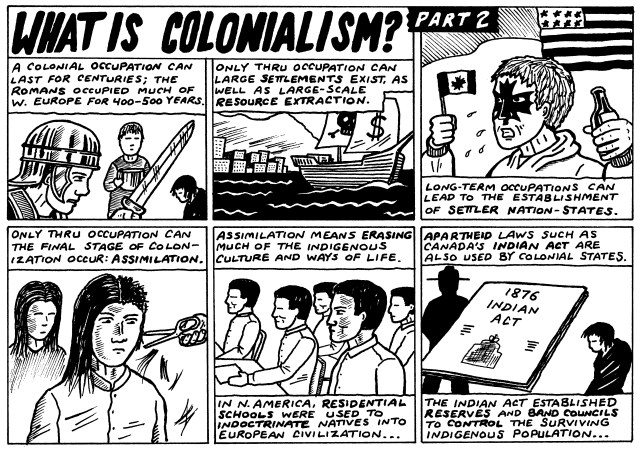
500 Years of Indigenous Resistance
From artist, writer and activist Gord Hill, a member of the Kwakwaka’wakw nation and author and illustrator of The 500 Years of Indigenous Resistance Comic Book (2010):
Final Notations
By Adrienne Rich 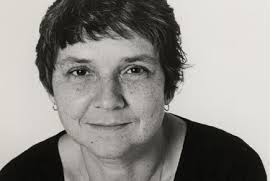
it will not be simple, it will not be long
it will take little time, it will take all your thought
it will take all your heart, it will take all your breath
it will be short, it will not be simple
it will touch through your ribs,
it will take all your heart
it will not be long, it will occupy your thought
as a city is occupied, as a bed is occupied
it will take all your flesh, it will not be simple
You are coming into us who cannot withstand you
you are coming into us who never wanted to withstand you
you are taking parts of us into places never planned
you are going far away with pieces of our lives
it will be short, it will take all your breath
it will not be simple, it will become your will
A Letter to Judge Wynn: Meditations on Breaking the Law
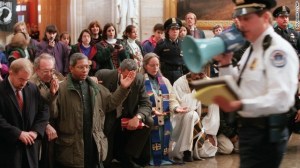
By Rose Marie Berger
If we could split ourselves
like a crack in the cement
(children’s names written when wet
a heart a flower a handprint)
like that mystical bread
(calloused hands holding up hunger
and night sweats and the one we once loved)
then we would say in our first voice: Law
and Order out of Chaos
we would listen and obey
teach our children hands up, look both ways
(pack them bubble-wrap safe
for shipping from this world to the next) Continue reading “A Letter to Judge Wynn: Meditations on Breaking the Law”
The Rich Man and Lazarus: Warning Tale and Interpretive Key to Luke
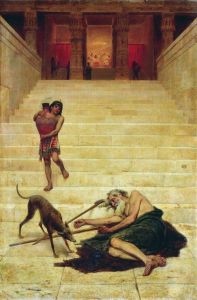 By Ched Myers, on Luke 16:19-31 (19th Sunday after Pentecost)
Note: This post is part of a series of weekly comments on the Lukan gospel readings from the Revised Common Lectionary during Year C, 2016. As was the case last week, this is a longer post, because of the importance of Luke 16 to those of us suffering from “Affluenza.” For a recording of a recent webinar Ched did on this gospel text, go here. [Right: Fyodor Bronnikov, “Lazarus at the rich man’s gate,” 1886.]
This Sunday’s gospel completes our journey through Luke 16. How rare it is that the lectionary allows a sustained look at Luke’s narrative argument! Last week’s text was Jesus’ subversive tale of the “defect-ive” discipleship of the beleaguered middle manager of a “filthy rotten system” (16:1-13). I read it as a poignant fable for those who would try to monkey-wrench the dominant economic system to provide a modicum of Jubilee justice for themselves and others. The “paired” story of Lazarus and the Rich Man represents, in turn, a warning tale about the dark consequences of failing to deconstruct the systems of vast social and economic disparity that hold our world hostage. Continue reading “The Rich Man and Lazarus: Warning Tale and Interpretive Key to Luke”
 Radical Discipleship